Archiv der Kategorie: Management

Here you find topics like planning, organization and leadership.

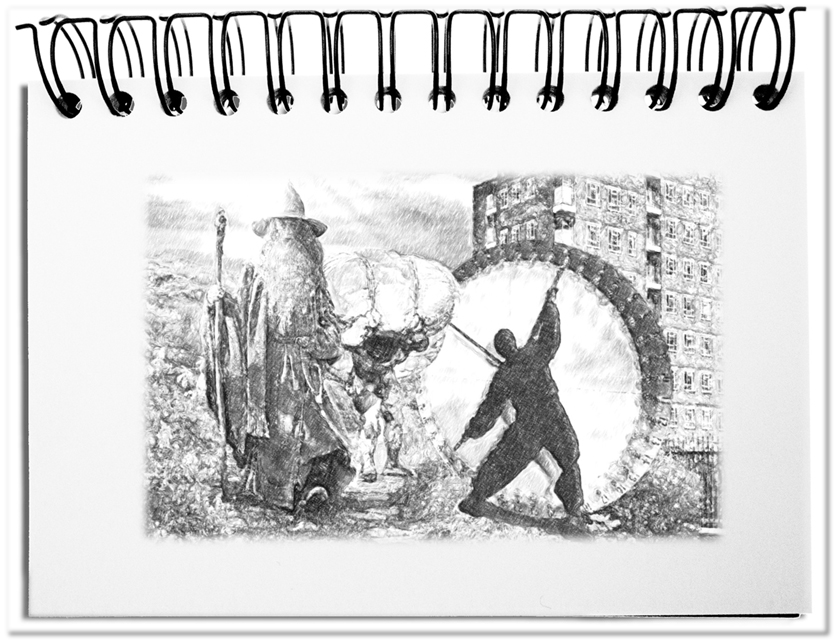
Agilemma – Spirits that I’ve cited, my commands ignore

Even if you fasten your seat belt, close the door and place a group of doorwomen in front of the office, as a manager you cannot hide from the demands of the VUCA world. The speed at which you have to react and the amount of skills required no longer allow us to rely on the rigid frameworks of the past. If even the American military sets up its troops with a new managing style, it should become clear to the last one that the time has come for new leadership styles. Since the solution is different for everyone, we have to design our own approach. At the same time, we run the risk of becoming sorcerer’s apprentices and being overrun by the released forces. – Spirits that I’ve cited, my commands ignore.

There are three aspects that tear you apart as a leader and give rise to the fear that you will lose control forever, once you have opened the floodgates.

  • New concepts
    What does it take to let go and engage in spontaneous improvisations that lead to a convincing result done by the self-organized participants? So far, everyone’s commitment has been crushed by distributing tasks, competence and responsibility on different shoulders. The greatest effect is achieved when everything is in one hand and the group takes responsibility for the result. People do not only spare the unproductive time of detailed planning, the slowing down of colleagues due to excessive control or the relief that is created by assigning blame to others. Those who do not drive these changes forward will be driven by the changes – now, or perhaps not before tomorrow.
  • Different leadership styles
    The troops stand no longer in line and follow orders. They have their own ideas and conceptions which they want to implement. The competition stops taking place between the own team mates but with other groups. In the future the individual destiny will depend on the fate of the whole team. This means for the manager that the organization is no longer developed by designing the positions and regularly control the behavior of the employees. The boss is now a coach, fostering his employees as an available contact person and solving the insolvable issues. The group is promoted as a whole, learns together and shares the joy and sorrow of the outcomes. If you don’t get involved, you lose the loyalty of your employees and thus your purpose as a manager.
  • Value-based governance
    In the past nothing functioned without governance and in groups it will never work without it. The personal commitment is the main reason for the willingness of the employees to get involved. The laws, standards and guidelines are the regulations that you HAVE to follow – otherwise you will receive more or less defined sanctions. In the end, this leads to doing things right – especially in the economic sense. This type of governance is exacerbated by filtered information, whose credo is shaped by „knowledge is power“ – it is not entirely wrong to either speak of censorship. The new approach focuses on doing the right thing out of inner conviction. The fuel is not the fear of punishment, but the intrinsic commitment to your task. This requires information distributors, who keep the involved people up to date. Those who cannot apply this value-based management are crushed by the old rules and eventually become obsolete.

This does not mean that doors and ways are opened to anarchy. It is about giving the team, and thus each individual employee, the freedom to achieve more with the existing strengths, instead of exhausting oneself with senseless and futile (self-) limitations.

Bottom line: The master of these magical powers is not the sorcerer’s apprentice, but the master. The loss of control of the trainee comes from the fact that he did not practice enough yet. That is why he formulates a bit early:

Bubble! Bubble!
Some route,
that, for the purpose,
water flows
and with a rich, full flood
to pour to the bath.

Johann Wolfgang von Goethe, The Sorcerer’s Apprentice

without having the capability to reverse the command. One or the other can certainly imagine the helplessness of the sorcerer’s apprentice. All concerned people are still integrated into the old structures. At the same time, many recognize the opportunities, but do not want to get into the situation of the sorcerer’s apprentice. For this reason, you should pro-actively take care of the new approaches of agility. In delimited special operation zones, which are exempt from the old rules, these new concepts, different management styles and value-based governance can be practiced by everybody. The Agilemma will slowly dissolve that way and the spirits that one has cited, you no longer want to get rid of, but to use it in growing circles.

Glow without substance

As virtualization progresses, the qualities of things, facts and, above all, people become more and more important. The selection of new employees, whether executing or executive, is becoming increasingly difficult. In advance it is only possible to assess to a limited extent whether the respective person fits into the company, the team or a task. If then the first selection is made by an area that has little knowledge of the daily task, decisions are made based on formal criteria that have little to do with the actual business. In the long term, it is more effective to leave the choice to the departments, which have the experience, know the different contexts and, above all, should get their personal impressions of the possible new employee. Who still believes in the copied CVs based on pertinent cook books, which consist of quickly made degrees plus many years of practical and international experience plus pronounced social commitment? This self-staging creates a glow without substance.

This substance less glamour does not have to artificially grind away corners and edges. Sometimes it is better to show profile, to have soiled oneself at work in order to come across more credibly on the basis of the scars of one’s own actions.

  • Personal glow
    With the introduction of the school and university system, the traditional learning styles, the long-standing apprenticeship as trainee and journeyman, were expanded with scientific study and research. The real goals of these learning systems were to transfer and anchor knowledge. The most important aim was to actively get to the bottom of the topics. Due to the increasing importance of a factual assessment, the focus of the evaluation has been shifted. A high score suggests appropriate skills. A clever strategy and a little luck in the tests is enough to pass. And this, although practical knowledge would be better in everyday situations.
    The personal appearance is better polished up by failures and realistic responsibilities without a gigantic budget, than by pretentious presence.
  • Entrepreneurial glow
    Other areas of the business also have certifications to prove their capabilities. With the appropriate certificates, customers are supposed to gain confidence in order to decide in favor of the according offer. Today, these proofs range from customer ratings, the so-called likes, to official certifications and frameworks such as ISO 9000 for quality management, ISO 27001 for information security or COBIT for IT governance. While these certifications were originally intended to reflect a company’s current status, people affected have learned to prepare for these exams to be able to pass. The real purpose of a neutral assessment of the real abilities gets lost.
    It becomes more important to prove with real-life examples that you can practically master your business, and not just to shine with a certificate that everyone has.
  • Borrowed glow
    If direct evidence of the reputation is missing, then only indirect signs remain, which are generated above all by ambiguous statements. The protagonists achieve this the easiest by mentioning and citing competent sources. For this reason, people and companies like to adorn themselves by quoting prominent thought leaders. In doing so, they implicate an appropriate mindset that makes inattentive target groups believe that the values described are important to them. This can be boosted by personally integrating or at least meeting the mentioned celebrities in an image-effective way. Within the target group the assumption gets triggered that you need to have special skills. On closer inspection, this type of indirect use of external appearance happens on a daily base in publications without the target group noticing the manipulation. This adornment with borrowed plumes needs nothing more than a large enough budget.
    If you want to take advantage of the experiences of others, you should seriously integrate them into everyday life and implement their ideas consistently and not just shaking hands media-effectively.

Regardless of the way reputation is built, it remains nothing more than an indicator. The actual efficiency only becomes apparent in day-to-day practice. Since it is not possible to see it in advance, on the one hand, the observers must be always aware of the risk of possibly being only attracted by a glow. On the other hand, individuals and companies must not rest on their laurels, but have to reprove it every day. Who is in competition is like someone who rows against the current. As soon as you stop rowing, you fall back. Reputation must be renewed without ceasing.

Bottom line: It is becoming more and more important to find new approaches in order to be able to recognize performance and its development potential in advance. Direct certification is only partially suitable for this, since the candidates prepare opportunistically in advance for passing an exam – not for acquiring knowledge. Although the indirect indicators generate evidence, they do not allow any real insights about the know-how and behavioral repertoire of those affected. The information society needs a new approach, in order to be able to recognize the glow without substance.