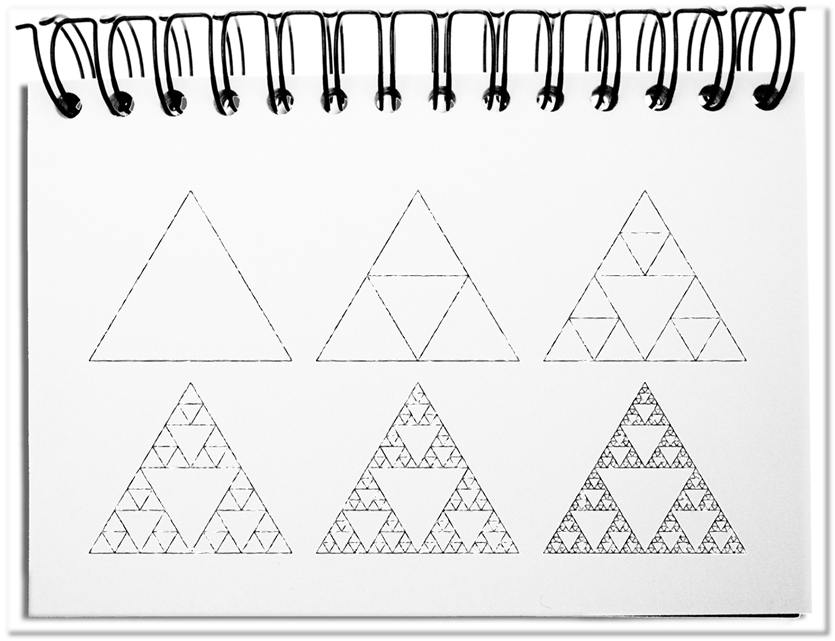
The world in which we live has only the categorization that we apply to it. For this purpose, outlines are developed from all angles, which organize the various aspects. One problem thereby is the question, on what level we are and how many exist. In addition, the facts can be described with differently fine details. Interestingly, similar questions are asked on each level, e.g. what’s happening? How is everything connected? Who is involved? As soon as similar aspects appear again and again, this is called self-similarity or fractality. The triangle that consists of triangles, which consist of triangles, which consist of triangles and so forth. The fact that there is no end to the detailing has been proved by the mathematicians, for example, with the Mandelbrot set. The self-similarity is sometimes unsettling. This fractal madness is, however, better treated with a skillful classification by means of viewing levels.
Levels of detail always require a reference around which the levels are built. Let’s take our Milky Way as a reference point, then the surrounding universe is the macro, our Milky Way is the meso and our solar system is the micro level. The following bullet points describe these levels of detail, which are applicable for any magnitude.
- Macro
The macro level is always the coarsest view. It provides a general overview of the considered area. This level defines the entire scope of a system. At the same time it forms the basic structure for further refinements. Examples are the society as a whole, the earth with the continents, the value chain of a company with its essential functions and sequences. For further refinement, it is useful to completely describe the previously determined scope on this top level. - Meso
The meso level successively spreads the elements of the macro plane across several levels, e.g. the continents into countries, landmarks, cities, quarters, streets, etc. On one level, the elements should be described with a similar degree of detail. The meso area consists of at least one level that is the bridge between the macro level and the micro level. Sometimes it may be necessary to build several levels. It should be kept in mind that the number of elements to be described multiplies with each level. Consider that each level consists of 5 elements; there are 5 elements on the first level, on the second level 5×5 = 25, on the third 5x5x5= 125 elements, etc. The purpose determines how deeply you detail. However, it is smart to resist the impulse to set up many levels, since the administrative effort increases exponentially – and ultimately kills any advantage. - Micro
The micro level describes the lowest level of the model and offers the finest details. In addition, there are no further refinements. Thus, in a street, houses are found in which are apartments. In this case, there is no information about the number of rooms or the decoration or similar details of the apartments. Thus the micro level determines the barrier to further insights. If this granularity is determined beforehand, one can resist the pressure of further detailing. However, finer evaluations than those on the micro level are not possible.
Besides these levels of detail, there is a view from the outside. This abstract perspective of the whole describes all elements of the model, e.g. the micro, meso, and macro level as well as the properties, the relationships between the properties, and the logic for evaluation. The meta-layer floats above the content, which avoids self-reference and other model problems. The meta-level is always a part of the observation that facilitates the navigation in the system. Examples of meta-levels are standardized structures, e.g. society models (society, family, and individuals), economic models (markets, companies, and households) or business processes (value chain, processes, and activities).
Bottom line: Descriptions can be created in any granularity. In the interest of the processability of the content, the macro level provides an overview and outlines the overall system. The meso level arranges the large sub-areas and establishes the cohesion. On the micro level, the finest components are found. The starting point is freely selectable and is derived from the purpose of the observation. The fact that one can refine at any level, further and further, is sometimes confusing and leads to the pressure to describe an additional one, and another one – and just one other. However, this leads to frustration due to the ever-increasing effort for those, who have to create the further refinement. It is highly suggested to avoid the fractal madness of describing ever finer by resisting the impulse of the refinement and to simply perform the desired evaluations on the available levels.