After four years of regular writing this post is the two hundredth in English. On this occasion I think verbally about writing. The momentum has not yet ebbed away. The contents do not really provide any revolutionary new aspects on the topics of communication, management, change management, meaning shaping, governance, strategy (the sequence corresponds to the frequency of the articles). And yet, they offer new perspectives. Some subjects evolved to a series, such as the ideal metaphor. Other articles follow daily headlines. This time I think about the reasons that the momentum does not stop.
Writing uses the same words as talking. Nevertheless, writing is a more conscious examination of the subject. By tonal exhalation words are formed, which, if they do not reach an ear, evaporate unheard. Writing remains. But why writing, if the described wheel is already round?
- Out of a need to communicate
Humans have been speaking for about 100,000 years and nowadays an average of 16,000 words daily. That the exchange of words is an important prerequisite for social togetherness can be seen in the cultural character of individual regions of the world as well as in their diversity. Important meaning carriers were and are religions. This can be seen in the Western approach to group the world in good and bad, right and wrong, or in the balance of yin and yang in the east. The progressions were driven by the natural needs to communicate – first verbally, for 5,000 years handwritten and printed for centuries. Writing remains longer, even if the carrier dissolves over time – paper very fast, parchment slower and stone apparently not at all. Let us wait and see how long the Internet provides the posts. - Describing issues
The contents that are transported go from economic accounting, to sacred and political texts to today’s literature. With all the variety of words, certain areas remain refused to writing. Feelings and abstract thoughts can only be described without being able to express the essential. As Wittgenstein put it in a nutshell: “What we cannot speak about we must pass over in silence.“ These are the areas that cry out for an additional formulation. Abstract themes do not have a tangible life and exist therefore only in the consciousness of the individual. What they make out of it can not be ascertained, since the inner thoughts are not accessible for other people. This is one reason why certain things are repeatedly described and thus become a printable version that can be discussed splendidly over and over again. - Finding appropriate words
Writing has the advantage that a train of thought that is expressed in words, can be improved. Theoretically, the right moment for the correction has come, when there is something printable. At the same time, the immediate reformulation of a sentence slows down the writing flow, because you can get into an infinite loop of correction. It is more fruitful to write down a longer text in a row, leaving it untouched for a certain time, and to rework it afterwards. This time you will notice parts that do not fit the actual theme. You find words that are inappropriate, too abstract, or too often repeated. At the same time, the appeal lies also in the formation of words that can not be found in a normal dictionary. The ultimate goal is to place few, and at the same time simple words, closest to the desired intention. As a result, several texts are being prepared in parallel. Once the proper degree is reached, they are completed. - Finding appropriate images
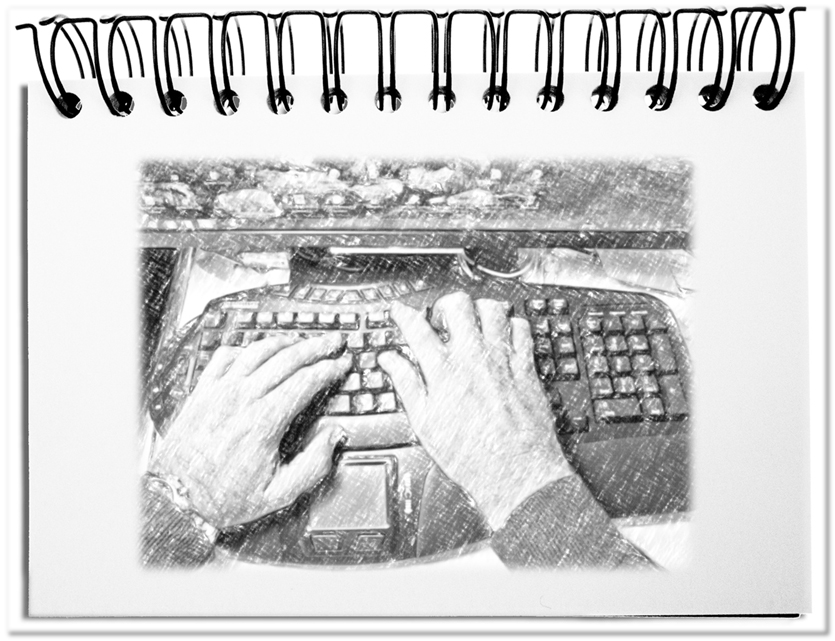
This is valid in a double sense. On the one hand, the contents are to be illustrated by means of figurative meanings. The search for a meaningful outline of the theme, analogies and metaphors are an important element of writing. On the other hand, each blog post consists of a scribbled stroke drawing. Since words can express only a part of the intention, the picture is another way to show the purpose. Writing does not start until the image is displayed. It creates the framework and always ensures that the original purpose does not get lost. The images can be realistic images of the subject or metaphorical visualizations. Quite rarely contradictions happen between text and image. If so, usually the picture will be reworked. The entire process of writing always consists of both: visualization and writing. - Practicing English
All blog articles are immediately developed bilingually. In addition to the fact that this increases the scope of the potential readership, an important reason is to make the texts better. Once the text is available in German, it will be translated into English. Unintentionally ambiguous passages show up in the German text. The two texts, German and English, are eventually adapted to each other and to the original intention. The huge vocabulary of English makes you aware of missing words in German – and vice versa. It is remarkable that the subconscious meaning gives signals as long as the formulation is not yet as it should be. The bilingual processing of the texts has proven beneficial for both languages, as the active vocabulary is expanded for both. - Trick the transience of time
As described above, what has been said dissolves in the air, sometimes unheard or misunderstood. There are also the thoughts, which briefly emerge and then disappear again in latency, as long as it is not written down. Otherwise, they become visible only with corresponding stimulus that provokes the respective region of the mind and brings the thought back into consciousness. A remedy is writing. A clever formulation, a coherent train of thought, or a Eureka, which would solve a long-standing smoldering enigma, might be lost. Sometimes in the sleep the solution suddenly appears before your inner eyes. Quickly turning on the light, grabbing the notebook and … crap, where is the pen. Without notes, the next day the idea would be gone. The same applies to every blog article. I do not remember, what it was, but I have already put the issue into words. And then there is the fact that up to now contents have been waiting for reading – now for four years. This also makes it possible to convey own thoughts longer than you could tell them. - Fruitful routine
An important element of writing is the routine that it takes to keep getting to new texts. Of course the right mood helps in writing. Sometimes it is worthwhile to pay attention to the inner resistance and not to force anything. This does not mean, however, that you give in to the impulse and get out of rhythm. In this case, it is one post per week. In the sense of the constant drop that caves the stone, the discipline brings by and by a lot of thoughts into the net and on the paper. In addition, the weekly routine offers a meditative aspect as well as food for your own satisfaction. And, of course, writing practice improves the everyday production of content – be it in reports, brochures or even in PowerPoints.
Bottom line: This text is a good example of the last one hundred ninety-nine blog posts. The subject was found, the picture was scribbled, and finally the structure and the formulations were developed. In this case, these are the reasons for writing: the need for communication, describing issues, appropriate words and images, practicing English, the transience, and the fruitful routine. Whether these reasons for writing apply for all or just for me lies in the eye of the beholder. For me it is enough to go on for the time being. The more pages are created, the more will be read. Perhaps another reason to continue this routine is also writing for the sake of writing.