
Archiv der Kategorie: Meaning design

In this area it is all about meaning design ===> http://www.meaningdesign.com

42 – The faith in the ONE Solution

Somehow the search for the world formula, the Theory of Everything, seems to permeate Western thought. While the Greek philosophers were all about the atom, nowadays, quantum physics challenges our common sense. Deep Thought had answered after 7.5 million years the question about life, the universe and everything with „forty-two“. The answer seems meaningless, because the beings, who instructed it, never actually knew what the question was.* It could have been clear to them that ‘Whereof one cannot speak, thereof one must be silent.’**
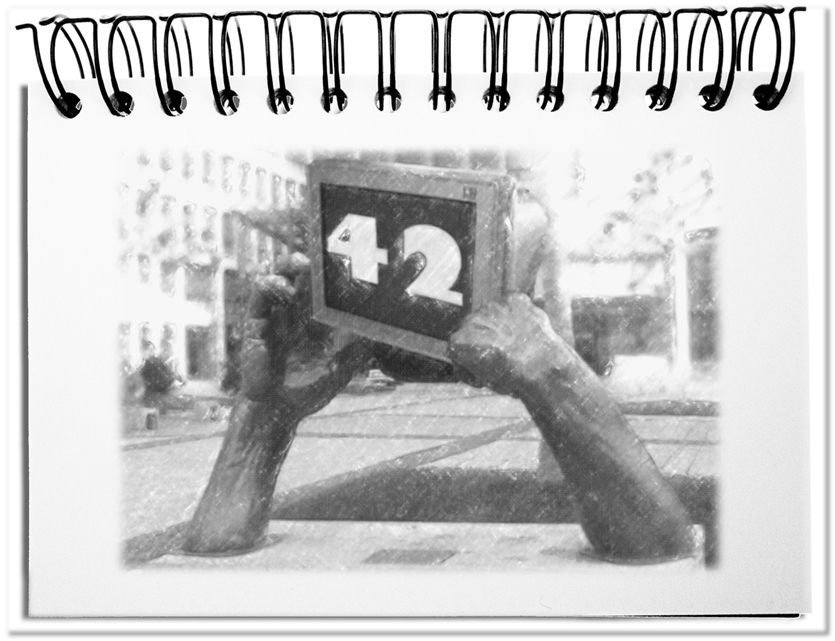
In our everyday life we are always driven by this childlike hope for ONE solution by the following aspects.

  • The Right
    Many conflicts arise when people can’t agree on what to do – What do the customers want? Where is the market going? Which strategy is appropriate? What does the product range look like? Even if a lot of parameters are considered, surprisingly this does not lead to the fact that the ideal is more crystallized. On the contrary! The outcome becomes more diffuse – perhaps because there is no such thing as the right one. In extreme cases the indication of the white rabbit applies: If you don’t know where you want to go, then it doesn’t matter which path you take.***
    Since there is no source that shows you the way, there is nothing left to do but design and introduce the right thing yourself.
  • Doing right
    Often there is also a dispute about how to implement your intentions – Which method should be used? What results are needed? How to speed up the process? Where else can you save something? This creates more and more constraints, which form an insufficient basis for the solution. Barriers on the one hand undermine good solutions on the other. In the end, the savers prevent a viable solution – and generate greater losses than they would have ever saved.
    For something to be done right, it must be fulfilled with the desired end. This is done by the people, who create the solution – and they need the necessary resources, even if they exceed, what was originally specified.
  • Best Solution
    We always strive for the best – The shortest term? The most reliable? The most manufacturable? The cheapest? The most maintainable? The most beautiful? The most manageable? In order to eventually find the best solution, everyone wants all criteria to be met – although speed is achieved at the expense of reliability or price; or maintainability is eating away beauty or manageability; and so on. The best sounds a lot like „42“ – it is in the eye of the beholder, what it means.
    The common understanding of your own quality enables the brand image that customers associate with the products and services. At the very least, it should be clearly defined whether one is striving for product or process leadership or customer proximity.
  • ONE Meaning
    The first step to a Theory of Everything is to understand that a term can be interpreted in any way. Without developing a common understanding of the requirements, the participants will not be able to meet expectations – e.g. actively engage customers; openness; collaboration; adaptability; intrinsic motivation. If the structural layers remains, the efforts will not fit together.
    Words alone are not enough to convey a common understanding. It is necessary to ensure that the scope for interpretation remains as small as possible, through appropriate explanations and the practical example.

Bottom line: It is difficult to understand how clueless management is, when it comes to the fact that their messages are nothing more than a simple „42“ and afterwards they are surprised that their intentions are not coming true. The belief in ONE solution prevents the more effective outcome that would be possible through the cooperation of the many. A first step is to understand that doing the right thing right, the best solution and the ONE meaning is an illusion. The basic conditions are shifting. The world of work is undergoing radical change. Mass solutions only function in cooperation with all parties involved. And they all have their own idea of “42”. If the company is to continue to exist, this can only be achieved by moving away from the belief in ONE solution and by bundling all resources in order to let them jointly determine what „42“ is.

*) Douglas Adams: The Hitchhiker‘s Guide to the Galaxy

**) Ludwig Wittgenstein Tractatus logico-philosophicus 7

***) Lewis Carroll: Alice in Wonderland
 

Through the veil of symptoms

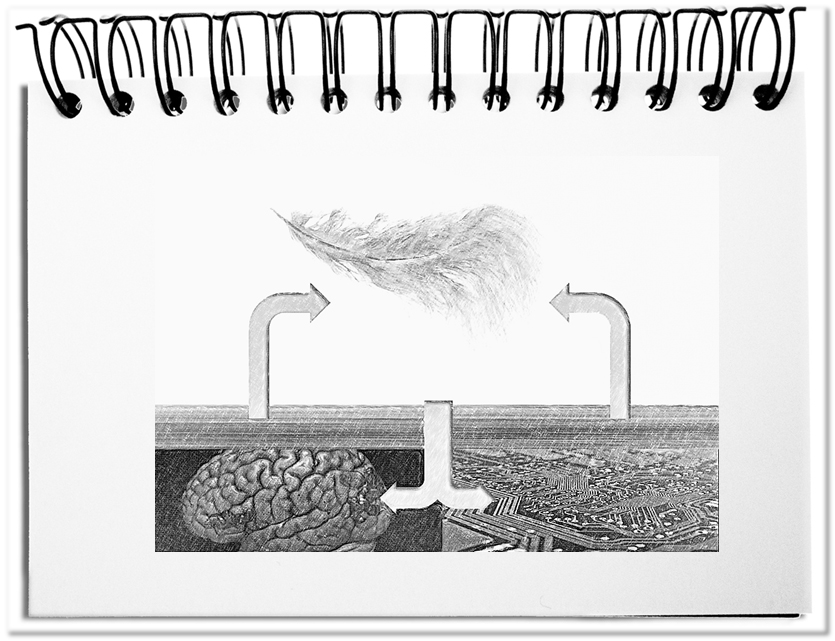
We still have no explanation of how we are actually able to think consciously. Already the appropriation by means of We that implies that others think is not a matter of fact. And yet we have a silent agreement that we see, hear, feel, taste, smell and think similarly. But we still do not know how the stimuli of the environment are translated into our mental inner self and how our consciousness evolves. All we got is our ‘Cogito ergo sum’. Nevertheless, we ask whether machines have awareness. Only indirect symptoms are measurable – electrical activations and the observable activities. Through this veil of symptoms, we continue to search.

To penetrate the veil, we have at hand the elements of the world, sensory signals, our own consciousness and the resulting activities and artifacts.

  • The world as such
    We take the flora and fauna as well as the natural and man-made things for granted. We are convinced that they are, independent of the observer. The philosophical question is: Do the leaves rustle in the forest, even when we are not there to listen?
    Such questions can come to our minds without being able to find them in others, also not in other living beings. How could you do that on a computer?
  • Perceived signals
    We perceive the world through the five senses. Thus, the receptors in the eyes receive light that is transformed into mental images, the ears perceive sounds that become music, touches on the skin trigger emotions, delicacies stimulate the tongue and create taste experience and scents we sniff and trigger memories. The individual components can be taken more or less good with measuring instruments. However, the triggered experiences cannot be translated from the measurements.
    Of course, we get the signals into a computer. However, we have no idea how to translate the signals into an understanding?
  • Subjective processing
    Nerves transmit the received data from the receptors into the brain. How the signals are translated along the way is unclear. From our own experience, we can certainly confirm that we are aware of our environment. We create images from shapes and colors, which we even recognize in two-dimensional images. High and low, bright and dull, loud and soft sounds become symphonies. The surface of a wooden table feels good. The Madeleine reminds you of the childhood by the sea. The scent of damp grass smells like summer.
    There are still no approaches to let mental processing run in a computer – let alone to be able to observe an emerging consciousness.
  • Visible action
    What we observe in ourselves we cannot see in others – at least not directly. We only have the indirect view of the actions of others. We see their body language, gestures and facial expressions, hear their intonation and observe their activities. From this, we derive their mental and emotional state. The visible acts that (presumably) result from their thoughts, only allow interpretations of what is going on in their mind. We observe the consciousness of other people even more indirect than with ourselves.
    The processing of a computer can be easily tracked – the results that are displayed on the screen or printed out. This goes so far that we can create three-dimensional worlds in the computer and even print out artifacts.

The feather that we can see and touch triggers feelings that make us, for example, smile. In a computer, one could program a feather that is recognized by a camera and sensed by a sensor to make an artificial face smile on the screen. However, this does not mean that the computer develops feelings, as we have. In the medium term, the fast processing speed will lead to more and more visible actions being trained into the computer. The impression will be that the computer behaves like a human being. Whether it develops consciousness or not, will be hardly recognized, just as with other people.

Bottom line: In artificial intelligence, a lot is still argued with faith. The stimuli that the things of the world trigger will be sensitively measured. The processing in humans will not be transferable in a foreseeable future – especially not as long as we do not know what is happening in our consciousness. However, the programs are becoming increasingly powerful so that they can trigger visible actions as if … Believers can look through the veil and presume that there is consciousness behind. Nonbelievers can think the opposite. For the moment, there is no chance than glimpsing through the veil of symptoms.