
Archiv der Kategorie: Management

Here you find topics like planning, organization and leadership.

Reducing unintended consequences

The increasing complexity of tasks inevitably results in narrowing of the perspective of the acting persons. Increasing time and cost pressure prevent us from thinking outside the box. This increases the unintended consequences and burdens the desired effect. Nobody can afford to look beyond the box anymore. Good examples can be found in politics – when climate protection has to fight with nature conservation for space to install wind turbines; when the health of consumers is endangered by the extensive use of glyphosate in agriculture; when power supply lines are impeded by local residents; when traffic cannot be diverted because other disadvantages emerge; when temporary employment models and the promotion of the low-wage sector increase the risk of poverty now and in the future. The social need for further development is prevented by interests of few. That way, the parties involved are mutually depriving each other of a desirable future.
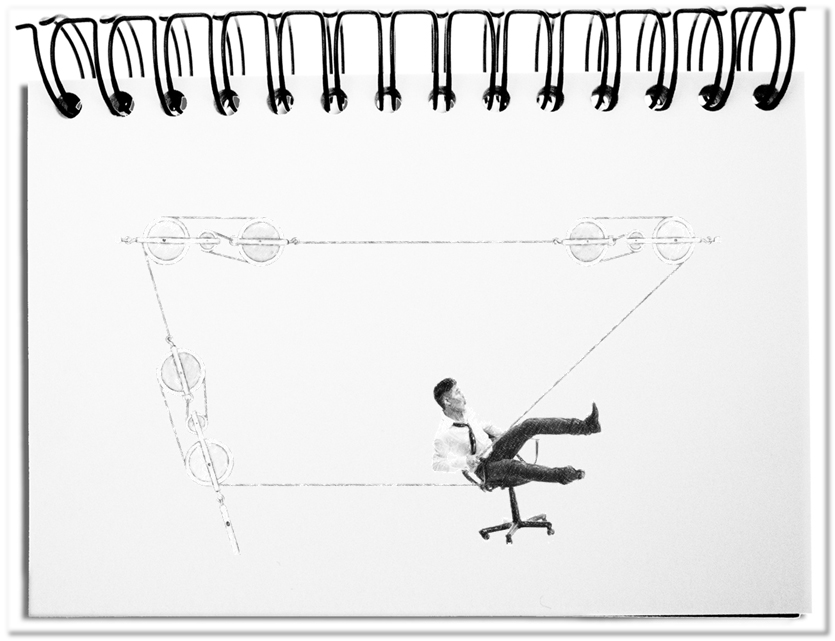
In order to secure creative leeway, the outcomes of measures must be recognized and dealt with at an early stage – whether they are intended or not or not even the direct consequence of the doing. They influence the acting persons through evolved or designed activities, the selected target groups or unforeseen third parties, i.e. everyone. The difficulties arise from a lack of foresight and awareness of the weaknesses, which are:

  • The missing overview
    It comes from the quality of the available data that, in the absence of current data from the future, are mainly extrapolated from the past into the future. On the other hand, the quantity and complexity of the available knowledge as well as the resulting butterfly effect make it impossible to provide reliable predictions.
  • The persistence of old solutions
    The habit of copying old things and reusing them in a rash way leads to solutions that no longer fit the current circumstances – like the administrative tasks that continue to be paper-based.
  • The suppress of existing interests
    The expectations of stakeholders remain unconsidered and, despite everything, influence the results – as soon as, above all, the decisive stakeholders are not involved.
  • The cognitive distortions of the participants
    The tendency of the actors to put their own goals above those of the whole leads to distortions that burden the result – if the participants do not align to each other

In order to get the weak points under control, it needs the conscious consideration of the task. It is already enough to go through the following steps.

  • To work out the initial situation with those concerned, so that everyone has a common view.
  • To describe in brief the purpose, in order to convey the raison d’être to the parties involved.
  • Anchoring a snapshot of the desired future with everyone so that they can act coherently on their own.
  • Prepare a comprehensive proceeding that avoids pragmatically restrictive approaches with their unwanted surprises.
  • Once the activities are prepared, they should be cross-checked: Are the actors known? Is the purpose described? Do the circumstances fit? Are the planned, visible actions appropriate?
  • If further influences are now being carefully sought during execution, unintended consequences should occur less frequently and identified stumbling blocks should be eliminated early on.

Bottom line: Today’s way of working leads to the situation that neither the time nor the means are available to think outside the box. This means that threatening surprises remain undetected for the time being and cannot be eliminated at an early stage. In order to better manage these unintended consequences, it is advisable to address the above-mentioned aspects: clarify the facts; make the purpose tangible; formulate the vision; keep the approach flexible; check the coherence of the measures; and eventually, work through everything carefully. In addition, the requirements of modern management continue to apply – clear objectives, defined roles, fixed time and cost budgets, etc. Looking at ALL the above elements, the unintended consequences should be reduced.

Learning to fly

Since everybody is latently connected with everyone and is exchanging constantly data, we have to deal with too much of too many. Per minute almost 200 million emails are sent, 50 million messages are transmitted and more than six hours of video material are uploaded to YouTube. Nearly one third of the world’s population uses Facebook, 2 billion YouTube and even more than 300 million LinkedIn. The call for more information is still ongoing, even though users are looking for filters to handle the increasing amount of data. At the same time the information bubbles are perceived as disturbing. We need a new vantage point that allows us to keep the overview.

In the end, it’s all about triggering appropriate activities that take you further towards the desired future. The following aspects create a new perspective.

  • Accepting dynamics
    The more data that pours down on you within a moment, the more volatile are the insights that can be derived from it. It remains to be seen to what extent scientific studies are able to generate timely propositions before conditions are moving on to change. Already today, many results cannot be implemented because too many studies are being developed. At the same time, never trust any investigation that you have not done yourself.
    In order to continue to be able to make decisions, you have to accept the VUCA world and again form your own opinion. Developing your own thoughts and explanations, which adapt incessantly to the changing circumstances, is the maxim, in order not to fall behind due to static thinking.
  • It all starts with oneself
    Usually explanations are searched at first in the environment. No one is an island, which leads to permanent influences from the outside. A circumspect investigation always includes considering external factors (e.g. STEP). The social, technological, economic and political framework conditions determine the scope of action. If, however, you limit yourself to that, then you would clearly miss the point. It is one’s own ideas and convictions that mostly work unconsciously.
    It is anyway more difficult to achieve changes in the external environment than within oneself. Before you start wanting to change the world, it is easier to change oneself – once you have become aware of the limits. The own parameters only have to be activated by rethinking – from the responsibility of others to your own.
  • Overlooking the whole
    More data always means more details, which often do not fit together. After entering a forest and getting closer and closer to the fauna and flora, more and more subtleties show up. If one looks at the individual aspects, the context gets lost and the forest disappears behind the individual tree, bush or moss. If you save a bush, it has little effect, without measures for the forest as a whole. The same applies to all daily tasks, which, the finer they are drawn up, the lesser they have an effect on the overarching unity.
    If you look at the forest as a whole by looking at it from a helicopter, you can see relationships and building clusters. Measures taken at this altitude provide more to the whole than the detailed, endless preoccupation with the subtleties. We have to move away from the part to the whole.
  • Ensuring survival
    Over the past centuries, the economy has learned to think big. In order to be able to afford the big things, the decision makers have learned to make decisions at the expense of the future. With the assumption that growth secures the future, the funds generated are used to expand the business. This is similar to a pyramid scheme, where the current profits pay off the debts of the previous deals. This short-term thinking ensures the bonus of decision-makers who move on, before the consequences of their decisions reach the company.
    In order to maintain the business for all participants, measures are needed to ensure survival – human image of Theory-Y, organizational fitness, long-term cooperation, minimum viable product (MVP). Away from growth thinking, towards profitability.

Bottom line: In times of alternative facts (don’t trust any statistic that you haven’t falsified yourself) the question arises, how to make decisions even though the basis of the resolutions evaporates. In this context, systems thinking is a good idea. To do this, we must a) accept the dynamics, b) understand that we are primarily responsible, c) redirect our attention from the part to the whole, and d) shift the focus from growth to viability. This means for the many detail-obsessed people to dissolve themselves from the facts and to learn to fly.