Archiv der Kategorie: Management

Here you find topics like planning, organization and leadership.

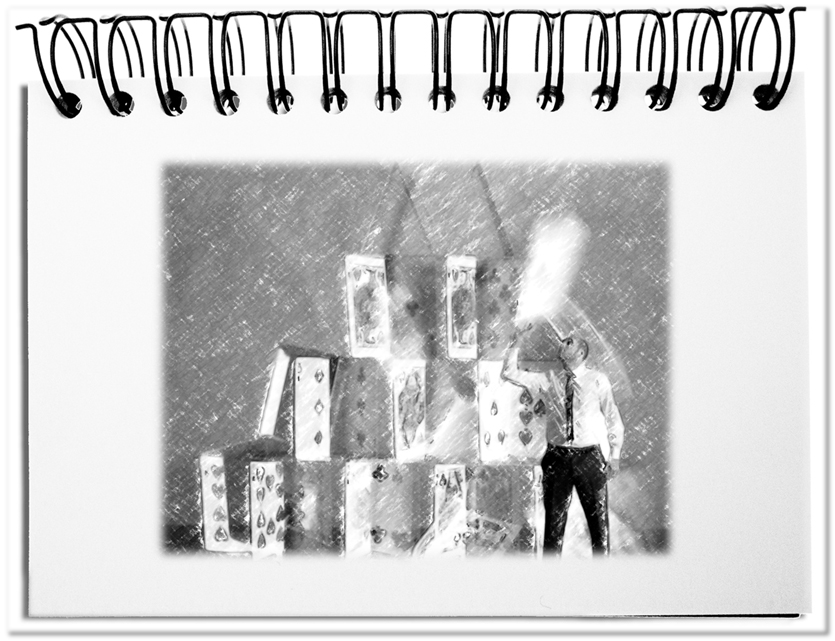
Agility could actually be used since a long time

When the workforce has access to all necessary data regardless of rank and reputation, anytime, anywhere, and can immediately decide on the spot, then at the latest legacy approaches will become obsolete. The enthroned decision-makers who have lost contact with the business, the chains of command, where the actual decisions are diluted and taken too late, as well as the applications for applying an application that generate unnecessary tasks and no longer fulfill their original purpose no longer fit the time. This explains the yearning for new forms of collaboration. The implementation is difficult, because the desired state is characterized by self-organization that must be allowed – which makes a large part of the tasks of the decision makers futile. This autonomy does not need new structures, but a new mindset. And as soon as these basic attitudes would be given to the managers and employees, they could also flourish in a traditional environment. Agility could actually be used since a long time.

The mindset, however, is a personal trait that is shaped primarily during the development in the direction of an opportunistically submissive command scheme. What have always prevented agility are people, the managers and the employees alike, who lacked the corresponding mindset, e.g.

  • the trust that all pull together;
  • team learning that expands the common skills;
  • the feedback that provides appreciative suggestions for improvement;
  • the culture that is based on ethical values, not on paragraphs;
  • the intrinsic commitment that keeps obligatorily the momentum of every team member.

The following traits have always undermined agility.

  • Micromanagement
    This is not a formal requirement of leadership, but the intrinsic pressure of individuals to interfere in every detail. It doesn’t matter whether it’s about wanting the best or whether the involvement in the subtleties is due to a lack of self-confidence.
  • Fault intolerance
    Everyone should be aware that everything can always be done better. For this reason, all results should be celebrated. When one can speak of a mistake, depends on the observer. Particularly disturbing for the team are those people, who deal generously with their own mistakes and who pursue perfectionism to the point of aggression with mistakes of others.
  • Blame- instead of solution-seeking
    At work, the emphasis on shortcomings and persistent reproaches indicates whether it is a question of playing the blame game or searching for a solution. Agility has an impact when solutions are achieved. In the end, the feedback from the customer determines the quality.
  • Indecisiveness
    A prerequisite for agility is the decisive setting of clear goals. The best possible clarity is achieved through the appropriate smartification of the objectives. It becomes difficult when the decision-makers cannot decide and oscillate back and forth between different goals.
  • Double Binding
    The world is not black or white, but infinite shades of grey. It is always possible to do one thing and not let the other in these grey areas. Dangerous are the double-binders, people, who wish for two variants and in the end criticize, when one solution is not as perfect as they expected, regardless of the perfection of the other variant – and of course vice versa.
  • Energy hijackers
    Agility lives from its own momentum and the acquired abilities. Energy hijackers have learned to exploit others for their own interests. That way they burden others with their own tasks by demanding support and keep getting others out of their rhythm.

In the future agility is a must, since reaction times are getting close to zero. It is no longer possible to call for guidance and help with each step. The employee wins the business at the touchpoint with the customer exactly at the moment when he is there.

Bottom line: New wine in old tubes is often regarded as something bad. In the case of agility, however, it is rather an expression of decades of inability to use the skills of the employees in a way employees would favor. The hurdles on the way are individual employees, who have reached leading positions due to the corresponding upswing. They disrupt through their micromanagement, fault intolerance, blame- instead of solution seeking, indecisiveness, double binding and limitless energy appetite. Before any structural changes happen, it is necessary to develop the required agile mindset, e.g. trust, team learning, feedback, culture and intrinsic commitment. Then agility produces its effect – even though it actually could be used since a long time.

The Crux of the right time

Today’s entrepreneurs are at the mercy of a much more volatile world. Perhaps that is the reason why they are looking for the right time. In the past, the development of novelties was well advanced when marketing was put into place. Today, startups begin their PR as soon as an idea as a one page and a business plan describe the enterprise and the first three fiscal years. This enables investors to provide funds for the development of the idea at an early stage. The crux is that at this moment the future proposition is still in a vague state. Everyone has to ask the question: when is the right time to become visible in the market with what level of detail?

In retrospect, with the de facto outcomes in mind, everyone is smarter and knows why something did (not) work. For founders, however, it is helpful to have some indications of the degree of maturity of their novelties beforehand. Additionally to a realistic business plan, the product and/or service should be described in a way that the application context, the deliverable, the design and any extras are clearly outlined.

  • Application context
    Each offer has to be prepared for one or more application fields. This goes from the thematic areas of application, to the geographical locations, to the corresponding target groups, to the respective use cases. A hammer drill is rather not used in a surgery room. Software with a Chinese interface will certainly not be a big seller in Europe. Mountaineers equipment is of no use to the athlete. And only in an emergency, when there is no scalpel at hand, a surgeon will make the tracheotomy with a kitchen knife. What conditions need to be taken into account? Which target group is targeted? What are the typical use cases?
    Therefore: Clarify at least one application context with its conditions.
  • Deliverable
    A deliverable can be a product or a service, or a mix of both. Describe the features or use as well as the required inputs and generated outputs. The service consists of practical, symbolic and economic advantages. Without a sufficient description of the deliverable, you should get out of this meaningless PR loop. There is no point in talking about the best and simplest product or the friendliest and fastest service. What are the technical features of a product? What is the task of a service? How do shape, color and haptic support the application? What makes the application easier for the users? What extras are provided – advice, customer support, financing? What requirements must be met? What are exemplary results?
    Therefore: Describe the product and the customer support as if it had been on the market for a long time.
  • Design
    The design of the deliverable is decisive for the acceptance by the customer. There is no deliverable without having to be designed, since they are all part of the real world. An ugly device will not prevail. An alien user interface repels. The lack of a classified style provides a unique selling proposition, but customers initially have to get used to it. How do you want to be perceived (e.g. best product, customer-driven solution or the most economical deliverable)? Which remembrance can be linked to the customer support? Which categorizations (e.g. style, content) are possible? How clearly do you want to position yourself?
    Therefore: Design the deliverable in such a way that the desired target group is reached and convinced.
  • Packaging
    The packaging has to fulfil certain tasks – which you can see in the many unboxing clips on YouTube. The packaging should be considered from the beginning. It is used for protection, storage and transport. With the appropriate design, it serves as advertising space and also promotes sales. In the case of customer support, packaging covers the shop layout, the staff clothing and the ergonomics of the website. What packaging does the product need? In what context is the customer support presented?
    Therefore: Create appropriate packaging for the product and the customer support.
  • Extras
    Today, all offers include supplementing components such as accessories and extras that provide further incentives to buy. More and more complex deliverables require more and more professional advice and customer support. Sustained customer loyalty is promoted through informative newsletters and a lively online community. An added guarantee and favorable financing round off the proposal. Which extras can you offer additionally? How can you skillfully advice your customers? What other gadgets can be proposed?
    Therefore: The completed assortment should plan appropriate extras right from the start.

Even if this effort may seem very high, you should be aware that it is very difficult to develop marketing for something that yet cannot be explained in detail. The crux of the matter is when are you sufficiently prepared. In any case, there is a lot to be said against starting marketing early, with the first idea, or very late, when everything is finished. If people want to know more details, it’s probably not enough. If they’re waving off due to too much information, it’s probably too much.

Bottom line: The tendency of start-ups to develop their websites early on and to plan the corresponding marketing measures is clumsy, as a lot is still changing and must be adapted subsequently. The first step, in any case, is the preparation of the product and/or service: description of the application context, the deliverable, the design and the packaging as well as the extras. The crux of the right time is left over. The main thing is that you do not become active too early or too late.