
Archiv der Kategorie: English

Critics, Curators and Commentators

The media need a continuous flow of contents that are sent, printed or posted. Every little topic or subject finds its own access to its audience. Hundreds of TV channels are broadcasting around the clock. Likewise many magazines flood the newsstands. Apparently, this bulk cannot be supplied anymore with first-hand contents. The creative power shifts slowly into the second row. Critics, curators and commentators become more important than authors, artists and other cultural producers.
Kritiker

It is actually practical, if people take over the task to sift through the flood of information and to prepare bite-sized pieces. Newscasters, correspondents, experts and contemporary witnesses comment around the clock on daily events. There are already evolving new formats that review and consolidate the flood of criticisms and comments. This way valuable broadcasting minutes get filled with repetitions and annotated comments. Breakfast programs, lunchtime shows, afternoon formats and eventually night programs are developed around original contents.

What is actually happening, if the creativity of the doers gets lost and becomes shifted to this monotonous re-use?

It is easier to report on others, than coming up with something by yourself. The lengthy work of a writer is naturally less attractive for the today’s sprinters, who only have the breath for the short distance, than the quick comment in radio or television programs. Thus, one processes more books per year, as if one would have to write them.

Everyday things become news in the absence of doers, who fill the existing broadcasting time of the audiovisual media and the pages in the print media and the Internet. Accordingly the feuilletons observe the red carpets and celebrate royal newborns. Various weekday formats explain the newest diets or culinary arts. In science formats the Stone Age is reported and scenarios are developed, about what would happen, if humans would disappear from one day to the other. In technology formats new cars are tested and old ones get pimped. Eventually the same is discussed and repeated regularly. Always the same museums, theaters, authors, filmmakers and artist are presented in the public.

Bottom line: The culture becomes impoverished by soft-washed ruminating of few original contents. Instead of reporting on new, not yet established makers, they always pass on the same participants from one channel to the other, from one feuilleton to the next. The spectators lose essential lifetime by being entertained with short repetitions of critics, curator sand commentators that they do not need. The creativity of producing original works and the required stamina go pop. In the end the contents does not count anymore, but only the new format. This could be the beginning of an unproductive era that does not leave anything behind but gimmicky critics, curators and commentators, who contribute nothing else to the culture than their vociferous formats.
I do not see anything, …

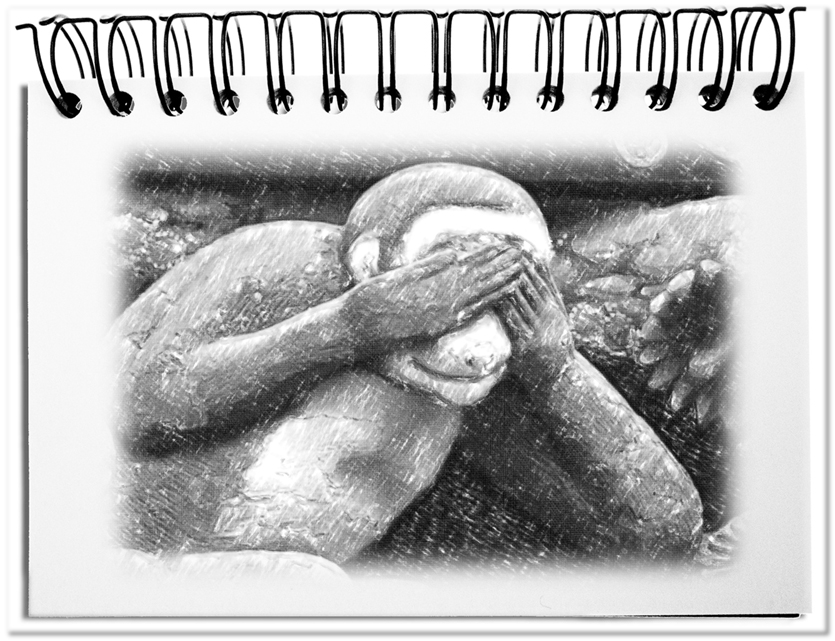
There are many reasons not to notice circumstances. Without the appropriate view to the happening it is asked too much, to observe anything at all. Since this defective vision does not happen deliberately, referring to aspects of the current situation is a crucial pre-requisite, in order to better jointly recognize connections. The right moment for additional descriptions is the statement „I do not see anything, ….“

NikkoNSee

For better understanding, we can look at the reasons for blind spots.

  • … because someone or something interferes my view.
    In front of a wall that has neither door nor window, with best intentions it is not possible to see, what is behind the wall. For better insight there are no other ways than striking a breach into the wall or to look behind it from a higher view point or by smartly walking around the barrier.
  • … because I carry blinkers.
    The own field is the basis for certain findings. However, sometimes your own experience is a bar to see. The internal convictions work like blinkers that do not let through any attractions, which take place outside of the professional field of vision. In such a case it is crucial to irritate people in such a way that they turn their heads into the desired direction and register new points of view.
  • … because I suffer from some sort of visual impairment.
    As long as the view is not sharpened by formative experiences, although you can see the happening, yet you cannot recognize the relationships. This blur leads to false conclusions and thus to an incomplete picture. In this case additional explanations are needed, in order to receive a high-contrast and meaningful picture.
  • … because it is too bright or too dark.
    Favorable lighting conditions are a requirement for a clear view. If one is dazzled by too much information, then this flood outshines the own horizon. If one receives too few inputs, then one stands in the dark and has no visual aid. In such cases the crucial information should be made available in a manageable quantity, in order to have something recognizable
  • … because there is nothing to see.
    If someone does not see anything, this can also be due to the fact that there is nothing to see at all. If empty words and abstract terms are used that do not state anything substantially, there is also nothing to recognize. In this case it is worthwhile to make abstract messages more understandable.
  • … because I may or should not to or because I have to shut my eyes.
    Internal information that is classified as secret has to be treated confidentially. They cannot do anything else than closing their eyes and not speak about it. This does not mean that there is nothing to be seen, but for legal reasons you are forced to keep silent about it.
  • … because I can’t do it.
    There are cases, in which one does not refer to it, since there are no proofs or simply no words to talk about it. An interactive discourse can provide clarity. In these cases for the aspects that you couldn’t express previously are jointly developed and documented.
  • … because I do not want it.
    The reasons, why someone does not want to show something, reach from the current personal mood to professional reasons. Lacking acceptance or commitment create a personal distance that leads to the fact that someone shut oneself off. A simple way to cover this is to say „ I do not see anything, … “. For this reason you should not forget to analyze, whether there are reasons for a not-wanting.

Bottom line: „I do not see anything “ is not a statement that you should simply accept. It has to be the starting point for discussing the reasons of this apparent blindness. As soon as you become aware that there might be many reasons, it makes sense to investigate and bring some light on the issue. Eventually you will be seeing more.