
Archiv der Kategorie: English

The culture of pointing the finger at others

The index finger is the most used independently of the other fingers. An embarrassing function of showing is the accusation of other persons. It is overlooked that when pointing to other ones, three fingers show back to oneself.
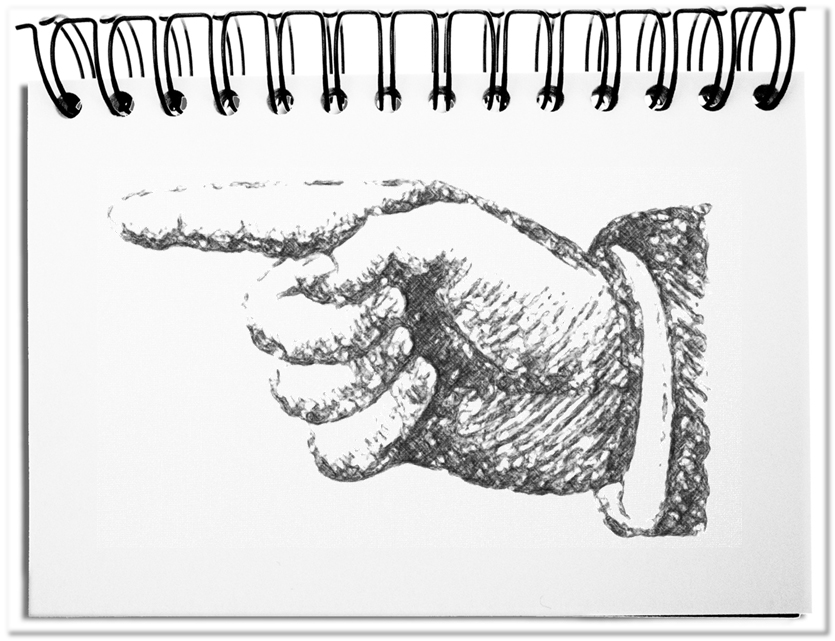
Pointing

Failures are committed in all cultures. The difference that makes the difference is the handling of charges in the public. To accuse other people is a cultural trait that is located in the West. The concept of guilt is here connected with the idea that guilt can be paid off with penance. In contrast, the Middle and the Far East follow the concept of shame. It has no back door that allows to atone for the failure. The face loss is irreparable.

The everyday use of public criticism and the use of the index finger is rather a characteristic of the west. People are quickly more or less formally accused to be responsible and defend themselves instinctively.
In the East, accusations are rarely discussed in public, in order to give the responsible persons the opportunity to be ashamed publicly and to draw the appropriate conclusions.

Practitioners of finger pointing overlook that pointing with the finger provides extensive conclusions about them.

  • Accusers show the self-understanding to be in the position to accuse other people with the lifting of the index finger. However, as long as the role of the prosecutor is not formally assigned, there is no authorization to actually criticizing other people. They usurp this role.
  • Recognizing the failure presupposes a good understanding of the failure. This gives in return the basis for speculations about the context of the prosecutor. This circumstance is best expressed with the Bible saying, „Who is without sin, casts the first stone “.
  • There is an intention connected with each accusation. This reaches from a fundamental desire for justice, to self-righteousness, to interests that do not have anything to do with the actual failure. So the reason of an accusation can be to improve the own competitive position, to call for attention, to settle old scores or something else. The intention mostly remains secret. As soon as the actual purpose is recognized, it provides additional indications for the assessment of the situation.

Bottom line: Finger pointing is a dangerous action, since independent third parties could draw conclusions about the personality and intentions of the accusers, which are not wanted.
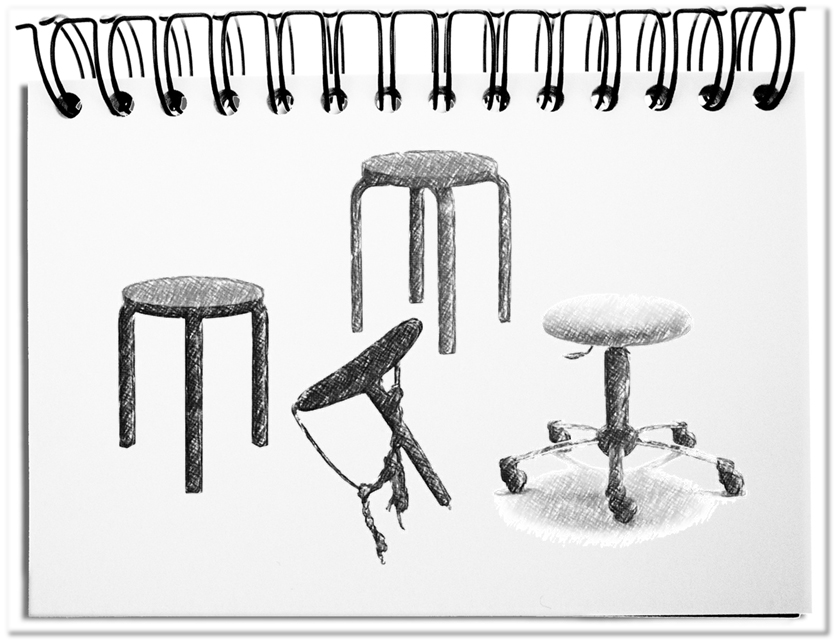
N-legged

Seats differ from each other depending on the use. There is no one and only solution, because the requirements deviate from each other in each case. This becomes evident with the one-legged milking stool that is fastened with a belt and that provides maximum mobility. In contrast, the office chair comes along on five legs and offers maximum stability despite the rollers. Accordingly, businesses need in each case a certain number of pillars in order to fulfill the purpose of the enterprise.

The equivalents of the supporting legs are in business the responsibilities for projects, tasks, products, organizations and similar, which are assigned under one roof. The following thoughts are intended to stimulate the consideration of this question.

  1. The one-legged approach concentrates on one purpose. The project manager, who is responsible for one project, concentrates just on it and ensures that nothing goes wrong. The available capacity is fully assigned to the project.
  2. Stability rises, as soon as a further pillar is added. On two legs, it suits better than on one. Employees, who settle two tasks, do not need to give everything. They have thereby a larger variety at work.
  3. The three-legged approach secures the stable condition. A responsible person has healthy variety with three products. The diversification prevents harmful routine and enables skillful distribution of the available resources. Three main points are within our cognitive abilities and therefore well workable.
  4. From another leg, arise four sides that topple more easily. Accordingly, organizations that consist of four areas reach a complexity that is still manageable, but already reach an increased risk.
  5. The five-legged approach has a manageable complexity and stands stable. However, the attention per topic is limited to 20% – in other words four days a month or one and a half hours a day. Thus, the limits of manageability are reached.
  6. More legs increase the complexity and become less manageable and eventually become too much of a risk. The attention is always absorbed by the “squeaking wheel”. One can take care of the other areas, if they create bigger problems than the others do. The consequence is a swinging back and forth between the areas.

Bottom line: Stability is best achieved from three to five pillars. Keep the number of tasks, products or organizations that are in one responsibility, within this range. As soon as the number continues to rise, the (cell)division into new units is recommended.