
Archiv der Kategorie: English

The views at the state of affairs

Fruitful negotiations need an approach that is focused on the issue rather than on the relationships and the personalities involved. Dealing with expectations and the search for common ground are more than the superficial wrangling for individual advantages. It is easier to agree, if there is a Win-Win situation for everyone. In order to make a result possible, objective, jointly determined reference points are needed. The state of affairs derived from the existing standpoints is crucial. If you find a common view of the initial situation and the conditions associated, some contradictions do not arise. The dominoes allow to experience this. Look at the following image! What is it all about? What do you notice? Which thoughts jump to your mind?
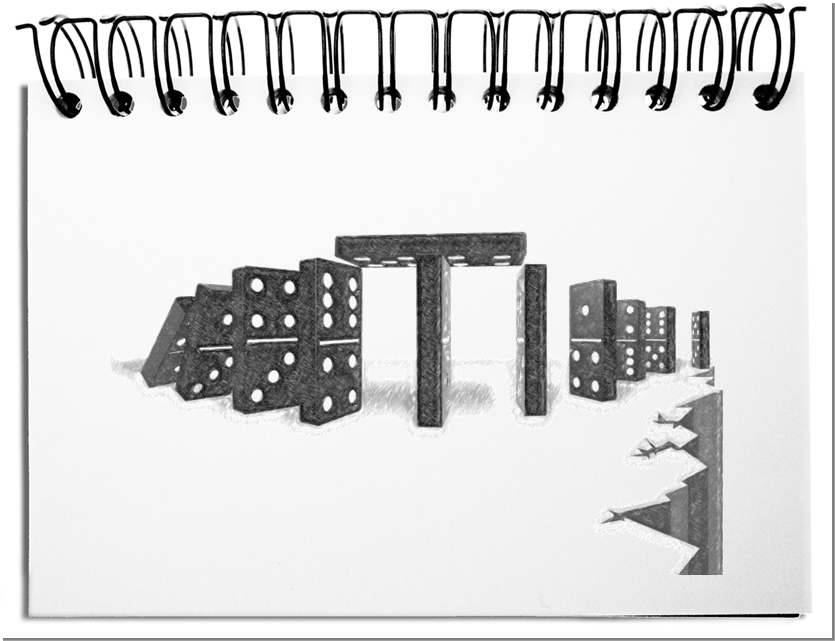
When looking at one situation, all participants have their own ideas, as they approach the situation from different viewpoints, focuses and subtleties. For this reason, all should start by describing the situation that is the basis for the negotiations – the issues, relationships, sequences, dependencies, and preconditions. The following perspectives help additionally.

  • The look at the beginning
    Especially when a snapshot of the situation is taken, nothing moves, which makes it necessary to find the entry point that obviously triggers the situation. Depending on this, the explanations, justifications, and negotiation points differ. That is why we ask ourselves: where does it start?
  • The look to the end
    On the downside, the situation is determined by its end point. The last stone completes the process. Some imagine that it tips over – or maybe not. The boundaries of a negotiation determine where the need is for discussion and where not. You agree upon the following questions: Is this the end? And what happens then? To what point does a negotiation make sense?
  • The look for saliences
    Our attention is particularly attracted to individual stones because something is different – the toppling stones, the two T-forming ones, or the stone close to the edge. However, these peculiarities do not mean that they are important for the negotiation. Therefore, the saliences should be jointly questioned: What do they mean for the reconciliation?
  • The look beyond
    So far, we have been looking at the obvious – the stones and the abyss. The abyss is only implied. We do not know how deep it is or what can be found below. The meaning of the scenery is also left to the imagination of the viewer. The mental cinema that begins should be articulated so that the participants can understand what the thoughts of the others are. The following questions bring these hidden agendas to light: What happens in the end? What is the point behind it? Why does this situation exist? Like this?
  • The holistic look
    As soon as we have a clear view beyond that, we can combine all the previous findings into one explanation. This provides extended perspective – the holistic view. Only the connections between the views lead to a conclusive starting point. Now we get a common answer to the question: What is happening here?

These are by far not all perspectives, but essential ones. There are infinitely many more. In serious negotiations at eye level, the parties involved should share their point of view. This will result in an appropriate interpretation of what is happening, leading to a mutually satisfactory outcome.

Bottom line: In most cases, the participants discuss the „wrong“ issues – personal attitudes of the counterparts, the various negotiation positions and the arguments that allow the winner to take all. It is more effective to jointly describe the starting point so that everyone talks about the same thing. That way many misunderstandings are avoided from the outset. These include: where it all starts and ends, what you notice about the matter, what is the point behind everything and how everything is related. By jointly developing the state of affairs, unproductive negotiations are avoided at an early stage. On this basis fruitful negotiations can start.
What I do not know I care to

Peter Drucker has pointed out that you can only control what you measure. Today we are overwhelmed by numbers, data, and facts. More than 3.7 million patents are registered every year – many in the field of digitalization and medicine. At the same time, not all information reaches us, either because they are not collected, published, or even withheld. The innumerable observations provide different facts, which means that it is up to us to decide what we believe. Since there is always justified doubt about the data, the apparent freedom of expression is of no use. Not only are our own opinions expressed in an aggravating manner, but other points of view are actively falsified and defamed. Too many use the media for the targeted manipulation of the masses. We must learn to deal with the unsettling flood of stimuli, to leave our own filter bubble and to take an interest in other stances. It is not skillful to close one’s eyes: What I do not know I should care to.

Our human data processing is genetically adapted to hunting and gathering. We are programmed to instinctively detect hazards, such as poisonous plants, dangerous animals, and places. We are not prepared for today’s dangers, the simple mechanisms of manipulation: e.g. said is considered done; repetition seem to confirm statements; emotions, especially fears, anchor for a longer time; incomplete alternatives limit reality to themselves. Since dealing with today’s virtual world is not something we were born with, we have to learn to deal with it for the foreseeable future. This article deals with the first hurdle on the way out of the victim role: the conditions of visual perception.

  • You can only see when you look
    The eyes are on the front part of our head. This means that the gaze falls in the direction, in which we move or turn our head. Most of the 214° of our field of vision, we see blurred. The area, where we see sharply, covers only 1.5°. Everything outside the field of view, we do not see. To make sure that we miss nothing, our eyes move unnoticed across the scenery, i.e. the reality or pictures. For the invisible part, we have an additional channel that attracts our attention, the ears, so that we can direct our gaze in the appropriate direction.
    Without looking, we see nothing.
  • You only see when you find
    Since the mass of data that reaches our eyes is blurred, it is imperative that something attracts so much attention that we focus on it. Interest is aroused by contrasts, deviations, but also uniformity (e.g. when we expect deviations). Contrasts are created when complementary colors, color saturation and different brightness levels appear side by side. This also applies to lines and shapes that break certain pattern. These deviations can appear statically or dynamically in the field of vision. In addition to these spontaneous triggers, we find something, because we consciously search for it, e.g. a certain house in the skyline. However, we do not only find it consciously, but also unconsciously. When we, for example, skim over a text, certain key words are not processed immediately, but only after we turned the page, we feel that we have seen something interesting and scroll back to consciously search for it. These unconsciously detected impressions remain available for a long time but are difficult to activate.
    Without finding, we see nothing.
  • You only see what you recognize
    A good example of recognition are abstract paintings, such as Malevich’s famous painting Viereck (Square) from 1915, in which a black square is shown against a white background. Some will know the explanation and others will simply see a black square. All that remains in our memory is what we recognize in the picture, derive from it, and take away as a memory. This applies to modern art, to business and private life. We only remember, consciously or unconsciously, those things that we recognize or that we can assign to a certain category. The carnival parade and the procession of the thousand warriors in Japan can only be distinguished, if we can classify them accordingly – all the others see nothing more than a large group of people walking in conspicuous masquerade.
    Without recognition, we see nothing.
  • You only seem when you change perspective
    The visual impression is always in competition with the next. If we drive with a sightseeing bus through Paris, then we turn our heads all the time, as there are landmarks everywhere. And by looking at the Eiffel Tower for a longer time, we quickly miss the Seine panorama or the Trocadero. Not until we detach our gaze from a view, we have the chance to see something else. During a trip, one misses so fast many specialties. According to this, remaining in always the same echo chamber generates only the confirmation of what we already know. Only if you leave the filter bubble, you have the chance to learn something new – even, if you run the risk of destroying your own world view.
    Without changing the perspective, we see nothing.

Bottom line: The problems of opinion formation already begin with the visual perception that filters our world view before we get into the realm of fake news. On the one hand, vision is not adjusted to the sensory overload, we are exposed to today. On the other hand, what we see does not provide a comprehensive impression of what is happening, since we only perceive a part of the world at a time. If we were able to absorb everything that is presented to our eyes, we would go nuts and become unlivable. For this reason, we should develop a conscious relationship to our perception: We only see, when we look and find and recognize, until we change our perspective. The more people observe a situation, the more descriptions we get – with matching, additional and contradictory insights. In spite of the difficulties of the different statements, all impressions should always be collected and considered, as this gives a more comprehensive overall picture. The same should be applied by modifying the old saying: What I do not know, I care to.