Despite the digital euphoria, we will not see that human labor will be extensively transferred into the cyberspace in a foreseeable future. This transfer into the computer is limited to the simple, repetitive tasks that you don’t want anybody to do for a living – preparing and kneading doughs early in the morning, welding and painting car parts, producing minerals from mines, performing chemical analyses, providing simple technical services, sending serial letters, etc. As long as it is not about specialized tasks that follow a clear process, the machines are not expected to develop the kind of common sense that is needed in social, sanitary, cultural, design and leadership professions (see more here: Melanie Mitchell, Artificial Intelligence: A Guide for Thinking Humans). This means that we still have to deal for a while with the skillful structuring of work and interaction of people. In order to achieve this, you need the right image of human beings.
A big burden for the management in order to find clever cooperation models are the stereotypes, these by many used generalizations of single persons, which do not describe the individual objectively enough. They lead to assumptions that strongly influence our dealings with others as well as our various actions and decisions. In the sixties of the last century, McGregor described two basic types of man that show the effects.
Theory X
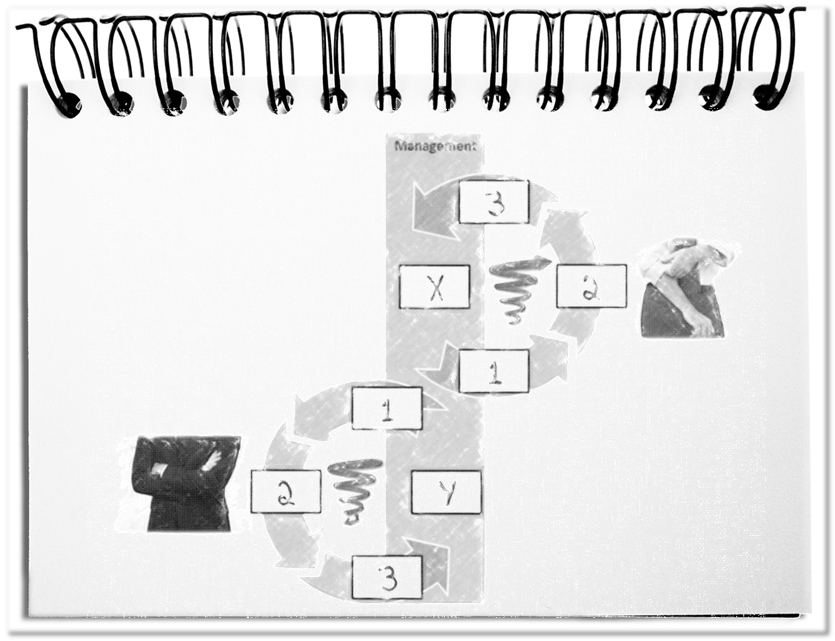
Theory X is the basis for a strict direction and control by management. The leadership is based on the following aspects. (1) The average person has an innate aversion to work and avoids it, if he can. (2) He must therefore be forced, controlled, managed and, where necessary, sanctioned in order to ensure that he adequately involves himself in achieving its organizational objectives. (3) The average person prefers to be guided, wants to avoid responsibility, has little commitment and above all wants security. On the basis of these assumptions, the following vicious circle (X) arises.
- The leaders derive from this the need for strict guidelines and regular monitoring of the employees.
- The employees fulfil the tasks as required. Decision-making authority and responsibility has the manager. Active thinking and arbitrary adjustments by the employees lead to conflicts and sanctions.
- Through the distribution of task, authority and responsibility, employees become averse to responsibility and risk and suppress any impetus to intervene actively – continue with (1).
The management feels vindicated by the reluctant behavior of the employees and strengthens the guidelines and controls. Repeated cycles increase the tensions. The end is predictable. The company freezes in a jumble of regulations, on a suppressed enthusiasm by small-scale management and the destroyed commitment of the employees.
Theory Y
Theory Y strives for the coordination of goals of the management and the employee. The following assumptions provide the basis for it. (1) The average person has no innate aversion to work. He sees it, depending on the conditions that can be influenced, as a source of satisfaction that is carried out voluntarily or as a source of punishment that has to be avoided as much as possible. (2) The human being guides and controls himself in the implementation of those goals, to which he has committed himself. (3) Commitment that directs one’s own towards common goals is rewarded by the satisfaction of the ego and self-realization. (4) The average person not only assumes responsibility, but seeks it – resistance arises from bad experiences. (5) Problem-solving expertise is not limited to the leaders, but is widely spread throughout the entire staff. (6) The skills of the staff shall be used as far as possible. Based on these assumptions, the following cycle (Y) evolves.
- The leaders offer the employees enough freedom to act and leave the control to them.
- This enables employees to determine their own engagement and leads to active participation in the search for solutions, decisions and continuous improvements.
- Task, authority and responsibility are in the hands of the employees, who are willing to take the initiative and to assume the responsibility for their doing – continue with (1).
In a repeated run, all participants get to know the opportunities and advantages – freed from control, the leaders can take care of removing road blocks and to provide strategic orientation; the employees learn to use the increased elbow space and expand their contribution as entrepreneurs in the company.
Bottom line: The VUCA world has accelerated to such an extent that the old leadership approaches are to slow. Despite this, the old leadership structures persist. Companies prefer to seek their salvation in a new office architecture, the introduction of playful practices and the demand for more employee commitment. The office plan dissolves the defined workplaces and creates adaptable working landscapes to which employees are exposed without preparation or acclimatization. Unreliable, rigid planning steps are replaced by agile procedures with Post-its and a large number of small events. The entrepreneurial tasks are expected from the employees – planning, decision-making and control competencies are now in their hands. The leaders lose their raison d’être, but retain their positions and the final decision. For everyone, this is an unusual situation that raises many questions: Why do we still need managers? How do we ensure cohesion and interaction within the company? How are decisions made for the benefit of the company? Who makes what contribution to the company’s success? How becomes performance rewarded? There is much more to consider. In order to exploit the capabilities of the participants, you cannot avoid replacing the ideals of the industrial age (i.e. division of labor; doing the right thing better and better; growth; reducing costs; etc.) with new approaches in favor of viability – i.e. using existing internal ingenuity; ensuring internal and external win-win; decisive generation of customer satisfaction; creating social value.
A decisive prerequisite for this is, as a first step, the right image of the human being.