
Archiv der Kategorie: English

42 – The faith in the ONE Solution

Somehow the search for the world formula, the Theory of Everything, seems to permeate Western thought. While the Greek philosophers were all about the atom, nowadays, quantum physics challenges our common sense. Deep Thought had answered after 7.5 million years the question about life, the universe and everything with „forty-two“. The answer seems meaningless, because the beings, who instructed it, never actually knew what the question was.* It could have been clear to them that ‘Whereof one cannot speak, thereof one must be silent.’**
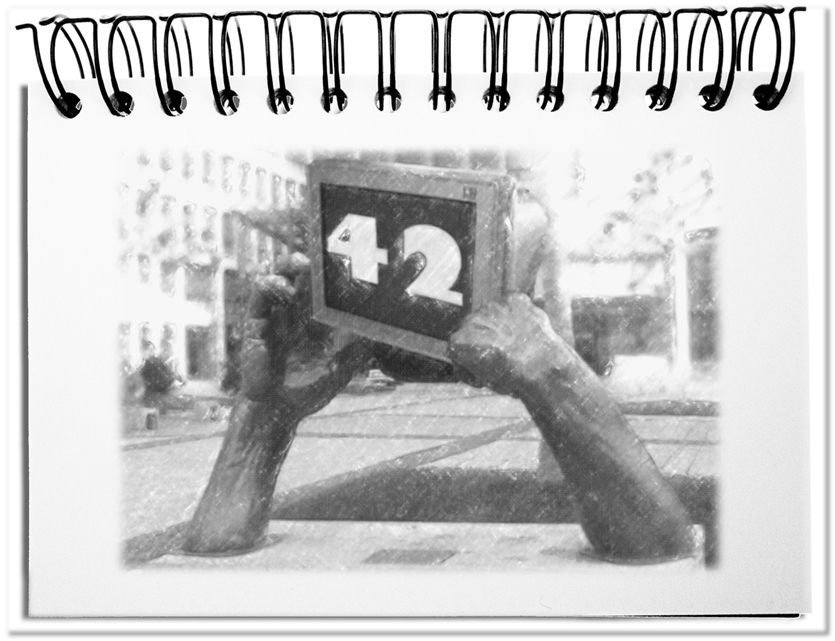
In our everyday life we are always driven by this childlike hope for ONE solution by the following aspects.

  • The Right
    Many conflicts arise when people can’t agree on what to do – What do the customers want? Where is the market going? Which strategy is appropriate? What does the product range look like? Even if a lot of parameters are considered, surprisingly this does not lead to the fact that the ideal is more crystallized. On the contrary! The outcome becomes more diffuse – perhaps because there is no such thing as the right one. In extreme cases the indication of the white rabbit applies: If you don’t know where you want to go, then it doesn’t matter which path you take.***
    Since there is no source that shows you the way, there is nothing left to do but design and introduce the right thing yourself.
  • Doing right
    Often there is also a dispute about how to implement your intentions – Which method should be used? What results are needed? How to speed up the process? Where else can you save something? This creates more and more constraints, which form an insufficient basis for the solution. Barriers on the one hand undermine good solutions on the other. In the end, the savers prevent a viable solution – and generate greater losses than they would have ever saved.
    For something to be done right, it must be fulfilled with the desired end. This is done by the people, who create the solution – and they need the necessary resources, even if they exceed, what was originally specified.
  • Best Solution
    We always strive for the best – The shortest term? The most reliable? The most manufacturable? The cheapest? The most maintainable? The most beautiful? The most manageable? In order to eventually find the best solution, everyone wants all criteria to be met – although speed is achieved at the expense of reliability or price; or maintainability is eating away beauty or manageability; and so on. The best sounds a lot like „42“ – it is in the eye of the beholder, what it means.
    The common understanding of your own quality enables the brand image that customers associate with the products and services. At the very least, it should be clearly defined whether one is striving for product or process leadership or customer proximity.
  • ONE Meaning
    The first step to a Theory of Everything is to understand that a term can be interpreted in any way. Without developing a common understanding of the requirements, the participants will not be able to meet expectations – e.g. actively engage customers; openness; collaboration; adaptability; intrinsic motivation. If the structural layers remains, the efforts will not fit together.
    Words alone are not enough to convey a common understanding. It is necessary to ensure that the scope for interpretation remains as small as possible, through appropriate explanations and the practical example.

Bottom line: It is difficult to understand how clueless management is, when it comes to the fact that their messages are nothing more than a simple „42“ and afterwards they are surprised that their intentions are not coming true. The belief in ONE solution prevents the more effective outcome that would be possible through the cooperation of the many. A first step is to understand that doing the right thing right, the best solution and the ONE meaning is an illusion. The basic conditions are shifting. The world of work is undergoing radical change. Mass solutions only function in cooperation with all parties involved. And they all have their own idea of “42”. If the company is to continue to exist, this can only be achieved by moving away from the belief in ONE solution and by bundling all resources in order to let them jointly determine what „42“ is.

*) Douglas Adams: The Hitchhiker‘s Guide to the Galaxy

**) Ludwig Wittgenstein Tractatus logico-philosophicus 7

***) Lewis Carroll: Alice in Wonderland
 

Bureaucracy prevents

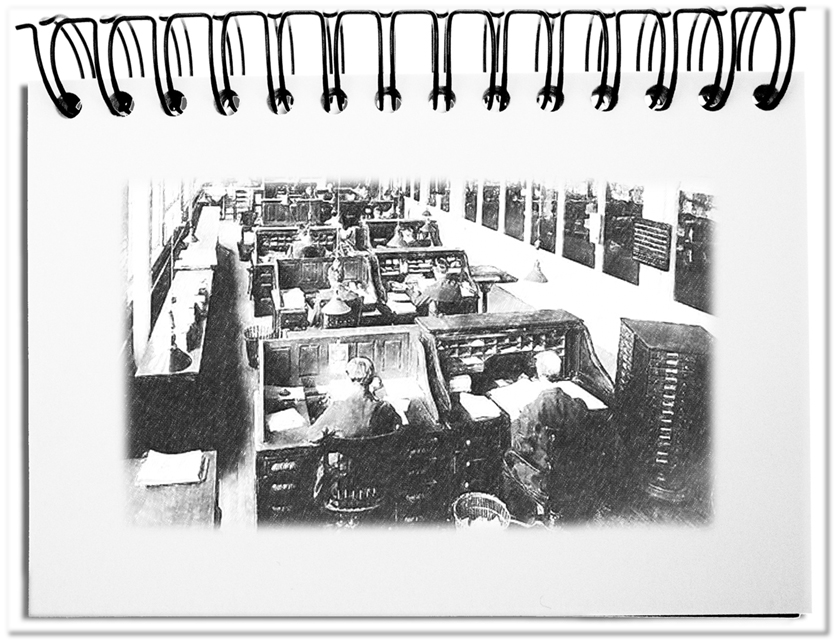
The reign of the administration is actually an outdated way of steering a company – with objective, formal, regulated, verifiable and distributed tasks, authorities and responsibilities (TAR). With enough time to design, allocate and implement routines, i.e. to train, companies behave like machines. Over time, weaknesses are eliminated as well as the process and quality of the entrepreneurial officialdom improved, in order to increasingly deliver the desired results with greater reliability. With the digital transformation and the accompanying acceleration, even the last bureaucratic apparatuses will notice that they are losing all economic competition, because bureaucracy prevents the work styles that will determine henceforth success.

For this purpose we look at the ’new‘ requirements.

  • Digitalization
    The coherent adaptation of all parts of the business to virtuality is the core of digitization. The processes of the future will take place in IT. The data is processed independently by powerful software (sometimes called Artificial Intelligence). Machines produce not only products, but also services. Even personal tasks can be automated (e.g. automated complaint management).
    The acceleration generated by the computers will be possible when the bureaucratic checkpoints and decision points take place quickly and, without staggered chains of command, immediately at the point of action.
  • Customer orientation
    Today’s customer is often better informed than a company’s contact person. They are thus better prepared and have more and more specific wishes, which have not been taken into account within the framework of ‚bureaucratic‘ product development. If the top management is serious about their customer orientation, then the customer, who expresses a wish, dominates anything else. If the interface to the customer has already been digitized, then the programs must be able to satisfy the customer in spite of his special requirements.
    Even before the digital transformation, companies understood how to focus on the customer and his wishes – every employee with customer contact in the Ritz-Carlton can spend up to $2,000 without consulting a superior to satisfy customer wishes.
  • Innovation of products and services
    Many innovations were found by chance – e.g. Penicillin, Post-Its or Teflon. It is not the prepared process that creates the idea, but an impulse that unexpectedly triggers the Eureka in someone out of nowhere. Consider the everyday annoyance of having your notes fall out of your hymnbook, as well as a colleague, who develops an adhesive that simply doesn’t stick permanently – and we have adhesive notes of any size and form.
    This thought flash cannot be ordered or expected according to a schedule. If additionally the idea has to be described, submitted and adopted according to a certain rule, any fantasy suffocates.
  • Self-organization
    The replacement of the chain of command is self-organization. Every employee should act intrinsically motivated as an entrepreneur in the company and generate more value than before. Employees have to decide their own limits although it is expected that these boundaries will be interpreted more generously than they could ever be given by a superior. Not to forget saved managers, who are no longer needed when everyone is leading themselves.
    People forget that new remuneration, reporting and management systems are required, in order to go beyond bureaucracy and enable employees to control themselves by providing non-bureaucratic support such as adaptable IT, rapidly provided resources and an open corporate culture.
  • Globalization
    The world is the playing field in which business nowadays has to assert itself. This requires a mindset that adapts to the respective region or country. A group of bureaucrats of any kind will not be able to develop a bureaucracy that fits everywhere.
    Different languages, rituals and behaviors cannot be summarized in a consistent system, because a meaningful translation into all languages is not possible; the rituals follow local society and religions; the appropriate behavior is often contradictory.
  • Quality
    As soon as a bureaucracy takes over the leadership, the employees no longer feel responsible for giving their best, but only for fulfilling the requirements. Thinking would always question the rules. This means that employees cannot accelerate a process, although it would be possible. It does not work, because the predefined process requires certain detours. A customer request cannot be implemented, because the specifications clearly regulate what the customers have to buy. Defects in the product arise, when the task execution becomes more important than the corresponding quality.
    The specifications determine exactly what has to be done, which quality grades have to be fulfilled and how long one should deal with something. If the required working time is then met, one has fulfilled its duty – although there are still ideas for more.

Bottom line: A clear indicator of the ability to use new forms of work and structures is the status of the own bureaucracy. As long as a result is checked based on formalities and formats and new ideas are ignored, you will have difficulties in the foreseeable future – you will not be able to keep up with the speed of digitalization; real customer orientation will remain a dream; innovations will only be possible with a lot of effort and external support; self-organized teams will dissolve quickly; one will no longer be able to keep up with global competition; quality will become worse and worse unnoticed. Of course only, if you don’t manage to let go your bureaucracy and its representatives. Because: bureaucracy prevents.