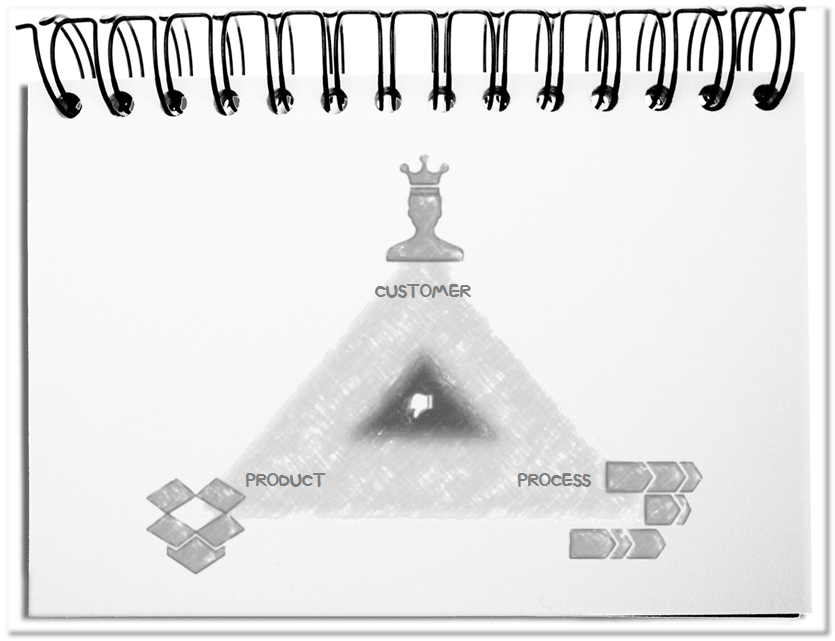
In the days of the guilds, the quality of the performance was the focus of interest and the figurehead of the masters, the responsible manufacturers. In the last two hundred years specialties have evolved with the advancing division of labor. As a result, the focus has shifted – from the product to fulfilling a subtask. The actual products have receded into the background. The success of the individual areas is determined by the continuous refinement of the particular abilities:
- The development is delivering more and more prototypes,
- The production produces ever more at lower cost,
- The sales department is always acquire new customer groups and
- The marketing delivers ever new campaigns.
As a result, the business units lose sight of the actual services and act based on the look at their own value creation that always covers only partial aspects. This goes so far that start-ups market their business idea before the actual product is available, leading to major, unnecessary efforts that have no effect. And this, although it is generally known: Form follows function.
The venture depends above all on the most convenient offer for which the customer is ready to pay – be it goods or services. A description of the available features is crucial to ensure that the various tasks are performed with minimum effort. The following points are of great value to the overview of the articles and services.
- The service core
fulfills the wishes of the clients – an MP3 player plays music; a hotel night offers a hotel room, incl. room service and breakfast; a Swiss knife cuts, screws, drills, saws, lights, up to a total of 56 parts in one tool.
The service core can be identified with the following questions: Which customer needs are satisfied? Which features are required? What is relevant to the clients? - The design
of the products happens almost by itself due to their physicality. The material must be selected, shaped, provided with a surface and colored. Intangible services can also be designed. The dealing with customers, such as friendliness and empathy, the reliable activities, such as consulting, training, advertising, and catering or the administration of facilities consist of processes and employee behaviors, which also can be designed. Nowadays, design not only serves as a temptation to buy, but also influences the entire life cycle of a deliverable –
for physical products: from economic production and warehousing, through ergonomics and a predetermined lifespan, durability and ease of maintenance, to disposal; for services: from planning, through development and operation, to the sun downing of an offer.
These design aspects can be identified with the following questions: How do customers perceive the services? How does the design influence the customers – and the life cycle? What other advantages can be achieved with minimal effort? - The add-on services
include further offers for the customers, which are available free of charge or for a fulfillment fee of the core tasks. This ranges from supplemental assistance in the use and maintenance of the services, through extensive accessories, to performance-related tips as well as platforms for exchanging ideas, e.g. with online communities.
The following questions provide some ideas: What else do the customers want? Which add-ons can be offered right away with little effort? Do the supplemental services increase customer loyalty or even the sales? - The brand aspects
are the unconscious forces of attraction that bind the customers of a product or service to the company. Established brands, the name or logo, the type of advertising and key images already evoke positive associations – e.g. the famous Marlboro man or the Mercedes star, the elaborate Apple trailers or the Mazda humming, all trigger in the best case positive feelings in the audience – and they become part of the brand with the purchase.
The brand aspects can be determined with the following questions: How does the customer perceive the company? Do the products match the brand? Do we send messages that do not match our desired image? Which activities support the brand?
Bottom line: The points described the service core, the design, the add-on services and the brand aspects are essential components of the business activity. Nevertheless, these points of view are rather late or not at all formulated. They are the meat of the deliverables. These descriptions influence the perception of the customer’s and, at various points, the life cycle of the services. A lot of momentum gets lost when the developers, manufacturers, and sales people have a different understanding of the deliverables. Describe your product, because form without function wastes already scarce resources.