
Archiv der Kategorie: English

When doing gets false

These seasons that seem colorless and uncomfortable to some. When the clouds are hanging low in the sky and moisture is constantly exposed to gravity. The soil is no longer able to absorb the water. And artificial roads seal the ground additionally. Then shallow lakes are formed everywhere, in which the dark clouds are reflected. And then a car drives through a puddle and hurls the water into the air. Bad luck for those, who are passing by at this very moment and, in addition to the rain from above, get a gush from below. The natural reaction is to scold after the car.
But why? What the hell happened? Who did something wrong? The motorist, who was forced through the puddle involuntarily? The pedestrian who had nothing better to do than walk by the puddle right then? When gets doing false?
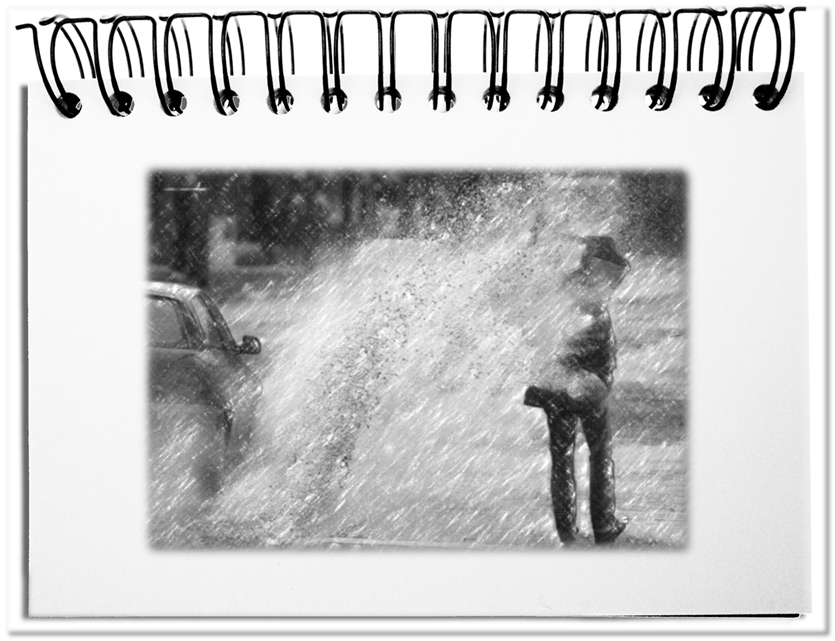
Let’s take a closer look at the situation.

  • The driver
    Driving with a car in pouring rain can be strenuous, even at 40 kilometers per hour. The spray of oncoming vehicles, the thick raindrops and the roads full of puddles require the full attention of the drivers. And then it happens very quickly. If it weren’t for the pedestrian besides the puddle, the driver would have done everything right. He had no reason to soak an unknown passer-by. Did he DO something false?
  • The Pedestrian
    With such weather, you don’t chase a dog outside. You can’t escape moisture with the largest umbrella. At the next corner the drops are even flying horizontally. One escapes only partially from the downpour. And then it happens very quickly. If the car hadn’t arrived exactly at the moment he passed the puddle, the pedestrian would have done everything right. I bet the passerby didn’t want to take a shower. Did he DO something false?
  • The circumstances
    It is not common for a downpour to dump so much liquid onto the road that the drains can no longer absorb the water masses. In the trenches at the roadside rushing streams evolve, which here and there expand into small lakes. It is easy to sink in these puddles of water above both ankles. And then it happens very quickly. With a sufficiently dimensioned drain, this puddle would not have formed and the car would not have sprayed the pedestrian. No one had created this general weather situation either. Or who DID something false?
  • Prior reasons
    On this day, the driver had started his journey earlier than usual in order to drive particularly carefully. The pedestrian had waited specifically long for the rain to stop. The road was built in the eighties according to the latest guidelines for drains. Many other stories could be told. And then everything happens very quickly. In the end, fate came true at this puddle. No one would search in the previous stories for the cause. Or what was DONE false here?

Nothing happened intentionally. Everything is just an unfortunate concatenation of circumstances that led to the event described. And actually, false DOING is not the right description for errors that happen. No one makes deliberately mistakes like this – except: the arch-enemy who waited to deliberately throw a giant fountain at the hated pedestrian. Whereby this action is not really a mistake, but a well-founded, deliberated act,

Bottom line: To do something wrong requires that there is an intention part of it. If mistakes happen at work or elsewhere in everyday life, then these events, whose guilt is blamed on someone, cannot be prevented, because they happen unintentionally. Ok – you could have been more careful, less negligent and more committed. And yet mistakes would still happen. To do nothing is the only way to avoid wrongdoing. And that would be the biggest mistake. To maintain momentum, it is better to develop tolerance to errors. A mistake is a learning opportunity and provides the starting point for new solutions. Then doing won’t get false – and less goes unintentionally wrong.
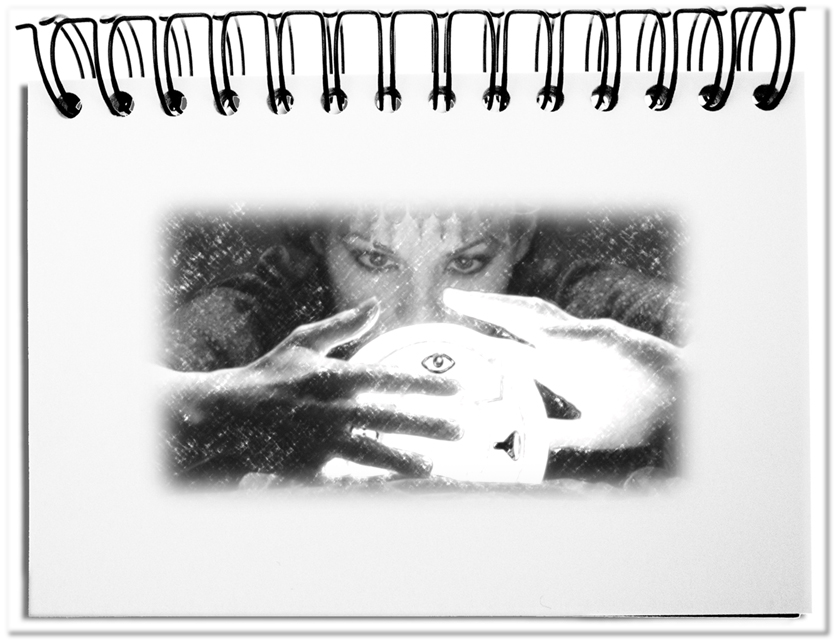
The look into the future

Our utterances are naturally limited to what we can express with words, images and other means. The resulting signs are accessible to everybody in different ways. And although we know that there are people who lack certain sensory channels, for example when they are blind or deaf, we can hardly imagine that we lack other channels. Thus, Rudolf Steiner speaks of the ability to perceive in the spiritual world – which is not granted to everybody, we do not allow ourselves or because we simply do not notice it. Like there is spiritual blindness, some lack the ability of looking into the future. And if someone has this gift, then he gets advised: If you have visions, you should go to the doctor. A look into the future is a basic prerequisite for designing the present so that you arrive in the desired future.

For all those, who lack the practice of anticipating the future, we have a look at different forms of foresight.

  • Vision
    The vision is the visualized impression of a future picture. It offers a snapshot of the introduced prospective conditions – next year, in ten years or even further ahead. Conditions are disseminated in a way that someone expects or fears that are utopias or dystopias. The aim is to inspire or frighten people. The target group completes the missing descriptions of these emotional futures with its own details. This creates a profound effect on them which, eventually, engulfs them emotionally – downwards in a negative vicious circle or self-reinforcing in a positive upward spiral.
    In order to achieve this effect, a meaningful sentence is needed that tells those affected, what to do, for whom and when.
  • Scenario
    The various outlines are elaborated visions with more content. For this purpose the political, economical, social, technological, ecological or legal influences are determined and combined into various drafts with different characteristics. The result should be clearly distinguishable extremes – the best possible and the worst possible. For the individual outlines, appropriate supporting and counteractive measures are developed subsequently.
    Effective scenarios have no limitations on how strongly the individual variables of the influences can evolve.
  • Strategy
    The scheme for the future is developed taking into account a preferred vision of the future. Here you find further details of the vision, mission, common basic understanding, strategic direction, goals and core. It uses a roadmap to connect the present with the introduced future. Ongoing activities are kept on track by orienting annual scheduling accordingly.
    The quality of the route into the day after tomorrow is reflected in its progress, i.e. the continuous approaching to the desired state.
  • Story
    Storytelling is so popular because it provides a target-group-oriented narrative. In the story, the feelings of the vision mingle with the detailed picture of the scenarios and the timeline of the strategy. The aim is to inspire the audience and encourage them to participate.
    The story draws its strength from the common thread that remains in the memory and is carried by word of mouth, without additional marketing measures, from one to the other. This transmission preserves the original message, even if it continues to evolve through new subtleties. At the same time, it can be easily linked to one’s own reality, which means that it is reused more often.

Bottom line: It is impossible to know the future, as the forthcoming influencing factors are unknown in advance. A good example is the Internet, which has brought such a surprising shift in reality to the whole of humanity. What we can master, however, is to anticipate the future and then actively strive for it with actions. Most things emerge covertly, as can be seen with Ludwig Kapeller, who described the concept of immersion as early as 1926, just when the first electronic mass media came into being. Less than a hundred years later, many people regularly dive into the virtual reality of their computer.
It is up to you, whether and how you look ahead: with a vision, with scenarios, the defined strategy or a well told story. It is crucial to allow oneself this view into the future. This is the only way to MAKE it real.