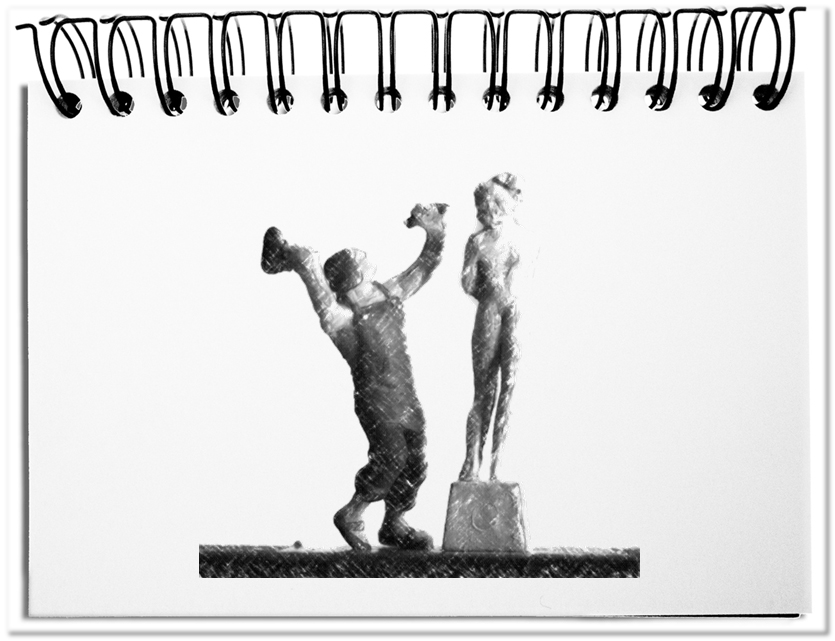
Just as the water is seeking its path, sometimes almost turning in circles, but always finding its way down into the valley, the same way companies are looking for the organizational line-up that achieves the balance between flat and steep structures. Two findings provide a clear framework. On the one hand the Dunbar number describes the number of people with which someone can keep in touch with – actually 150 or between 100 and 250. If the number of members exceeds that number, the group should be split up in order to ensure functioning. On the other hand, the Miller’s law determines the ability of humans to process simultaneously 7plusminus2 information units (so-called chunks). If more than nine chunks appear at the same time, the risk of overlooking or doing something wrong automatically increases. This determines the framework for the eternal answer of the design of an organization.
Based on the Dunbar number and the Miller’s law there are possibly a maximum of four layers1) and a maximum span of control of nine2). In individual cases it is not the calculability that determines the structure, but the boundaries become clearer. In addition, the span of control is influenced by the following aspects.
- The abilities of the protagonists
The executives, who have an appropriate understanding of their tasks, a suitable toolbox and sufficient empathy master larger spans of control. In addition, specialized and ambitioned employees make leadership easier. - The complexity of the tasks
Simple tasks that are clearly described, seldom change, allow routine and require little interaction with others, promote larger spans of control. Increasing interaction with other areas as well as continuously changing influences and requirements limit the span of control. - The geographical distribution of the protagonists
If all participants are sitting in a room, it allows a maximum span of control. The further the members are apart, e.g. distributed globally between Japan and the west coast of the USA, than the span of control will decrease due to tougher reconcilement down to a minimum. - The available governance
A Governance described in sufficient detail allows for wider spans of control. It is not a matter of regulating everything in detail, but of outlining the decisive aspects in such a way that everyone can follow them and develop a common mindset – including principles, alignment ways, basic understanding and clear roles (task, authority and responsibility). - The predominant management style
The self-understanding of the managers includes above all their comprehension of how the interaction between management and employees has to happen. The more authoritarian the management style, the shorter the leash on which the employees are led – which leads to a lower span of control due to the performance limits of the managers. New approaches are based on self-organization, i.e. employees take over management, coordination and control – which enable a larger span of control and flatter structures.
Bottom line: The eternal answer of the span of control is not only theoretically clear – k+kn<=150; where k is the span of control and n the number of at least two hierarchical layers. In daily business, the span of control has settled at five to nine – higher and lower outliers confirm the rule. The number of levels is mitigated by the division into semi-autonomous business units, as soon as a certain number of members (more or less 150) is exceeded, new units are formed. Companies that operate outside this framework should critically review their performance – How fast do we make decisions? How agile are we? What friction losses do we detect? What is the contribution of our structure? The measures derived from this include organizational adjustments, according to the eternal answer
1) Using four levels, a span of control of three is possible ( 3*3*3*3+3=84).
2) Two levels and a maximum span of control of 9 are possible (9*9+9=90).