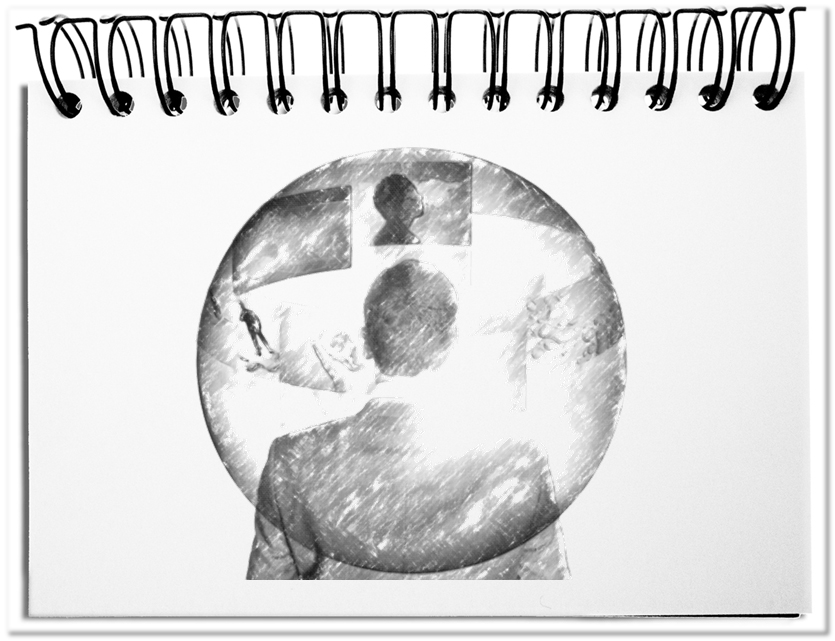
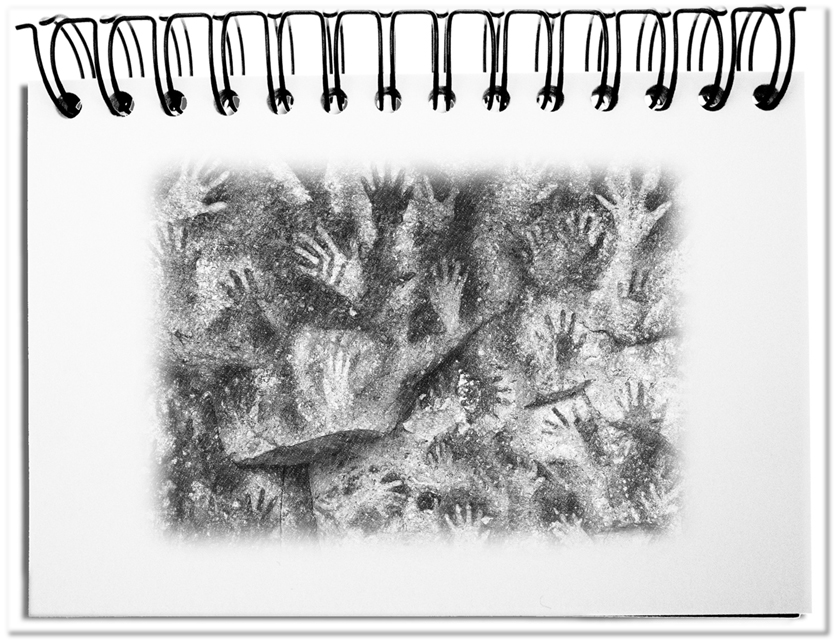
We learn through observation, from teachers or others, and from the experiences we make ourselves. In this case, everything happens in our minds – in each individual. The lessons are conveyed through oral transmission and appropriate carrier media – e.g., tools, instruments, sculptures, visualizations, and multimedia. When you lack contemporary witnesses, past experiences only become visible through objects. From historical findings, we derive the insights of earlier people. Oral traditions, such as those of the Aborigines, who have passed on past events and experiences from generation to generation since time immemorial, are not regarded by traditional media as confirmed evidence. Therefore, for instance, Wikipedia rules do not accept posts handed down by mouth to mouth. Thus, much of our knowledge lies in the darkness of the undocumented. The presentable know-how is limited to the artifacts that have been found – hand axes from 1.75 million years ago; over 40,000 years old flutes; cave paintings and sculptures that are over 30,000 years old. For all the objects’ physicality, the meaning and associated thoughts and skills remain out of reach.
Through appropriate interpretation, insights, such as knowledge about forgotten medical agents, can be brought back to life. A decisive role in reuse is played by the language, the transmission medium, and the context. These aspects are also valid of the flood of peer-reviewed, scientific publications (more than 2.5 million articles in 2018). What should we consider when we want to learn from past experiences?
- Language reveals – though not everything
We live with the illusion that convictions can be comprehensibly put into a linguistic form. This way, we oversee the fact that the expression formats cannot fully convey the actual meaning (see meta-model of language).
This is especially true for the signs and words used and the varying vocabulary of languages (jargons and translations) – for example, when the understanding of short, medium, and long term is shortened from one to ten years to one month to three years, it results in different effects. In the first case, the future can be jointly designed. In the second case, the workforce is always running after new directions without having any chance to participate.
Historical statements can only be used by making assumptions. Although we can read the word’s string, we do not know what was initially meant. Ancient Greeks distinguished project-like business activity for earning a living and financing leisure from physical slave labor. This no longer corresponds to our current view, which focuses on work-life balance. Today, the incentive to work (the work) arises intrinsically from the urge for recognition and self-affirmation and extrinsically from pecuniary and other monetary benefits. The longing for work-life balance is the attempt to replace the labor stresses with leisure activities (the life), not ease of mind. The inconveniences of work, the dependencies, external regulations, and incapacitations are supposed to compensate for these disadvantages of work with an exuberant calendar of spare time activities.
The concepts of work and non-work have shifted repeatedly over the centuries – even in recent years with the agilization. Despite this, companies continue to adhere to the vertical and horizontal division of labor. With their outdated approaches, companies fail to introduce new leadership styles for the agile VUCA world. - The medium conveys – though not forever
The longevity and availability of a medium determine whether conceptions stay visible. Inaccessible and protected from light, dry cave walls have preserved signs and images over forty thousand years – ceramic tablets last 5,000 years; books and manuscripts experience several centuries; films dissolve after 40 to 150 years. Just as most artifacts from the past have disappeared, our current media will disintegrate – optical storage media last five, 100, and in professional cases, 1000 years; hard drives and flash memory survive up to ten years. The lack of oral history means that most of the experiences disappeared due to the media’s short shelf life. Even if they survive a long time, they must first be found and readable. Remember the Dead Sea Scrolls, which were discovered after almost two thousand years.
Additionally, the undocumented pieces of the puzzle are missing for a better understanding – the experiences that were not recorded and the lack of understanding of their creation context.
Handbooks provide general principles, but it would go beyond their scope to describe the related environment. Thus, the application with changing tasks is a mental transfer performance that is only possible with a lot of overhead. One example is the elaborate BPM of the eighties, which no longer fits today’s rapidly changing activities. - The context supports – although not everywhere
Experiences always arise in a specific environment. The authors always presuppose the understanding of the accompanying circumstances. Subsequently, they forget essential explanations of the context. As a result, the elaborated impressions remain misleading. Let us consider the rule of the people, the democracy, i.e., the population’s participation in political resolutions. In ancient Greece, only so-called full citizens were involved in decisions – 10-20% of the inhabitants (i.e., Athenians who could fight, but no women, slaves, or foreigners). Today we understand democracy as the participation of the whole population, equal rights, majority decisions, etc. – at least in principle.
The context is composed of different scopes (local, regional, continental, and global). The resulting mix is challenging to grasp – the New Yorker Manhattanite differs from the Californian San Franciscan, and at the same time, they share the American dream.
The corresponding contexts are not provided and get lost over time. Today we try to establish this context with cultural studies, which is difficult because these contents are rarely described, and contemporaries can no longer be asked. Let us think about the design of processes according to the principles of Taylorism: there is one, best way; place and time are fixed; detailed structured tasks are pursued; one-way communication; small-scale targets without reference to corporate goals; third-party quality assurance. In the fast-moving world of VUCA, these demands can no longer be realized due to the zero-latency reaction time.
Bottom line: Due to the language limitations, the rarely available and problematic to understand evidence, and the lack of context, the prior experience can only be reused with great effort. Previous experiences are often used to get the target group to agree through the authority bias (i.e., the tendency to accept an authority’s statement, regardless of its content, although one has a different opinion). Even Goethe proclaimed in Faust, “For what one has in black and white. One can carry home in comfort.” With the flood of sources, experiences, and fake news, there are too many approaches that an objective choice of the “right” approach becomes impossible. For this reason, we have to make our own experiences – err, bearing mistakes, and try again until it works.