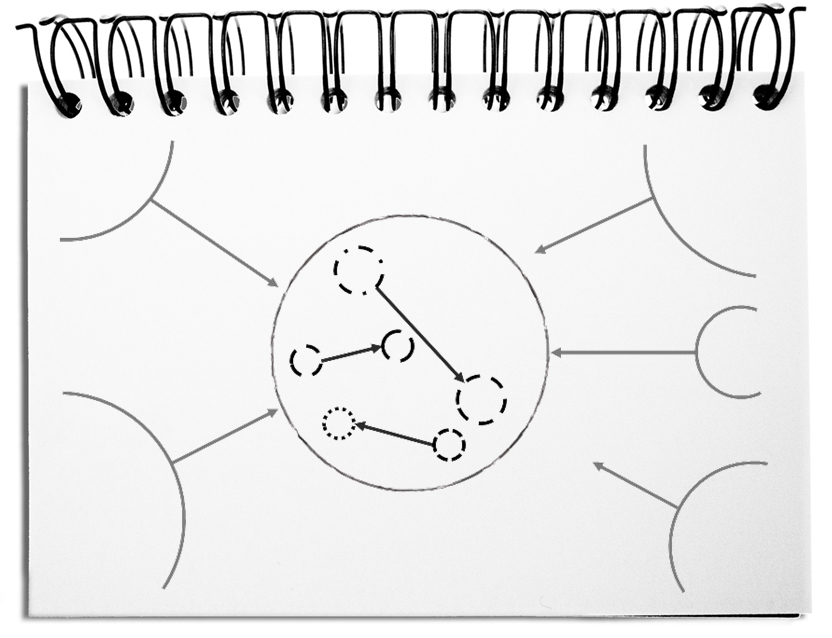
The more people work together, the more it matters to be aligned to a goal, to obey common rules and to understand each other. Collaboration nowadays not only takes place between functions, but also across the borders of the enterprises and the sectors. Thus, different values and rules collide. Complex structures with mutual relations and dependencies evolve. The coordination is a form of control as part of the leadership tasks *1. The good news is that leaders have the choice, how they coordinate.
Out of various possible mechanisms for coordination, the following provides a manageable mix of alternatives for controlling groups.
- Market
The introduction of market rules steers indirectly the interplay. Since all activities are connected to expenses, the contest based on supply and demand offers a quasi-automatic regulation of the options. The more alternatives are available, the smaller the costs. The rarer the offer, the higher is the price. With this approach, especially internal services that are providing cross-charged deliverables decrease the expenditures in the mid-term. - Agreements
Anyagreement (e.g. contracts, policies, compliance to standards) determines the type of cooperation. The formal definition of rules guarantees early on that all involved people are clear about what is expected. Since an agreement requires the consent of all contracting parties, the interests of all are considered. - Partner selection
The coordination through a conscious partner selection already defines before the actual cooperation the common rules. The appropriate selection criteria, admission rules and the desired etiquettes have to be visibly documented in advance. Thus, all involved people know what they are in for and whether they want to participate in this collaboration or not. - Result orientation
The results that are agreed in as goals, synchronize all activities. This requires a consistent planning, to which the individual goals refer. The employees receive thereby a clear target and leave them with the freedom of the how-to. The HR systems for the control, the evaluation and the motivation are based on it. - Hierarchy
The classical approach of leadership assigns the tasks, the authority and the responsibility to the participants on different levels. The chain of command that determines the control, the decisions and the escalation procedures is clearly defined. The superordinate level has thereby the right and the obligation to lead. - Linking-Pin
Pro-active coordinators keep the projects continuously moving. The so-called linking-pins assure as overlapping contact partners the mutual exchange through management-by-walking-around. A linking-pin reaches from the driver, to the caretaker, to the supporter of the collaboration. In any case, the linking-pin functions as connection between the involved units. They are able to translate the different requirements in such a way that everybody can understand and obey. - Diplomacy
One of theoldest procedures is surely the negotiating skills of diplomacy. Similar to the linking-pin, it is only activated after there is a need for coordination. In the simplest case, the exchange of ideas begins between the involved people. However, also negotiations are organized or, in the case of crisis, mediated between the parties. A typical format is the Taskforce.
In principle, the coordination mechanisms can be used separately or arbitrarily mixed, as long as the cooperation and the goal achievement happen in the end. Since the conditions of the business are changing constantly, the hierarchy is surely the most difficult to use, since it needs a long time, in order to be established fruitfully. Linking-pins and diplomats are surely the most practical solutions in times of change and for various cultures.
*1) Additional leadership tasks are the self-management, the conception, the communication and the cooperation