
Archiv der Kategorie: Meaning design

In this area it is all about meaning design ===> http://www.meaningdesign.com

Mechanisms of Design

Everybody, who is competing for people’s attention, is looking for starting points that let them stand out from the rush of sensual stimuli. For this purpose we all can rely on basic patterns – Gestalt principles or Gestalt laws. These are mechanisms that can direct, guide and seduce perception.
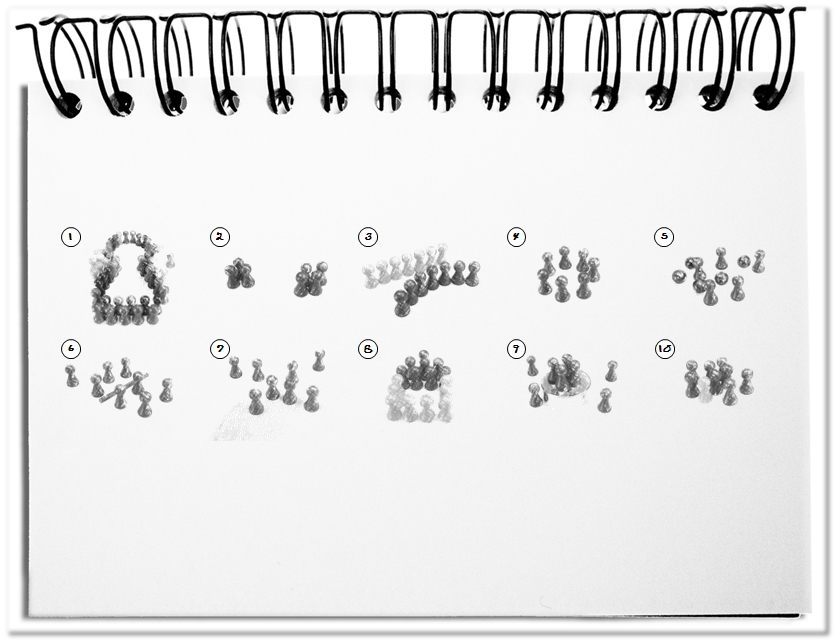
The media has used for a long time these mechanisms, which are also treated in Gestalt psychology. The following mechanisms describe some basic principles.

  • Mechanism of the figure-ground (1)
    The perception happens quasi-automatically, without deliberately parsing a scene. Thus the attention subconsciously lands in an image on the central object, the figure placed in front of a background. In rare cases, the background comes to the fore and distracts from the actual foreground.
    In order to pack a message easily recognizable, the content should stand out clearly from the background.
  • Mechanism of proximity (2)
    If several things are close to each other, then we perceive them as a group. That way, extensive representations can be divided into smaller areas. Good examples are newspapers in which paragraphs in the print space are delimited from each other by a corresponding white space.
    In order to make the outline of something easier to recognize, related parts should be closer to, with a noticeable distance from each other.
  • Mechanism of continuity (3)
    If things are in line and follow a path that consistently continues across borders, we assume that they belong together. This can be found on maps where lines often cross one another. The observers are able to detect the continuation of a line when ambiguous intersections are avoided.
    Related elements should be arranged in a line and other groups should be clearly differentiated.
  • Mechanism of closure (4)
    If individual elements form a closed form, then we no longer regard the individual building blocks as noteworthy, but rather the resulting form. The meaning then arises from the resulting group.
    Groups can be made visible through an according arrangement of certain elements into a formation.
  • Mechanism of similarity (5,10)
    The same shape or color is a strong indication that they are similar things. In situations that consist of many individual parts, we are able to identify the groups because of the similarity of the elements. In moving constellations groups can also be distinguished due to the same direction of movement.
    Things that belong together should have common features, e.g. shape, color or size. The elements that do not belong should be clearly set off.
  • Mechanism of the common region (6,7,9)
    If individual elements are found in areas separated by a border, we perceive the individual parts in different zones as related. The individual areas result from recognizable borders or areas of different colors, surfaces or shapes. The common regions may result from a simple pattern, such as a chessboard, or from an organic figure.
    Through forming areas by drawing boundaries or designing areas, the respective building blocks can be presented as a group.
  • Mechanism of personal experience (8)
    An important mechanism is the personal experience of the observers. If they already know certain constellations, they recognize the corresponding groups. This becomes understandable, for example, when you learn a new writing system (for example Japanese Hiragana, Katakana and Kanji). Without the familiar types of strokes, non-Asians find it hard to learn the scriptures. Since everyone provides a unique set of experiences, teams recognize more structures than individuals.
    Different people should be involved for detecting groups, since more experience will lead to better creation of groups.

Bottom line: The presented mechanisms are sometimes are called Gestalt principles or Gestalt laws. However, this does not imply that these mechanisms will always work. But our pattern recognition influences the observation of objects like pictures, texts, films, web pages, etc. Our perception is guided through the content by the mechanisms figure-ground, closeness, continuity, closeness, similarity, common region and personal experience- whether we want it or not. The conscious use of the Gestalt principles, the Gestalt laws or the mechanisms of design ensures that we do not send ambiguous messages.
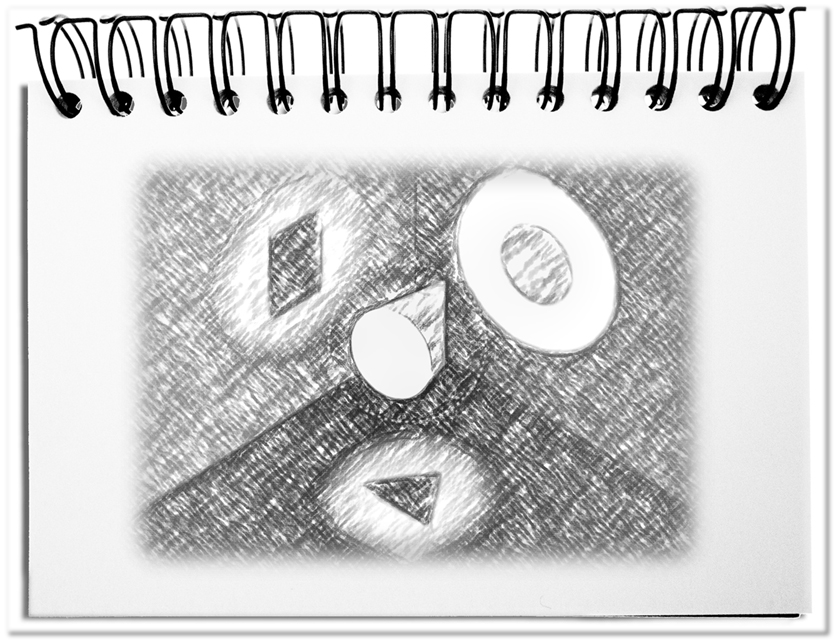
The Why needs perspectives

The answer to Why is not an easy thing, because it leads to different results due to the different perspectives. With the development of a new product, various aspects of a solution must be questioned. Imagine an app for your smartphone that generates new ideas for your business based on the own online activities. The freemium version offers one idea per day. The paid version has additional features and collects between 0.1 $ and 5 $ for each additionally retrieved idea depending on the contract. Why should you invest money in the development of this app? Why do you need certain functions? Why should customers subscribe to the paid version? To assess the viability of the draft, a set of perspectives can be used. This provides more comprehensive insights into the Why.

In the following, several perspectives are used to understand „Why“ the described app makes sense. In addition, there are still „infinite“ more other aspects that may be relevant. Let’s look at the draft out of some basic perspectives.

  • Customer Perspective
    Customers love Freemium, because they do not have to commit to anything and can use for free more or less of the benefits of the offer. One idea per day adds up to 365 free ideas that allow a real assessment of the benefits. The consideration of the personal attitudes delivers results, which are worth knowing for everybody. Of course, the professional wants to be able to get more needs-oriented ideas. Flexible payment models serve these various needs. If one of the ideas comes to fruition, then the subscription is financed for a long time.
  • Contentual perspective
    The challenges are the topics and the approach to avoid the repetition of ideas. In the freemium version, the Internet activities are evaluated and condensed to one new idea per day. In the professional environment, more settings are needed to align the target area to a current task. Other features are available, such as tracing previous ideas. Evaluations have shown that ideas can be generated without limits.
  • Social perspective
    An important task will be the dispelling of the concerns of individual users, who feel being observed through assessing their Internet activity. They overlook the fact that these traces persist in the net in any case and that they get for the first time the opportunity to use these traces for themselves. The spared time, the advancement of the business and the increased reputation, which is generated by the ideas, should quickly let them be open for conviction.
  • Technological perspective
    This cloud-based service operates based on big data that is already used by major online retailers. You get additional purchase proposals, when you buy a CD appears „Other buyers, who bought this CD …“ The main difference of the app is the controllable semantic evaluation, which generates more and more ideas, and does not serve as a sales hook to buy something. The features can be set in a unique way with the special, multilingual meaning engine. The corresponding patent has already been granted.
  • Economical perspective
    It is common to attract large user groups via freemium offers. The business case assumes that 10% of the free accounts book the paid packages subsequently. This results in revenues that bring the project into the profit zone within three years. Analysts concluded that the effect of conditioning will be driven by the usable ideas that will motivate users to stay an active member for a long time. A small, solvent group will be interested in elaborate additional offers. The critical tipping point is reached after two years. Thereafter, the main task will be to ensure availability and to continuously expand the offer.
  • Political perspective
    So far, the introductory provisions allow a cross-border exchange of ideas. Should there be a tightening of customs regulations, then the supply can be easily nationalized, i.e. the programs are set up nationally and need therefore no longer operating across borders. There are no disturbing distortions to competition since it stimulates the business of key competitors, like consultants and creative firms. The results of the app consist of short ideas, which create comprehensive consulting services for the implementation. The use in crisis regions and authoritarian states could be difficult because the network access is not guaranteed.
  • Legal perspective
    The data that is used consists of the data tracks that the user creates in the net. In principle this data belongs to the users. The ideas that are generated by the app are public domain and can be used free of charge by the users. It is planned to include a legal verification in a premium version. The product liability of the offers resulting from the ideas remains with the manufacturer. From a legal point of view nothing speaks against the app.
  • Ecological perspective
    The impact on the environment is mainly determined by the operation of the data centers – air conditioning, electricity, the fuel of the emergency power generators. The actual ideas are not polluting per se. Ecologically questionable ideas are filtered out to the extent that environmental damage is minimized on a non-dogmatic level, e.g. waste of natural resources and non-recyclable waste is avoided by default. The app has a positive effect on CO2 footprint of the idea scouts, who limit their research to the net.
  • Own perspective
    The developers have reported that they are proud having found these resourceful algorithms, since more and more ideas are needed in the future to make small businesses viable. For them, the program is a contribution to the world of work of tomorrow and after-tomorrow. They already have plans for much more extensive analysis capabilities. The positive attitude of the involved people promises long-lasting momentum for the development of new features.

Bottom line: Of course, the story is fake news. But, the example clarifies that looking at a new product out of only one perspective, e.g. the business case, is inadequate. Additionally each of the indicated perspectives has its purpose. For this reason, it is always beneficial to change your standpoint, to put on a new hat, to walk in the moccasins of others in order to get to an overall assessment. Only then, one perceives the actual potentials and is able to recognize the challenges at an early stage. In order to get better, the Why needs perspectives.