
Archiv der Kategorie: Meaning design

In this area it is all about meaning design ===> http://www.meaningdesign.com

Charging words with meaning

In times of populism, words are charged with meaning. The meaning of a word actually arises in the mind of the readers or listeners, who link a message with their thoughts and thus develop their personal understanding. However, this effect can purposefully be distorted by additional information. Notably specialized language jugglers, who suggest to the listener that they know what is meant, produce their own messages. Through these influences, the audience is incapacitated and manipulated according to the conviction of the presenter.
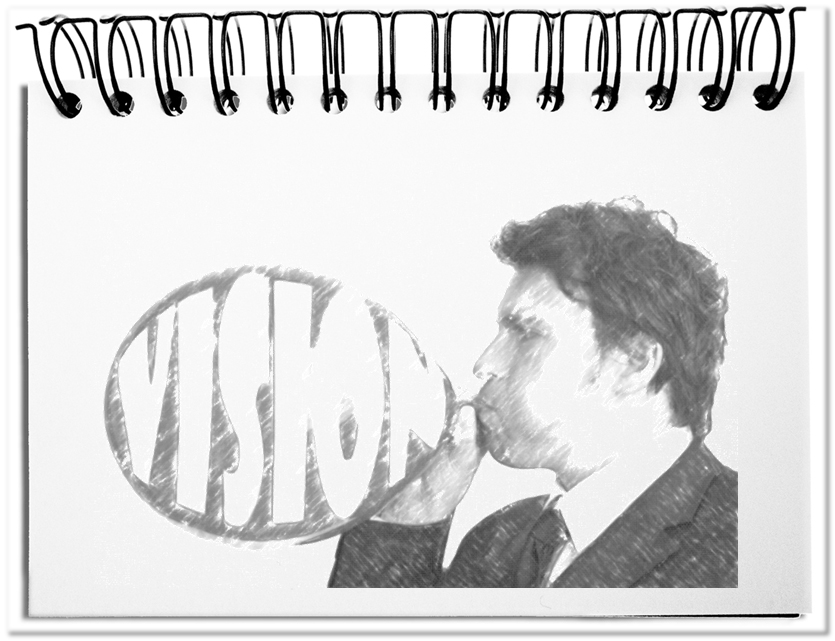
How do they load words with meaning?

  • Assuming falsified intentions
    The direct way to a new meaning is to allege directly that the original speakers or writers have certain intentions. Based on this you quote examples that create the prepared framework, the deliberate manipulation. Whatever was originally said is gone. Example: With the statement „The author wanted to tell us that …“ the commentator defines a new meaning. You should especially look for these assertions, because they could indicate a distortion of meaning.
  • Shifting the context
    Less obvious is the shift of the context. By attributing statements to a particular group or by placing them in a historical context, new possibilities of interpretation arise. Since words are in a constant state of change, one can find a negatively charged time in history. The content receives thereby a new conceptual basis, which falsifies the original statements. Shift of context creates a new meaning. Example: The statement „We are the people“ in the context of the year 1989 produces in Germany a different meaning than related to 2014. It is helpful to be aware of the context!
  • Reinterpreting with ambiguous synonyms
    Words are often ambiguous – e.g. the step through the break of the wall gave him a break for eating a break. Content can be directed in a particular direction by using appropriate synonyms, which in turn have a wide field of interpretation. This can be done with several words simultaneously or successively. Example: The statement „Through transparency of the expectations you have more advantages“ is distorted by using other words „With a clear view on the needs you expand your profits.“ The word choice should always be questioned.
  • Covertly contradict
    It is tricky not to pronounce an interpretation concretely but to contradict socratically with another interpretation. This implies a new meaning, without making it explicit. For example, “Honesty is the foundation for communication” might be contradicted by saying, „The own attitude should never create a disadvantage in mutual interaction.” It is clever not to get distracted by contradiction from what is really objected to.
  • Judging titles
    The assumed impartiality of news reinforces statements by emphasizing individual aspects. Thus, a title prepares the readers for the objective news content. Unfortunately, the unbiased information gets quickly lost. Example: The following title “Violence against journalists at Pegida demonstration” focusses on the demonstrators, whereas „Dozens of arrests at demonstrations in Moscow“ is used to target the police. A look at the involved parties as well as the preferred or accused side is always beneficial.

Bottom line: At the end of the day it is not possible to know what someone originally meant. This makes all comments on articles of others above all an expression of the interpreter. Nevertheless, the impression is created that there is a certain, correct interpretation. In this case allegations, context shifts, reinterpretations with ambiguous synonyms, hidden contradictions of facts and judging titles occur. That way third parties, commentators and critics, charge every message of other people with meaning that does not necessarily correspond to the original intention. Be aware!
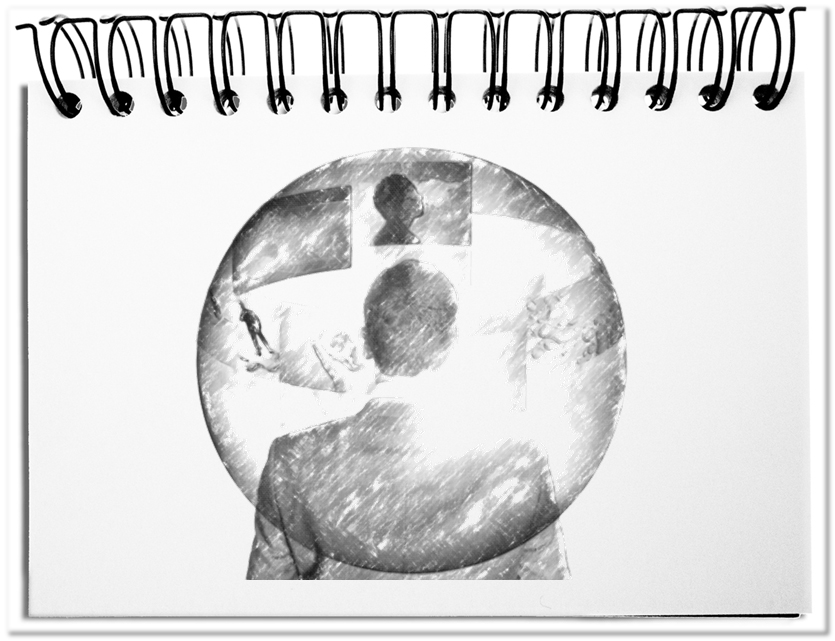
Beyond the informational bubble

If Socrates would have already known the term, one of his famous sayings would have been going like this – “I know that I know nothing outside of my informational bubble.” The fact that we cannot know what we do not know, is an uncomfortable situation. Since Gutenberg the availability of information has grown immeasurably by the mass media. Today we arrived in the Internet, where everybody can reach everybody, as long as they are found. In this complex world it is natural that the web pages are linked with like-minded ones – creationists link to creationists; supporters of the theory of evolution link to supporters of the theory of evolution. What constitutes these spheres? How can you get beyond the informational bubble?

The informational bubble is for example defined by the following aspects.

  • Consistency
    The cohesion in an informational bubble results from a consistent correlation. The individual components repeat and complement each other or even built on each other. In any case they never contradict themselves. For this purpose the necessary logic must be as simple and understandable as possible.
  • Language
    The consistency is guaranteed by a common language. The contributions always repeat a similar pattern. This leads over time to a High Context culture, which is only understandable from the outside and/or is interpreted in the wrong way. Informational bubbles subsist on their technical jargon.
  • Dogmatism
    Informational bubbles have to resist the tendency of influencing their consistency and their jargon. Different world views are as early as possible nipped by all means in the bud and are actively ignored. Repeating the contents through re-use is rewarded. Failure is defamed immediately, mostly as lack of knowledge or as lie or as fake news.
  • Internal linking
    An important function is the use of cross references within the own informational bubble. In the interest of consistency the link to opposite or other opinions is forbidden. Thus, a closed explanation system evolves that lacks openness and a discourse with other topics.
  • Filter
    The Internet insinuates complete accessibility. Therefore the net providers and the social platforms have the possibility to insert and in the meantime even the obligation to filter at any time. These filters prevent the visibility of certain web pages. Particularly countries and enterprises, which believe that they have to exercise control, can fade out undesired contents with simple measures and without being recognized immediately.

There is actually no way out of the bubble, except you have a look beyond your own nose. Additionally it needs:

  • Neutral search engines
    As long as there are overarching search engines, which can look into all informational bubbles, there is a large probability that you can look out of your own informational bubble. The problem is that one does not have any objective way of recognizing filtered contents except you get hints from other media or by word of mouth. You never know, what you don’t know.
  • General rules for filters
    In the best interest of maximum openness, rules for an open Internet should be defined. They should regulate technical blocking, the elimination of search results, the deactivation of web pages and self-censorship. In principle there are cases, in which filters are justified – pedophilia, terrorism, or the like. Unfortunately there is still no generally accepted interpretation, which web pages are to be filtered and which not.
  • Mutual tolerance
    The acceptance and connivance of other opinions is an approach, which is available for everybody, but for understandable reasons is not applied. The discussion of contrary positions would guarantee that the own approach gets more stable. Only with the appropriate tolerance, discourses become possible.

Bottom line: The informational bubble is a natural phenomenon. The common language, the necessity of consistent contents, the inherent convictions, consistent cross references and filters create an integrated approach. With neutral search engines, general rules for filters and common tolerance you can get beyond the informational bubble.