
Archiv der Kategorie: English

Election Grab Bag

Every day we choose our preferred alternatives out of the flood of possibilities. It starts when we wake up and decide to jump out of bed or stay in bed for another five minutes. In the day, we choose from many private and commercial offers, the ones we prefer. As long as we can afford them, we have no problem. Now let’s imagine that we buy a new jacket. When paying we find out that we get a completely different one. Upon inquiry, the person behind the register explains that the colleagues have agreed to give us a different one. What’s going on here?
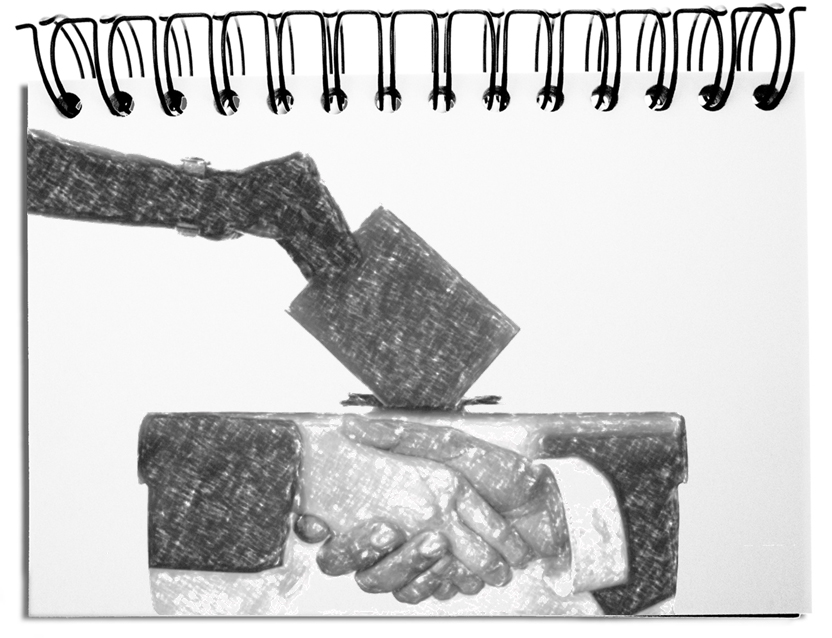
An election should always be free of influences, observations, and inequality. If this is not the case, this act becomes a farce. The same applies to democratic elections. At least two alternatives are required for a ballot. That way is how people and parties are selected to represent the electorate in certain offices. The fragmented opinions leads in Germany to an increasing number of parties. It results in a majority not being capable of governing – unlike in the USA, where are only two parties choose. Consequently, coalitions capable of reigning are formed AFTER the election – regardless of the voters‘ verdict.

  • Coalitions as late as AFTER the election
    Parties are elected. They promise their election program beforehand, which would be fulfilled at best if they would get the majority. The major parties in Germany only have enough for 20 to 30%. To offer the voter the alternatives for the election, the coalitions with their compromises would also have to stand for election. Only then would voters be sure that they would be involved in the politics of the following four years.
  • The final agreements
    Since the coalition agreement is negotiated afterward, voters cast their ballots for a grab bag. It is true that the partners in a coalition bring their programs to the negotiations and draw up a contract that lasts for the duration of the legislature. However, shortened compromises are agreed. They release the elected people from the promises made before the election. The electorate can act on them not until four years later unless they get again blinded by new promises. Additional agreements are negotiated tit-for-tat during the legislative session. After the election, the electorate no longer influences the parties. For the duration, they become independent in the style of classical sovereigns.
  • Big coalition – minor opposition
    The more percentages a coalition gathers behind itself, the more freedom it has. As soon as it brings more than three-quarters of the votes together, the result is that debates no longer take place in parliament but only within the government. In the big coalition, the alliance of the two largest parties was already sufficient to undermine parliament. This parallel society has the power because the parliamentary regulations no longer work. Parliament is not anymore part of the struggle for solutions.
  • Line whip replaces responsibility to the electorate
    Despite the principle of the free mandate that binds members of parliament only to their conscience, the members of a party follow the guidelines of their executive committee. Although voters select their representatives according to their attitudes, these qualities are lost in parliament. The line whip demands from the deputies to subordinate themselves to the party policy of the executive committee.

Bottom line: Politicians like to draw our attention to the „threatening“ influences of the internet, the „fringe“ parties, and the apparent problems in society – such as economic development, wind turbines, immigration, compulsory vaccinations, and masks. That way, they distract from the real issues with democracy. The electorate no longer has control over their parliaments. The parliamentarians pursue their agendas:

1) to get elected; 2) to implement party policies; 3) to serve their stakeholders.

An election thus becomes a grab bag. Only after the votes are counted, the governing coalitions are negotiated behind closed doors without the electorate. The electorate lacks the alternatives because the coalition programs have not even been negotiated before the election. In addition, the binding agreements become the maximum program for the government – no more. With a majority, the coalition can govern without considering the needs of the entire parliament. Decisions are negotiated within the coalition. In addition, the hidden factional coercion leads to the release of any responsibility of the delegates. Power is assumed by party executives and their representatives in negotiated ministries. The people’s representatives have thus found ways to govern, regardless of the will of the voters. With today’s sizes of parties, an election in Germany becomes a grab bag, the contents of which only become visible after the election is over and coalitions have been found and negotiated.

You are what you is

In Germany, around 2.23 million solo self-employed people work without dependent employees. They take care of all biz components and develop, among other things

  • the business idea,
  • the capabilities, offerings, and activities,
  • an overview of the required funds,
  • a description of the customer groups and sales channels,
  • the pricing for the assortment offered,
  • the business plan for the next five years, and
  • open a chargeable bank account,
  • invent a name and a logo,
  • obtain the official permits and insurances,
  • register a trade or other legal form,
  • conclude contracts with payment service providers and
  • prepare a legally compliant bid and invoice forms as well as the accounting.

Solo self-employed people have to work it all out by themselves before the first invoice can be written, unless they either have supporters who volunteer to help or use existing savings to pay for external support.

Starting your company is like taking off an airplane. It needs a long runway with a good take-off run until there is enough lift to take off and get to flight altitude. A company needs revenues, which only occur when possible customers are aware of the offer. This requires offers that are ready for use, good relationships, and meaningful KPI’s.

Ready to use products and/or services

The offers must be in a condition that they can be performed the next day. What does this mean? A baker wants to sell healthy mini-baked goods. To do this, she needs recipes for mini pretzels and croissants, organic suppliers, and a bakery line tailored to small products that she can handle on her own.

An idea is not enough to be marketable. This applies not only to manufacturing industries (e.g., procurement, production, distribution and disposal logistics, production, energy, process engineering) but also to people-related (e.g., consultants, therapists, coaches, trainers, social workers, nursing attendances) and fact-related (e.g., dry cleaners, banks, insurance companies, ICT, advertising) attendances.

Without the prepared offers, one or maybe two projects can be improvised during the start-up phase. But in the long run, this approach is dangerous because it is difficult for solo self-employed to get out of this treadmill. Moreover, although the first sales can be realized, the continuous improvisations damage the quality of the offer, lead to permanent overload and prevent reliable long-term utilization.

Good relationships
In the past, providers could meet in a marketplace and offer their deliverables for sale. This increased the likelihood of being noticed by possible clients. Even today, the clientele meet at the weekly market for fruit, vegetables, and eggs.

It is a good idea to start with existing contacts and relationships. For this purpose, the target groups should be classified according to interests, potential turnover, and other vital factors. The existing network can be graded here. By marking deciders and opinion leaders, a prioritization of possible customers is created, with whom the idea can be discussed or even offered at an early stage. It should be clarified who can best be addressed with which approach. By involving this clientele at an early stage, a favorable climate for offers and negotiations is created and may even make it possible to immunize them against offers from competitors.

There is no revenue without customers.

Important:
Customers are those,
who need the offer,
have sufficient budget AND
are willing to pay for it.

In the medium term, the first contacts generate new prospects through word-of-mouth and other publicity measures. Then, with mutual exchange and the offer’s visibility, more and more possible buyers (leads) exist to achieve the entrepreneurial goals.

Focused marketing
Once a publicly accessible PoS is established, flags can be raised with one’s logo and offerings, informational materials can be displayed, giveaways can be spread, and so on. However, if particular deliverables of any kind are offered that do not fit into a traditional marketplace (something solo self-employed people should consider), effective advertising measures are inevitable.

This is the approach taken by legions of providers who, in the absence of capacities of the solo self-employed people, want to assist in drafting, designing, and publishing. The keywords at the end of this article (see below: Supplement) give an impression of the number of topics. With all the pressure to generate sales as quickly as possible, do not get carried away with overelaborated promotional activities and the development of unrealistic external presentations. Focused marketing needs the following minimum kit, which must be created decisively by the entrepreneur:

  • a name that fits the personality and the business,
  • an overview with the offers (products and/or services),
  • a one-minute elevator pitch (statements to arouse curiosity with exciting slogans, outlining the proposal, showing customer benefits, examples, suggesting the next step through a call-to-action),
  • a presentation of the company (including company profile, core competencies, philosophy, history, personal introduction, goals, strengths, certificates, a service portfolio (preferably with prices), project examples, customer statements, data protection, contact and further info)
  • a flyer that further details the elevator pitch and provides incentives for customers to come forward; and
  • a first landing page on the Internet derived from the above points, which can be developed by oneself with the help of appropriate templates.

There should be no hesitation about getting inspired by established companies, but without trying to do the same. The big players have exceptional employees and an extensive budget that is not available to a start-up. When formulating a proposal, avoid platitudes such as best quality, less time, or lowest price. It is more critical to elaborate on what makes the bidder stands out: e.g., exceptional expertise, unique experience, merciless customer orientation, an agile approach, and precise outcomes.
The following applies to the messages: Less is more. Hubris should be self-critically avoided, and what one can safely master should be made one’s own as well as only be promised, what can be kept.

Bottom line: For all those who start the adventure of becoming solo self-employed, there is no doubt that their own business is the most important enterprise of all times. This self-confidence is essential to overcome the shallows of the first years. To have a chance of survival, the offers should be neatly worked out, existing relationships be used, and marketing be focused on the essential aspects. The litmus test when reading your external presentations is to look in the mirror. If you have not blushed and avoided hubris, you should have managed appropriate messages. In the end, you are what you is – no more, but also NO LESS.

Supplement:

Keywords for unfocused marketing

Working out the following aspects in their entirety goes far beyond what is required.

  • Marketing Strategies:
    Direct marketing, Networking, Influencer marketing, Referral marketing, Event marketing, Guerrilla marketing, Content marketing, Event marketing, Telemarketing, Email marketing, Social media marketing
  • Marketing plan:
    Market analysis; marketing mix (product, place, promotion, price); marketing objectives; key performance indicators (lead conversion rate, traffic conversion rate, cost per lead, cost per customer); marketing concept; Corporate Identity; marketing controlling
  • Promotional materials:
    Postcards, flyers, folders, presentation folders, long format postcards, door hangers, business cards, labels and stickers, stamps & ink pads, notebooks, magnets, paper bags, product tags, gift certificates, websites
  • Publications:
    Annual report, image brochure, customer magazine, newspaper, blogs, television, daily newspaper, display papers, online/mobile, outdoor advertising, trade magazines, radio, weekly/Sunday newspaper, movie theater, newspaper supplement
  • Events:
    Open houses, plant tours/tours, panel discussions, meetings, trade shows, trade show booths, webinars
  • Press:
    Releases, conferences, interviews, tweets, background interviews, editorial visits, videos, podcasts
  • Sponsoring
  • Online:
    Website; online advertising (banner, affiliate, email, keyword advertising, …); search engine optimization (SEO); landing page; lead management.