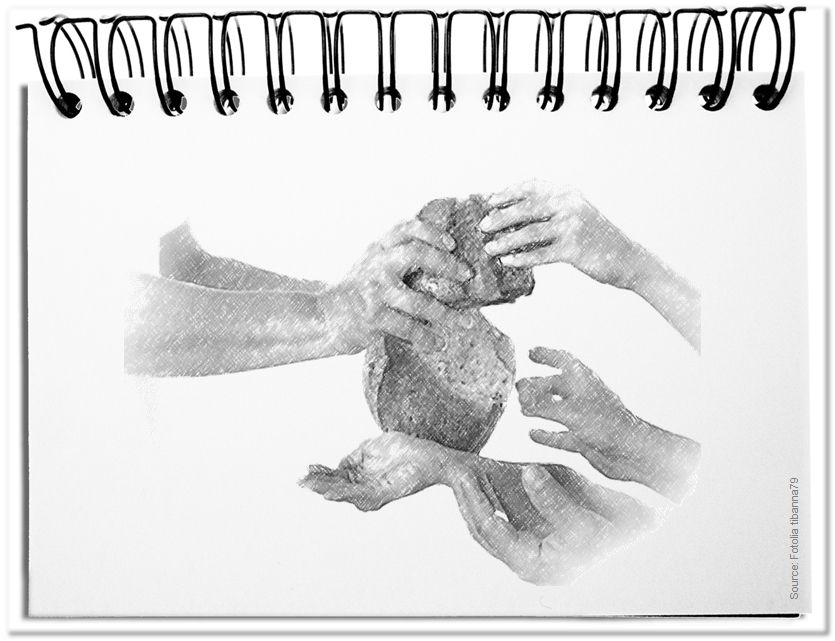
Sharing means to give or lend something that belongs to you, completely or partly to others. Perishables that could not be consumed will be used (e.g., goods with expiration date). Thereby, consumer durables are better utilized (e.g. Car sharing). Immaterial goods, like knowledge, increase the value and the spreading through additional use. Important conditions for sharing are owners, who are ready to put their property at somebodies disposal. Sharing with others – is this actually allowed?
In principle, the owners of goods should have the right to dispose freely their belongings. Nevertheless, there are also always obligations attached to the possession.
- Food may not be shared in Germany, if it has a consumption date „Use by … “ as well as e.g. raw fish, minced meat, raw egg dishes for which a constant cooling chain is not provable (in German only: http://foodsharing.de/lebensmittelrecht). Food with the label „Best used before …“ on it can also be shared after expiration of the best-before date..
- Consumer durables are e.g. cars, bicycles, apartments and devices of all kind. For some goods, however, there are legal aspects that exclude sharing. The car has an insurance that is tied to specific drivers or excludes commercial usage. This is also valid, if one shares his/her rented flat with others, without permission to sublease. For all goods, it remains also the question of liability, if, for example, the brakes of the vehicle do not work.
- Since there is knowledge, it is shared, e.g. the newspaper or the book, that are passed from one to the other or the newest hit of lady Gaga. As long as it is a physical object, sharing should be without any problem. As soon as, however‚ contents are ‘only’ shared by being copied, we are already confronted with copyright questions. Not to forget the secret documents, which are shared with the public by Whistleblowers. Additionally, this includes business documents that are shared with acquaintance.
- A popular form is to share work. Immediately the question of moonlighting as well as the liability and/or compensation of damages comes up. If somebody is injured, or somebody is dying, or there is a material damage in the course of such a sharing, these incidents are normally not covered by private insurances.
Nothing is more blessed, than giving. Some questions are valid for all forms of sharing.
- Can sharing have a price?
- May shared food or the use of a car or lending books or concreting the cellar cost money?
- How to look at this cash flow from fiscal point of view (keyword: financial advantage)?
- Does a new niche emerges, in which new business models go around existing bureaucratic rules as well as the rights and obligations of the established businesses?
If we go again toward market and bartering, the legal framework should protect givers and takers equally.
Bottom line: At all times existed the social sharing. This is where the positive look at this optimized use of resources comes from. We need an appropriate legal framework, in order not to criminalize the sharers, the givers and the takers, with this new form of social exchange.