
Archiv der Kategorie: English

The Native Language Effect

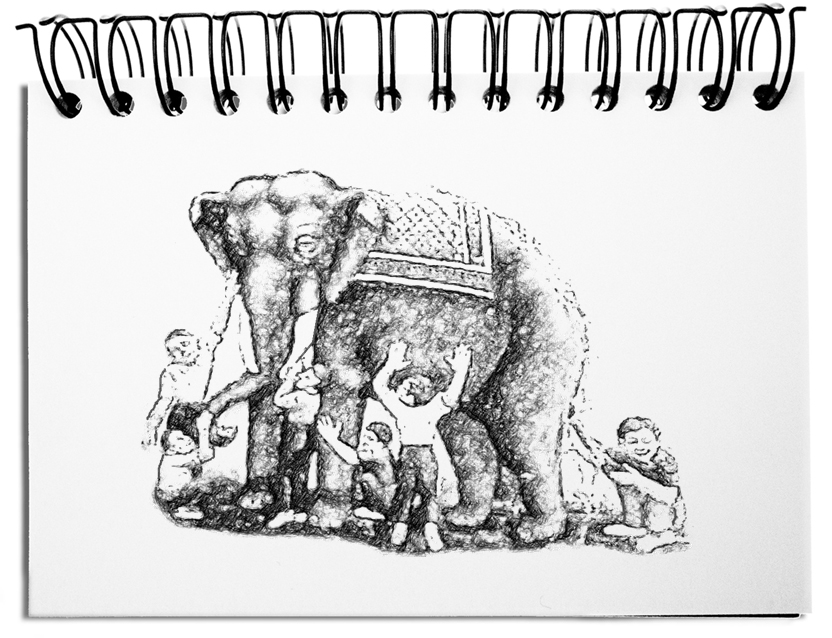
Imagine that six blind Indians encounter regularly an elephant. By coincidence, they always stand at the same place besides this huge mammal. Because they are lacking the overall view, each of them is developing his personal idea of this giant. If you tell the Indians that it is an elephant, they respectively imagine a fan, a snake, a spear, a trunk of a tree, a wall or a rope. Independently of their future conception of an elephant, they will always remember their first mental picture. That is the aftereffect of the first impression, the native language effect.
BlindMonks

What crosses one’s mind when considering a telephone? A hand crank? A rotary dial? Push buttons? A touch screen? Depending on your first experiences with telephones, you might remember one of the previous alternatives.  According to this, a cordless telephone could be self-evident or not for you.

Remember the clash of cultures between the user groups of Apple and Microsoft. The other system will always appear to be strange, not ergonomic and not intuitive. Despite al this, no matter what system you are using, you have to know the context sensitive commands, in order to be able to operate the system.

It is always the first contact with something that will stick in somebodies mind. The evaluation of new things is affected by it in the long run. For this reason, this aspect should always be part of the implementation of novelties.

Bottom line: It is an advantage to consider the native language effect in the designing of your businesses and deliverables. Thus, it will be easier for the involved people to assume and to use new things.

The personal dilemma of transparency

It is amazing, how easy legal and moral requirements for the handling of critical information come into conflict. The copyright forbids the commercial re-use of images, quotations and the like without the agreement of the author. In addition, the contract law that obligates to secrecy forbids the dissemination of internal information. At the same time, responsible citizens should reveal abuse relentlessly. Are we today in a dilemma concerning our rights and duties in the handling of information?

Undercover

When we look more closely, we find the following groups of persons, who are occupied professionally or for other reasons with such contents.

  • The commercial ‘information brokers’, who earn fully responsible their money with spying, are called detectives, spies, undercover agents and scouts.
  • The persons, who hand over facts mostly unconsciously, are the leaks, by which secrets arrive inadvertently at the public.
  • The groups of informer, who report and/or denounce individuals or organizations to the government or responsible authorities.
  • The unveiler, who publishes data, uncovers defects or releases an alarm, is called whistle-blower.
  • The slanderers or agitator delivers wrong allusions among the people.

Are the laws indiscriminately valid for these groups? What are the differences? Do laws and/or social expectations exist that contradict each other? Is the spy above the law of a country? Does the social responsibility of a whistle-blower weigh more than work contract that binds to secrecy? Is it actually legal to agree illegal behavior in a work contract?

After more than seventy years, everybody agrees that the civilian disobedience in the third realm was civil duty. Do we have to wait another seventy years, until the current cases of unauthorized disclosure of secrets are valued in the same way?

Bottom line: Provide measures in your governance, so that the employees can report internally about abuse, potential violations of the law and inadequate behavior, without risking sanctions. At the same time make it clear, which are consequences of sharing of secrets.