
Facts become conveyable through language, signs and numbers. The oldest signs were painted on the walls of Stone Age caves forty thousand years ago. We cannot determine to what extent the meaning of those days has survived in our cultural memory. Due to the lack of reference books, the meaning of ancient signs (e.g. an upside-down triangle s) remains incomprehensible to us, even though graffiti is a tangible fact that everyone can see. Nowadays, the sign has various interpretations depending on the subject area: in alchemy it represents water; in meteorology it represents rain; for hobos it indicates that too many people have already been there and there is nothing left to get; in mathematics it symbolizes the Nabla operator; in street traffic it represents give priority; in the broadest sense it also stands for femininity. What gives us the certainty that nowadays facts have only one meaning – for example, if the temperature increase of the last thirty years is not perceived as threatening? Are words and numbers more meaningful than simple signs – for example, when we meet at the bank? And if there is no universal meaning, what does that make of the conjured facts – alternative facts?
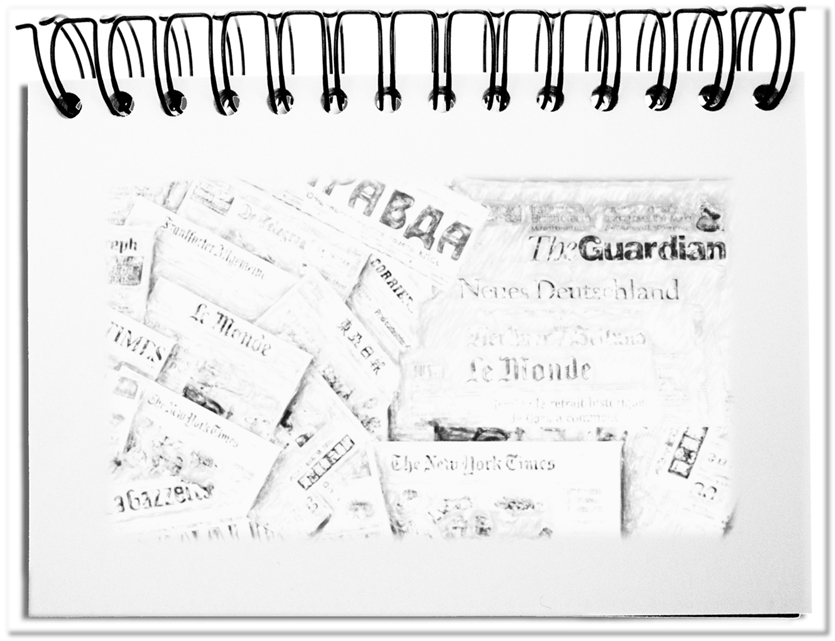
When looking at the production of facts, many influencing factors become apparent which can lead to a distortion of meaning.
- The perspectives on the facts
Your own location determines the look at circumstances. You can view the situation at eye level, from a bird’s or frog’s eye view. The angle becomes narrower and loses sight of the whole as soon as you get closer to details. The range of vision expands and lets subtleties disappear when you get an overview. The time perspectives also convey different views. In retrospect, the number of facts and findings are more comprehensive and conclusive as if only currently available sources are used – not to mention when premonitions about the future are formulated.
These few examples and the different positions of the viewers should make clear to everyone that the accumulated data will always be different. Despite several reliable sources and the examination of the statements in fact-checks, it is never possible to reach a sufficiently reliable conclusion as to whether or not a false report has been made. This means that somebody who doesn’t like the news can simply declare them fake news. - The hunter-gatherer of facts
The collection of facts is influenced by the character of the reporter. Different experiences, abilities and convictions filter their perception. This is mainly due to the fact that observers of a situation can only notice things that they already know or can be put into words and images. This results in an unconscious selection of documents, which in turn creates a tendentious picture. As long as others report in a same way, it seems to be factual, although the amount of similar statements does not allow any conclusions, whether the reports are true.
The observers’ world view unintentionally acts as a filter for the data accrued. This is how the technician prefers to see plants, machines and other technical matters. The philanthropist observes the people in their environment. And both will provide facts about the situation, which lead to different conclusions. - The interest-driven facts
The impact of hunters and gatherers is intensified, if only those facts are consciously collected, which confirm their own world view. This usually happens with ideologically biased reporters – whether they are left, right or centered. As an extreme example, we look at the conspiracy theorists who provide spectacular news in the otherwise pale information jungle. A well-known example is the allegedly faked moon landing, which was staged only to win the race to the moon or to distract from the Vietnam War.
These kinds of facts arise in all subject areas: Politics, science, economy etc. Here, overarching interests determine which news get into the media. A crude, albeit effective, attempt to twist facts is the prophylactic contradiction that tries to fend off a foreseeable accusation by accusing in advance opponents of spreading fake news. Whoever screams loudest wins the sympathy of the masses, although they suffer at the end a disadvantage – a good example is the propaganda of the screaming Brexiteers, who only bring disadvantages to Britain’s. - The quality of the facts
In the end, facts are data that have a certain quality. In addition to showing the respective perspective and the origin of the observers, there are quality criteria that should be fulfilled: comprehensibility, correctness, completeness, coherence, topicality, etc. There is often room for interpretation: for example, the degree of freedom of elections or the assessment of assassinations by state bodies. The correctness of a statement should be critically questioned (especially, if serious contradictions arise). The completeness of a message is difficult to detect (for example, if different views are not reported). Inconsistencies are easier to spot because the audience can find them (if one thing is reported on one day and something contrary on the other). It is also increasingly easier to check the up-to-dateness (for example, if old images are used in a new context or obviously are manipulated).
It has become common practice to pretend that the news quality can be checked by carrying out factual checks later. However, since they are based on the criteria used so far, they only provide confirmation of an interest-driven view.
Bottom line: Actually, we seem to have no more opportunities to get closer to reality. As a result, we move within our own filter bubble, which repeatedly confirms our own convictions. However, this article is intended to show that alternative facts are the very nature of things. The struggle for the one truth is pointless, since there is no such state. For this reason, we must be more sensitive to this objectivity and consciously deal with the available news. As soon as a report is filled with emotional statements (e.g. stigma words) and a corresponding intonation, all warning lights should go on (see e.g. this German television report). If this stops the faithful onward surge of lemmings, which blindly trust the demagogues and they no longer thoughtlessly follow the populists, then it would have been worthwhile to look at the inevitably alternative facts.
