
Schlagwort-Archiv: Roles

What constitutes a platform

New business models become reality, due to the saturation of the economy with computers and networks. Uber, AirBnB, Alibaba, Youtube and many more have created platforms, where service providers can meet and agree with interested people. These services poach, up to now, in the traditional business fields of taxi companies, hotels, department stores and media corporations. Typically, these platforms do not feel in competition with traditional providers. No drivers are hired, no hotels are operated, no goods are moved and no content is generated. In fact, they are not subject of existing regulations, which, for example, taxi drivers have to meet: a clearance certificate free of traffic offenses and other criminal acts, a medical certificate, the technical standards of the vehicles, the provisions of the passenger transportation law. In this sense, today’s platform providers are not commercial service providers in the above sense, but they are simply offering a place, where the providers and users can get together. What constitutes such a platform?
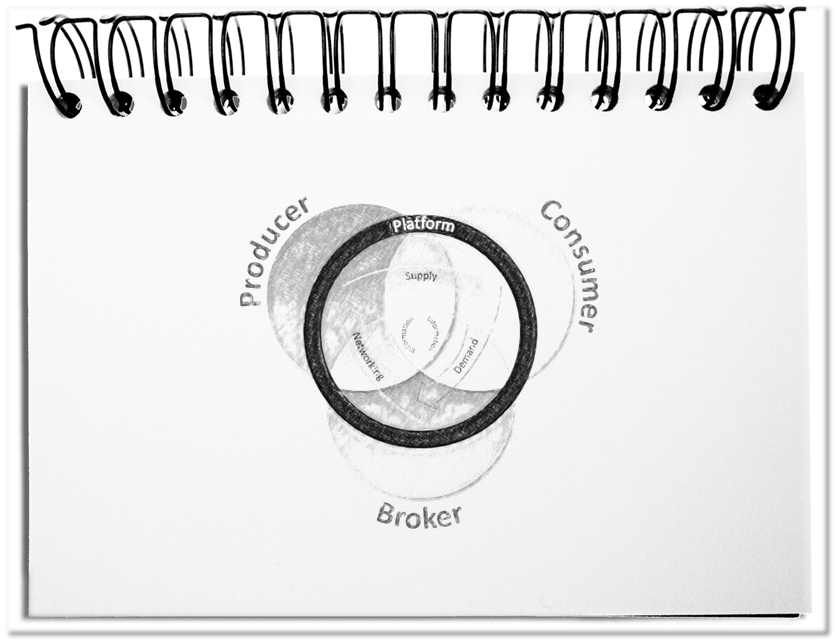
In the first step, we look at various building blocks, which form together the platform.

  • Protagonists (roles)
    A platform connects three groups of people. 1) The producers, who offer certain products respectively services. 2) Consumers, who are looking for these products and services. 3) The brokers, who connect producers and consumers and operate for this purpose a platform.
  • Added value for the protagonists
    The unique selling proposition of a platform, the USP, is the added value that the providers and buyers of the services as well as the intermediaries draw from the platform. A common interest may be the business sector (e.g. passenger transportation, accommodation, consulting and coaching services for companies). The producers have direct access to individual consumers. They find similar services bundled under one umbrella. The mediators benefit from the network that evolves over time.
  • Marketplace (Point of Sales)
    Services become visible, comparable and accessible on one platform. For this purpose stands are built, just as in a marketplace, in which the providers present their deliverables. The platform operators have the task to prepare the marketplace in such a way that allows the providers to present themselves in an easy way and that provides the buyers at one place the desired deliverables. This includes measures that ensure the reliability of the providers, make the offers comparable, enable the exchange of information and even ensure trustworthy payment transactions.
  • Information hub
    A platform lives on the available content. These are e-books, brochures, white papers that are ultimately provided by all protagonists. In addition, information brokers can place here payable content. The appeal of the platform increases eventually through appropriate interaction functions: forums, surveys and the like.

Bottom line: The platform is the basis for many new business models and at the same time the hub for a wide variety of business areas. Producers, consumers and brokers exchange their contributions under one umbrella. Like traditional market places, every participant can meet its needs here: offering and buying services and exchanging information. The variety of possible uses and the satisfaction of the interests of all protagonists constitute the platform.
You must be able to afford decentralized bureaucracy

As soon as you give Mr. Hammer a hammer, everything looks like a nail. This curse began with the division of labor. This creates in parallel Screwdrivers, Sawyers, Grinders, Painters, Welders, and Gluers etc. Everybody is brim-fill of energy and designs the environment depending on its specialty. In a similar way, administrative or better bureaucratic functions evolve in the enterprises and the public administration. All undertake dedicated their tasks and produce one administrative act after the other. How can you stop this fate?

Komplexes Netz

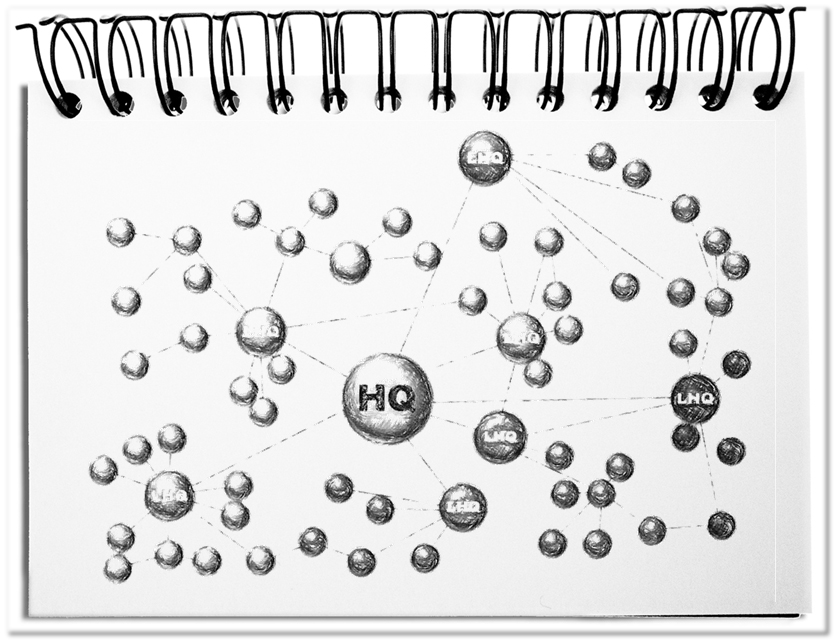
Let us consider as an example a group company that has its headquarters somewhere in the world. In different regions are local headquarters that have a similar structure and tasks. The Headquarter (HQ) controls the local headquarters (LHQ) that control the locations. All have staff positions that develop eagerly strategies, target values and guidelines – everyone, of course, for its area of responsibility. The result is a flood of regulations that develops redundantly, overlaps and often contradicts. Due to ever more hierarchical levels, this effect multiplies.

The following measures might defuse this development.

  1. Clear, non-overlapping distribution of tasks, authorities and responsibilities
    Everyadministration gets an aligned bundle of tasks, clear authorities and obligations. This avoids duplication of work, creates fewer regulations and a smaller variety of interpretations. The related units streamline themselves.
  2. Bundling of roles at the highest level
    The higher regulations are positioned in the hierarchy, the more uniform and the more economical become the results. This is particularly valid for basic guidelines, like e.g. the reporting system, performance reviews, or travel guidelines.
  3. Defined escalation and decision procedures
    Most of the friction losses result from unclear or competitive decisions. The clear, for all available descriptions of the decision levels, procedures and related committees enables all to obey the official channels.
  4. Defined reprisals in case of infringement
    Rules that are not connected with painful punishments, defuse the requirements. An understandable catalogue of implications for offenses increases the probability of compliance.

Bottom line: In each organization, no matter how large or distributed around the world, bureaucratization can be reduced by re-organizing the competencies. For this purpose redundancy-free roles are needed that are as high as possible established, with clear official channels and are provided with valid sanctions.

P.S.: The example of the European Union shows the same tendency. As long as the European Union can afford the luxury of national right in competition to the European right, enormous amounts of tax funds are wasted on unnecessary administration – quite apart from the bureaucratic hurdles between the 28 member states. The non-overlapping distribution of tasks, the establishment of the regulating agencies on the highest level, clear official channels for each European Union-citizen and for all a binding, uniform juridical system would make bureaucratic operational sequences easier. The bundling of national tasks within the European Union could save ten percent of the national bureaucracies.