Corona has made the public aware of the economy’s dependence on uninterrupted supply chains. In the current state of globalization, deliverables are coming from where they are cheapest. Manufacturing and distribution require complex supply routes – for raw materials, components, end products, and even services. As with all networks, the „last mile“ is the hardest part, often outsourced to external logistics partners, such as DHL, Hermes, UPS, DPD, GLS, FedEx/TNT, and, if necessary, small biz. B2C, in particular, depends on the delivery networks, literally every household.
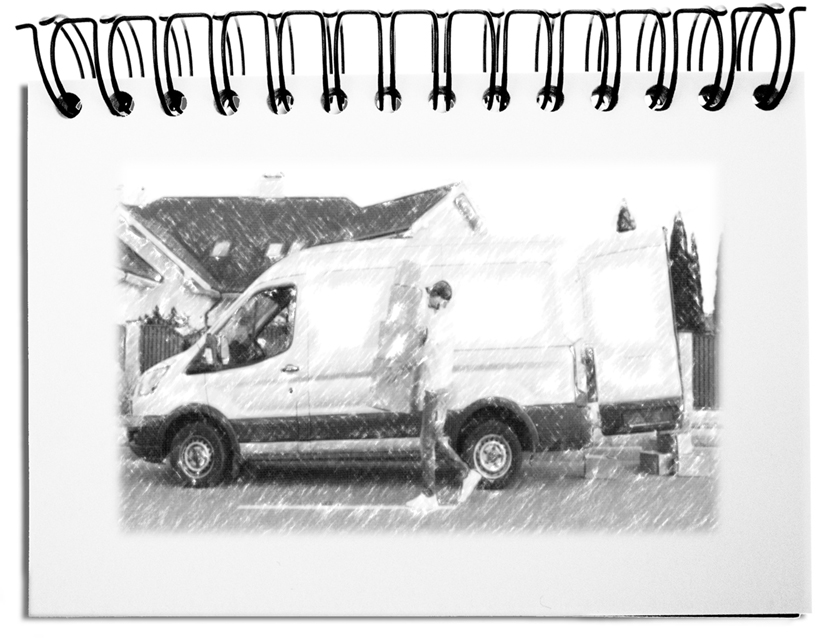
In 2020, each home in Germany received an average of 63 shipments. It means more than one delivery per week. Every shipment must be taken manually by a logistics partner on the „last meters“ and carried more or less far. The delivery companies work with their hubs from where they drive with their vehicles within the day to the addressees. Increasingly, drivers are skipping time-consuming stations. Can it go on like this?
- Too many
The distribution of shipments among several logistics partners is inconvenient for the shippers and the recipients. Each company has its approach to steer drivers, vehicles, procedures, and delivery points in the best possible way. As a result, many vehicles deliver to one customer per day. Each driver has its way of leaving packages and documenting acceptance – drivers are not afraid to sign on behalf of the customer or fill their systems with false status messages. Digitization indeed creates timely transparency. Still, misuse by drivers destroys this advantage (example message: Unfortunately, acceptance of your parcel has been refused. Therefore, your package will be returned to the sender.). - Automated non-contact
The quickest way to resolve a problem is for the addressees to contact the deliverer quickly. The assumption that recipients could contact the deliverer with just one click is one of the urban legends of the Internet age. Although providers offer online forms and a well-hidden telephone number to enable contact. All the customer gets is a well-worded standard message sent immediately to confirm receipt. However, it is automated feedback without any human participation. The spam folder in which the requests disappear cannot be traced. A phone call does not help either. Modern telephone systems provide lengthy verbal menus that need to be answered, only to end up waiting on hold until an employee picks and immediately hangs up. The whole thing now starts all over again. Remarkable is in this context DPD, who announces the upcoming waiting times every few minutes – 5 minutes in the beginning, then 14 minutes, then 1 minute, then 11 minutes, and so on. The end of the story is that the installed touchpoints are no longer contact points, but walls keep the customer away. - Inappropriate infrastructure
Undoubtedly, it is an advantage for the consumer society that people can order goods conveniently, from their sofa, and receive them in principle at the front door. ONE logistics partner would be much more sustainable – fewer appointments, less congestion, fewer differences, and more reliable delivery. As long as the recipients live in the countryside and have sufficient parking spaces in front of the house, stopping should not be critical – as long as it is delivered at all to the last, uneconomic corner. The risks and walking distances increase dramatically in inner cities since drivers are now consistently penalized for stopping in bike lanes or second row parking. It is even worse in traffic-congested centers. Since drivers have to distribute a lot of parcels in a very short time to get to their hourly wage, it can quickly happen that drivers simply do not deliver to complicated addresses because their standard run is jeopardized. Drivers‘ inhibitions are already so low that in complex cases, they decide not to deliver – „I don’t have time to deliver there.“ - Precarious employment
Delivery companies have few alternatives to spare money – first with salaries and then with vehicles. Permanent employees with a reasonable minimum wage are the most expensive way to provide a delivery network. Salaries range from up to 22% more than average, to even 10% less than the average (which explains why some parcels do not arrive reliably). The most favorable alternative for the parcel, express, and courier services is self-employed small biz owners. Here, the delivery companies benefit from the self-exploitation of the individual entrepreneurs. As a result, the black sheep drivers destroy the reputation of the delivery company at the touchpoint to the customer. With the current remuneration, it is understandable that the drivers take advantage of existing gaps. The dispatched companies support these relationships by placing orders with the cheapest suppliers.
Bottom line: The brave new world of online commerce thrives on the glamour of websites. Easy navigation and ALWAYS the best prices encourage customers to buy. However, the backbone of it all is not the online presentation but the reliable supply chain. With multiple disparate service providers, sealing-off through automated touchpoints, difficult delivery infrastructure, and precarious workforce, this biz model is at risk. The pendulum of online commerce eventually reaches its maximum amplitude. When the pendulum swings back, the local shops will win back customers for lucrative goods. In the meantime, the big companies will follow Amazon’s lead and establish their internal delivery management, making drivers a committed part of the biz. Companies like DPD will disappear in the medium term. The black sheep make the most significant contribution to the impending end of independent logistics partners of drivers who optimize themselves and do not act in the interests of their company.