
Archiv der Kategorie: Communication

Communication consists of perception, thought models and communication behavior.

The contingency of the empty paper

The paper does not care what is put on it. An empty sheet offers the greatest freedom for developing ideas. This tabula rasa is only limited by the edges of the paper. This limit can be offset with a respectively large sheet. But how do you get the best from this unused surface? How do you exploit the contingency of the empty sheet?
Emptypage

In most cases you grab the paper, if you want to set up a plan, arrange your thoughts or because you were ordered to have something to do. The actual solution is missing, which still has to be concretized. The following steps bring you quickly closer to the target.

  1. Start immediately
    The most important factor is to start filling the paper immediately, without delay. Do not waste time to think about how to get started. Do not waste time to search a good formulation. Do not waste time to consider the structure. Simply start immediately.
  2. Use accelerators
    ideally, you have a format at hand that makes you think better. This can be a grid or a mind map, questions (e.g. What? Why? How?) or simply a few words (e.g. the order, or arbitrary terms (e.g. Saobao, blue-yellow, soft-stoned)). These accelerators give the thoughts a first hook, on which you can continue to build.
  3. At first fill
    Suppress the impulse to correct at an early stage! Only until a certain degree of filling is reached, you continue with step 4.
  4. Remove disturbing aspects
    After the flow eases or contradictions emerge that slow you down, the correct moment is reached to revise. Everything that does not fit can now be put into brackets, reformulated or crossed out. Mark the elements in such a way that they are further readable, since they will be probably reanimated.
  5. Restart
    You know best, when is the right moment to begin a new sheet. You transfer valid contents to the new, empty paper. The structure can change, new terms may emerge and particularly appropriate ideas will be solidified. Invalidate the transferred sheet with a line, but do not throw it away. Thus, original flashes of insight will be still reachable. However, the current sheet is easily recognizable.
  6. Destroy
    As soon as a sheet does not contain more required value-add, because all relevant information can be found on the current or on other sheets, it can be ripped-up, crumpled-up, cut, shredded, burned or in any other way be destroyed and disposed. Imagine that the destruction of the paper also releases your mind from these elements.
  7. Final
    The concluding version is held as legible and recognizable as possible. This can be done by an appropriate clean copy or through a computer. You can decide how to deal with the intermediate results. In the sense of a mental garbage disposal, you do not need these papers any longer (see 6).

Bottom line: The editing of ideas by the spontaneous employment of a white sheet of paper creates results that are only limited by oneself. The paper allows everything, if we let it flow. Thus, the empty sheet offers the space for all imaginable, alternative solution.
I do not see anything, …

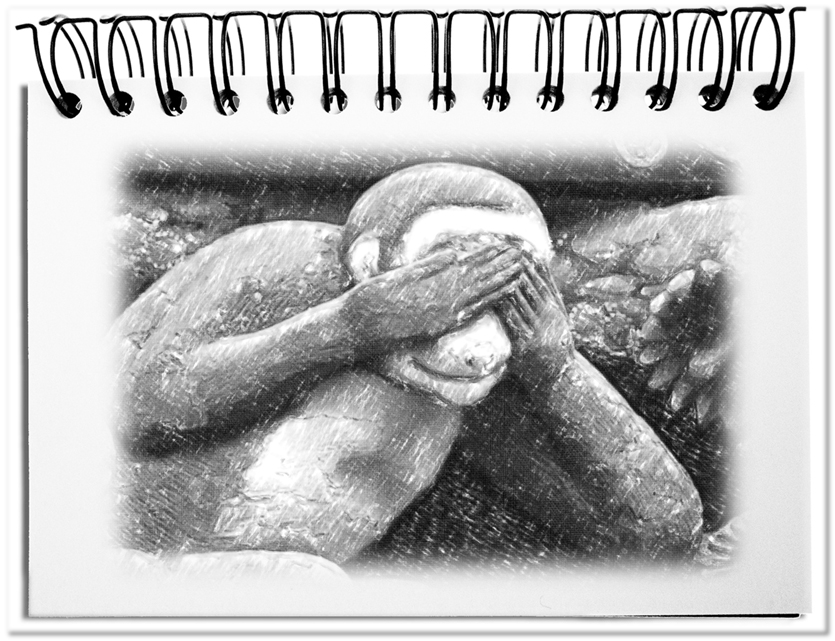
There are many reasons not to notice circumstances. Without the appropriate view to the happening it is asked too much, to observe anything at all. Since this defective vision does not happen deliberately, referring to aspects of the current situation is a crucial pre-requisite, in order to better jointly recognize connections. The right moment for additional descriptions is the statement „I do not see anything, ….“

NikkoNSee

For better understanding, we can look at the reasons for blind spots.

  • … because someone or something interferes my view.
    In front of a wall that has neither door nor window, with best intentions it is not possible to see, what is behind the wall. For better insight there are no other ways than striking a breach into the wall or to look behind it from a higher view point or by smartly walking around the barrier.
  • … because I carry blinkers.
    The own field is the basis for certain findings. However, sometimes your own experience is a bar to see. The internal convictions work like blinkers that do not let through any attractions, which take place outside of the professional field of vision. In such a case it is crucial to irritate people in such a way that they turn their heads into the desired direction and register new points of view.
  • … because I suffer from some sort of visual impairment.
    As long as the view is not sharpened by formative experiences, although you can see the happening, yet you cannot recognize the relationships. This blur leads to false conclusions and thus to an incomplete picture. In this case additional explanations are needed, in order to receive a high-contrast and meaningful picture.
  • … because it is too bright or too dark.
    Favorable lighting conditions are a requirement for a clear view. If one is dazzled by too much information, then this flood outshines the own horizon. If one receives too few inputs, then one stands in the dark and has no visual aid. In such cases the crucial information should be made available in a manageable quantity, in order to have something recognizable
  • … because there is nothing to see.
    If someone does not see anything, this can also be due to the fact that there is nothing to see at all. If empty words and abstract terms are used that do not state anything substantially, there is also nothing to recognize. In this case it is worthwhile to make abstract messages more understandable.
  • … because I may or should not to or because I have to shut my eyes.
    Internal information that is classified as secret has to be treated confidentially. They cannot do anything else than closing their eyes and not speak about it. This does not mean that there is nothing to be seen, but for legal reasons you are forced to keep silent about it.
  • … because I can’t do it.
    There are cases, in which one does not refer to it, since there are no proofs or simply no words to talk about it. An interactive discourse can provide clarity. In these cases for the aspects that you couldn’t express previously are jointly developed and documented.
  • … because I do not want it.
    The reasons, why someone does not want to show something, reach from the current personal mood to professional reasons. Lacking acceptance or commitment create a personal distance that leads to the fact that someone shut oneself off. A simple way to cover this is to say „ I do not see anything, … “. For this reason you should not forget to analyze, whether there are reasons for a not-wanting.

Bottom line: „I do not see anything “ is not a statement that you should simply accept. It has to be the starting point for discussing the reasons of this apparent blindness. As soon as you become aware that there might be many reasons, it makes sense to investigate and bring some light on the issue. Eventually you will be seeing more.