
Archiv der Kategorie: English

What border crossings are about

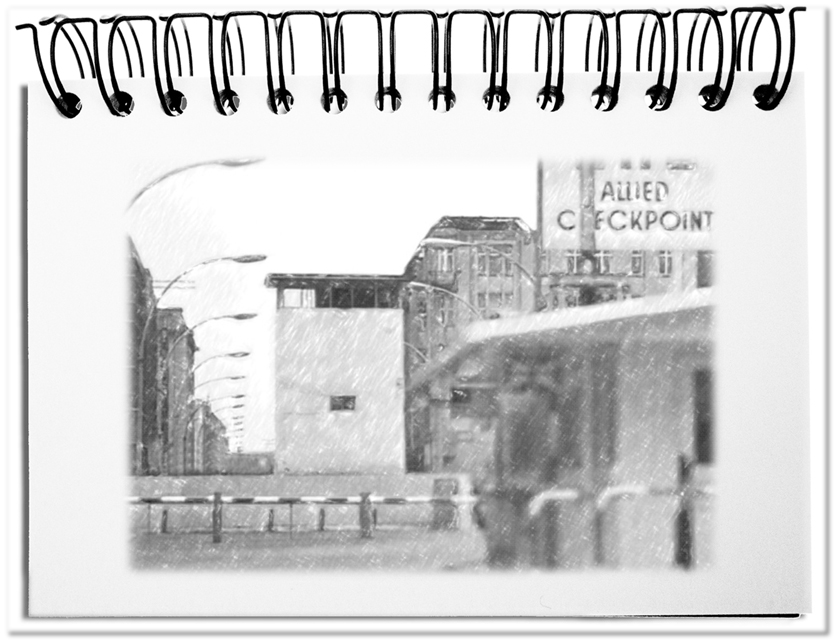
There was a time when Berlin was surrounded by a wall that made the city an island. At some point, you hit in West Berlin in all directions the wall, with only a few loopholes. Even today, the nocturnal journey through the former Checkpoint Charlie is still a noticeable border crossing, even without control and the wall. One dives from the white light of the West Berlin mercury vapor lamps and fluorescent tubes into the warm light of the East Berlin sodium vapor lamps. Even the attentive pedestrian notices that the traffic light man suddenly wears a hat. That’s what border crossings are about.
All kinds of systems live from the fact that something belongs to them and a lot of others do not. Often these boundaries are not so clearly marked. For this reason, it is important to be attentive to notice a passage from one system to another. The following aspects provide a simple grid to facilitate border crossings in a way that nobody takes any harm.

  • Context
    The space offers many recognizable boundaries – rivers, mountains, roads, walls, etc. Not every limitation automatically leads to an area with new regulations. However, it is very likely that something is changing, when you are exchanging the environment. Anyone who lives close to a river, on the left or right bank, knows these differences. Time also divides incessantly. Be it the past from the present or the present from the future or the before from the after. A border crossing also takes place when you enter a country after a long-haul flight by crossing the passenger boarding bridge – many passengers return home and others become aliens.
    You become aware of the context through these questions: Where am I? At what time?
  • Activity
    Especially diverse systems set up fields of activities or professions. Each type of employment creates a closed system with determined conditions, where those who belong to it understand each other. The others are excluded. This can be recognized by the clothing, the tools or the technical jargon – kick-off, throw-in, penalty, header, off-side (who might this be?). For outsiders, it is a kind of foreign language that must be learned.
    Quick access to the meaning could be achieved by asking: What is being done? What’s it called?
  • Abilities
    Over time, the abilities have become more and more specialized. However, it is possible to define areas of knowledge that together form a closed subject area, which in turn consists of specialized subsystems, which in turn … etc. This leads to different abilities between electro and thermos dynamicists or quantum physicists as well as to barriers of understanding between branches. The associated languages form further boundaries that demarcate or ostracize. Access to a different culture is made possible above all by the corresponding language competence – if Europeans speak of thinking, they point to the head, while Japanese tend to point to the heart.
    Overcoming this border is made possible by questions like – How do you do it? What do you have to learn?
  • Convictions
    The mental models of the members of a system are difficult to explore, because they only have an effect in the minds of the people. They become visible in the context, the actions and the demonstrated skills. The convictions form the mortar that connects groups of all kind. The crossing of the border is recognizable by the reactions of the people. If one violates their beliefs, like certain rituals or behavioral norms, then one is sanctioned without delay. At the same time, one is trapped in one’s own mental buildings – if, for example, justice is determined unilaterally. For some, a prison sentence is the worst, for others a flogging – although the need for punishment is common to both..
    The edge of convictions can be determined by cautious enquiries: How do you say that? What do you have to do?
  • Role
    A special form of border exists between roles. These are exceeded daily again and again – once you are an employee, then a boss, then a colleague, then a spouse, then a father, then a friend, then a member of the association, etc. In business life, roles are sometimes described in writing with task, authority and responsibility. The previous aspects (see above) are also different for each role – e.g. the different languages of the boss, the spouse and the association member.
    That’s why all the questions that were mentioned so far are raised here, as well as: What role is this? Which AKVs are included?
  • Affiliation
    The affiliation is the most difficult border because it hides fundamental aspects. Here the superordinate context of meaning and basic questions of life find deeply anchored answers. Fundamental borders, which are difficult to move, are formed by religions as well as economic and political systems. They are based on the personal belief and the bonds with one’s own roots.
    In order to cross these borders, respectful questions are necessary: What does that mean? What do I have to pay attention to?

Bottom line: We are constantly crossing borders unreflectively. Any border crossing can lead to a conflict. For this reason, it is important to be continuously aware of the limits. For this purpose one observes the context in which one finds oneself, the actions that happen, the abilities that become visible, the convictions that become recognizable, the roles that exist and the affiliation that characterizes the other side of the border. Borders lead to demarcation and ostracism, sometimes intentional and sometimes unintentional. Crossing borders is unavoidable, but can happen with the respective awareness in a way that nobody gets harmed. These are some aspects that border crossings are about.

More than said and heard

It’s surprising that after many years of having the team on the agenda, companies are still struggling to capitalize on the additional treasures of grouping employees into working teams. The promotion of individual careers, the artificially fueled competition for credit points and the lack of informal opportunities to exchange information hamper a relationship based on cooperation. Usually the individual criteria are still used to evaluate the performances. Individuals are in the focus – although that puts a strain on trustful cooperation.

The company or rather its representatives do little to ensure that this additional advantage can arise. Even though there is an agile momentum nowadays and everyone wants the appropriate commitment from the employees, there does not exist

  • the necessary, open structures,
  • agile workplaces and meeting rooms to meet spontaneously,
  • new distribution mechanisms for resources, or
  • executives, who renounce any micro management.

It can actually not exist as long as the decision-makers themselves are only employees in a multilayered hierarchy. Perhaps it helps to realize that a group of employees is more than the sum of the individual experiences – when more can be said and heard.

  • The senders have more thoughts than they can express
    The collaboration thrives on ideas that are exchanged within the team. The difficulty is the fact that much of the thoughts that a team member thinks about, cannot be completely shared. Many aspects are lost during the transfer into language and images. Through generalizations, the use of classifications, unspoken assumptions and the use of ambiguous terms, important contents are filtered out.
    Example: All sales people follow the sales process with the conviction that anything is possible. Their credo is AIDAS. Why can’t this be improved through intensive cooperation? We need agile procedures.
    In the example, many facts remain unspoken: Sales people? Sales process? What is possible? AIDAS? What makes cooperation intensive? Agile? The sender knows more, but does not express it more comprehensive.
  • The receivers determine the content of the perceived
    The exchange of ideas requires that everybody notices the thoughts of others. Since all people perceive through different channels, sometimes the spoken and sometimes the written word and sometimes a picture or a series of numbers are worth than a thousand words – as long as you do not miss the message. In any case, the target group is responsible for interpreting the statements. The path into consciousness uses the already existing thoughts and mental patterns of the target persons to enrich the contents with useful knowledge in their mind.
    Example: Jim and John have been working in sales for a long time and use for weeks Clickfunnels to collect 1500 new contacts every day, so-called leads, which they prioritize with their software module in order to turn in just one week the most interesting contacts into interested customers, who are willing to meet with our sales people.
    The example shows that the receiver immediately adjusts the perceived to his ideas: Jim and John are salespeople; Clickfunnels seems to be related to the sales process; 1500 leads per day are possible; the rest, e.g. the agile, has disappeared. The recipient has enriched some messages while hiding others.
  • Mutual discourse expands the comprehension
    Actually, everything is works as desired. The sender communicates and the receiver understands what he can. In fact, the receiver only bears the whole thing in mind so far. In order to share the experiences, everybody in the group must become a sender and share their feedbacks. The target people perceive the contributions again and link the contents with their ranges of experience. The ideas are further processed to a more comprehensive, joint result by mutually asking questions. The more intensive the exchange of ideas, the more comprehensive becomes the overall understanding.
    Example: How do we reach Jim and John? Who should join? What exactly does Clickfunnels? How can we use the results for needs analysis? How do we increase our flexibility?
    The example is not about rhetorical questions, but about filling gaps of understanding and creating a common picture. Once the saturation level is reached, the team works together more effectively and efficiently based on this consensus.

The magic of teamwork arises when employees can exchange ideas free from conventions and constraints – when they don’t have to be afraid of disadvantages due to their active participation. In order to achieve the desired effect, they need the appropriate freedom, both psychologically and physically. Not everything works out. But there is a good example that illustrates the opportunities. Let’s remember the Post-It story. Spencer Silver had invented in the sixties a glue that did not stick permanently. It was only when Arthur Fry had in church the idea to mark his hymnbook with sticky bookmarks that the idea of Post-It was born – today 50 billion sticky notes are sold annually. On average, everyone uses at work eleven sticky notes a day.

Bottom line: Without the corporate culture of the Minnesota Mining and Manufacturing Company (now 3M), this cultural artifact would probably not exist. For decades, it has been a showcase that you must allow the development of new ideas full bent. At the same time, it shows that people can complement each other extraordinarily. All companies need to do is to provide the appropriate conditions. Employees need the space, the time and the mutual discourse to produce results that individuals simply cannot achieve. There is always more than is said and heard.