Division of labor is determined by horizontal and vertical distribution of tasks. The enemy of this arrangement is the micro manager, who interferes with the tasks of the employees. A typical form is the supervisor call – the capacity killer from the top.
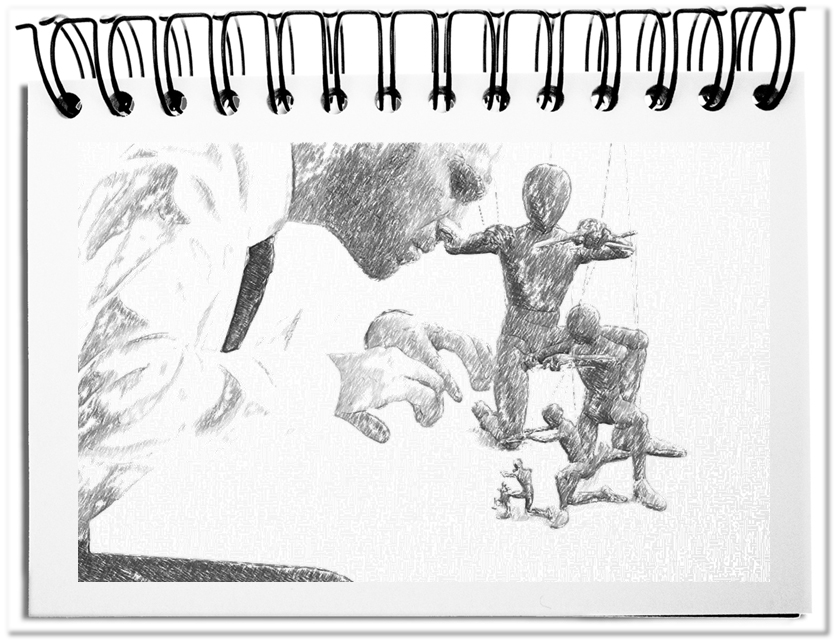
Originally the supervisor call had to terminate the function of a running program on a host computer. Programs did not come to an end due to errors in the program code. In order not to restart the entire computer, a SVC could interrupt this program. It always had to be decided, whether the procedure is frozen in an infinite loop or it simply had to process many data. Surprisingly there are executives, who proceed according to a similar pattern in their organizations. They interrupt ongoing tasks regardless of the consequences. How can you recognize them?
- Like the leopard cannot change its spots, we all have to live with our selective perception. We only consider what attracts our attention in the respective moment the most. Also decision makers cannot escape from this bias. As soon as people draw positive or negative attention with their activities, it can happen that a superordinate instance is motivated to a direct interference despite all delegation.
- Similarly the blind spot works, which makes the look at specialties impossible. For executives these are mostly the restrictions that are imposed by money or time budgets, which they are not willing to accept. In the US, bosses invented for this purpose “stretched goals”. In the mean time we know the negative effects, if the bow is overdrawn.
- Good leadership is characterized by an overview of existing and already used resources. As soon as this overall picture is missing, the requirements add up much higher than the possibilities that are available. Fatally the employees are double-charged for this deficit, since they are additionally accused of not being ready to make enough efforts. This produces a continuous discontent, which lowers the usual performance.
- An important instrument of the leadership is setting goals with a certain prioritization. Long-term planning offers for this the general framework. The damage that is caused by the repetitive change of priorities is immense. Nothing is accomplished. Desired changes do not take place. Personal goals are not achieved.
- A common approach is the temporary overriding of processes, hierarchies and schedules. And this happens, after the structures were developed, coordinated and decided. But why are you superior, if you do not have power to set this order off whenever you want.
- It is also popular to assign special tasks spontaneously – past all the installed chain of command. This going around the established rankings with an overriding from top to the bottom is multiplied by the frustration of the ignored levels. Eventually the commitment of the involved people sinks because of their expectation of the direct interference, since they cannot assert themselves in any case.
- The executives, who want to hold the pressure on the pipe by always coming up with new ideas, are particularly difficult. They undermine thereby the efforts of the employees to convert the ideas that they had just brought on the way. From the outside they seem to be creative and active bosses, who promote new things. That they bring nothing to an end, you usually see after they rose to their level of incompetence.
- Superior people, who do not trust their employees, are condemned to the fact producing only what they can deliver by themselves. Even though the decisive delegation of tasks would increase dramatically the effectiveness of the own area of responsibility.
- Those people are also remarkable who make their own ideas the measure of all things, despite missing arguments and out of complete hubris. They live out their Because-I-Want-It syndrome and do not even make an effort to consider the arguments of the others. It is only a matter of time, before the organization will uncover them.
Enterprises can overcome these exemplary symptoms of capacity killers, by taking care of their corporate culture. The most important tool is thereby the regular reflection of the way how executives behave and get to a decision. This is done with an open exchange of opinions within the top team and through employee surveys. Based on this, new ways should be found, in order to avoid awkward behaviors like SVC.
Bottom line: Leadership needs clear goals, roles and a consistent implementation. Superiors have to be thereby role models, who are passed on through all levels. In the positive case this happens for the advantage of the entire staff. Harmful behavior, on the contrary, can have life-threatening effects for the company. A good start is the persistent avoidance of the SVC – the capacity killer from the top.