
Schlagwort-Archiv: Authority

Level playing field is for no one free

When we meet other people, by nature we differ in physical, cultural and mental characteristics – height, weight, age, origin, language, culture, class, attitudes, abilities, activities and so on. Even close relatives develop more and more differences over time. Respectively many people desire an equal and respectful interaction with each other. On closer look it appears that this desired level playing field is for no one free.

Augenhoehe

Actually it is mainly a matter of making common cause in a spirit of no prejudging, of mutual confidence and with respect. The alternative positions are unpleasant for some people. Although the protagonists decide, in which position they are, apart from having equal level there are the following point of views.

  • Worm’s-eye view
    For those people, who look at cooperation from this perspective, a feeling of inferiority becomes sometimes apparent. If one supposes that the other one caused this situation, one feels degraded. This position offers the comfortable position of not being responsible, but nevertheless most people strive at least for level playing field.
  • Bird’s-eye view
    From this point of view these people develop quickly the feeling of superiority. This aspect does not often come from others, who put someone up on the pedestal, but from one’s arrogance. The illusion of having things firmly under control does not mean that the respective person also feels responsible. The associated reputation often prevents that everybody can meet on common ground.

Agreeing to meet on level playing field results in mutual give and take.

  • Jointly assigning tasks
    Tasks are mainly not a matter of taking over, but rather of getting rid of them. Level playing field means in this case that the selection of an activity is done equally. The obligations are not simply delegated from the top and are not simply rejected from the bottom. This requires an objective approach for the assignment. On the one hand the wishes should be taken into account and on the other hand the insight should exist that certain things have to be done.
  • Authority to the acting person
    The right of doing something is more likely what people struggle for. Everyone wants to have the authority to select and to decide. Level playing field means here to find a reasonable power allocation. One approach is to provide people the authority that they need to fulfill their tasks.
  • Taking responsibility for the own acts
    The responsibility in turn is something that one would like to delegate, since the consequences are in the worst case the loss of the own position. On level playing field means that one achieves the appropriate distribution of the responsibility. The superordinate have the responsibility for the aspects that they set for subordinates. The subordinate takes the responsibility for its own doing, without being able to refer for example to a necessity to obey orders.

A helpful approach is the bundling of tasks, authority and responsibility in one hand. That way taking over a task includes the authority attached to it and the responsibility for the fulfillment. The task has thereby possible negative consequences in case of the failure. This motivates the person in charge to fulfill the task with a successful conclusion and then, of course, pocket the wages.

Bottom line: In principle the human right is valid, since we are all equal. However, this is not sufficient to reach level playing field in daily life. There are things that must be regulated due to an existing hierarchy. Level playing field is for no one free. Both sides must strive for it. Putting the tasks fittingly in one hand is a smart solution.
The future of leadership

Guidance is one of the oldest roles in societies. And nevertheless executives are continuously looking for the right style of their role. Apart from the tasks and tools of leadership managers are concerned with the following questions.

  1. How much involvement is possible?
  2. How many rules are needed?
  3. How do I distribute tasks, authorities and responsibilities?
  4. How much loyalty do I need? How does it emerge?
  5. How do I promote cooperation?
  6. How to select executives?
  7. How much leadership do we need at all?

Do new systemic concepts like holistic, autonomous units, interconnectedness, participation, and self-organization, pave the way for new, yet not recognizable styles of leadership? How does the future of leadership looks like?

Fuehrung

Executives provide goals, organize, decide, evaluate and foster employees by using various tools (e.g. role descriptions, regular communication, performance reviews). They control with it their area, create orientation and take responsibility for the results (You find more about tasks and tools of leadership here: http://www.malik-management.com/en/malik-approach/malik-basic-models).
Without leadership, these aspects have to be developed in the team and consent has to be agreed. Positive examples of self-organizing groups are the agile teams in software development and other creative professions.

Nevertheless, new approaches imply also new answers to the questions of executives.

  1. Involvement results from democratic forms of cooperation, like having a say and participation. These can also be established in connection with hierarchical structures. For a long time, autonomous, self-organizing teams are common practice in the context of bureaucratic structures, like projects, Centers of Competence or Production islands.
  2. Regulations range from chaos to orderliness and from voluntary to mandatory. They are important tools, in order to clarify the desired behavior of the employees. These rules become meaningful with the appropriate level of detail that covers the tension between patronizing and autonomy. The joint agreement of basic guidelines in the governance minimizes the number of regulations.
  3. Task, authority and responsibility (TAR) of a role should be consolidated under one roof. The best example of the distribution of TAR is the subsidiarity principle of the Vatican. It bundles decisions at the point of action. Only if this is no longer possible, the role is established on the next higher level.
  4. The loyalty is an important element of leadership that cannot be directly created. On the one hand, it results from the authoritarian or charismatic attitudes of a leader. On the other hand, it evolves from the indirect stimulation of the commitment with personal, content-wise and formal commitment amplifiers.
  5. Cooperation can be designed in various ways by using the new possibilities of networking and self-organization. The exchange of information can be realized with common intranet sites, discussion groups and blogs. The employees access via mobile PCs or smartphones their necessary data wherever and whenever. The employees meet independently of their whereabout within phone and video conferences.
  6. The selection of executives has an influence on their acceptance. However, democratic approaches like the direct selection or recruiting of leaders by the employees, does not guarantee their effectiveness. Independently of the selection procedure, there will always be some employees, who accept the boss – or not. As you can also see in politics, democratic elections result in a distribution of 51% to 49% – i.e. half of the population does not want the winner.
  7. At the latest, when the number of members of an organization exceeds the magic Dunbar number of 150, we need leadership and an adequate hierarchy. Small organizations, like start-ups, can survive for a certain time without formal structures. We should not to forget that these are also often driven autocratically by a founder.

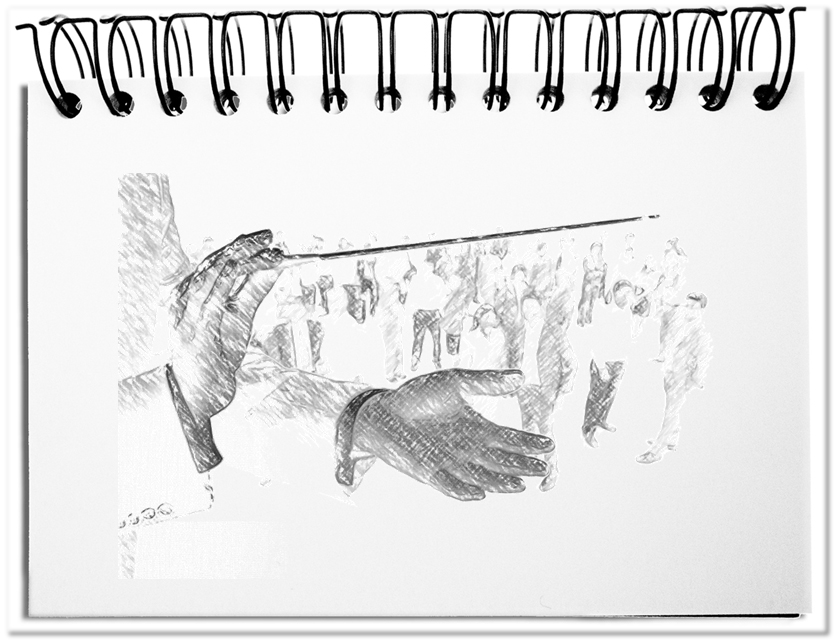
Bottom line: Like an orchestra will never like to forgo the conductor, we cannot let go the integrating role of leadership in the future. Each undertaking needs the strategic alignment and concluding decisions by executives. The guidance becomes state-of-the-art by using the new possibilities for cooperation.