We all have our look at the conditions of the world. Currently http://ow.ly/GeMxx billions of people lives in the world. Unfortunately it is difficult from the perspective of political and economical decision makers to deal appropriately with this incredible number of views. For this reason, one considers the view points of groups, e.g. government, enterprise, lobby and other groups of interests. A universal point of view is the public opinion that represents the majority of the society. These attitudes and behaviors are detected through representative surveys. Whereas in former times people were shaped by common upbringing, education, books and mass media, today an enormous amount of channels and institutions stand equal side by side. As a consequence everyone seeks heaven in his own fashion. Does the public opinion still exist? Or does the public opinion evaporates as a practical tool from the public discourses?
If the commonalities of a society dissolve, the resilience is at risk, …
- … because common sense is no longer seizable
In the past, people were influenced with news by common channels, e.g. the local daily papers as well as the public radio and TV stations. This created a common state of knowledge and convictions. With the emergence of special-interest channels and the Internet today everyone is in the position to select ones sources. Thus, the commonalities get lost. Each perspective is cultivated and evolves in its respective direction. Therefore a common sense of the smaller groups emerges. The large, social common sense is lost thereby. - … because culture dissolves more and more
Through the advancing fragmentation of the society it becomes more difficult to recognize the core elements of culture (more here: http://www.memecon.com/cultural-aspects.html). Languages, actions, attitudes, experiences and the identity are increasingly scattered across different groups. Over time incompatible groups evolve that are in competition with each other. In order to come to a common direction, for all parties’ acceptable compromises have to be concluded. The call for a common culture becomes stronger. - … because social cohesion disappears
As a consequence, people orient themselves increasingly towards their group. This leads to a developing delimitation from others and a stronger emotional binding to the values of the own group. The existing energy for the common tasks is consumed in favor of petty disputes. The general problems remain unresolved and the societal commonalities get lost. - … because the large parties dissolve
Even the Grand Coalition of Germany represents only 48% of all voters, considering a polling of 71,5% http://ow.ly/GeSHe. The CDU/CSU (18.3 million voters) received together just little more votes than the non-voters (17.6 million). Democracy created itself rules, in order to remain functional with such circumstances. The consequences are more and more parties and ever more populists. - … because the basis for governmental decisions evaporates
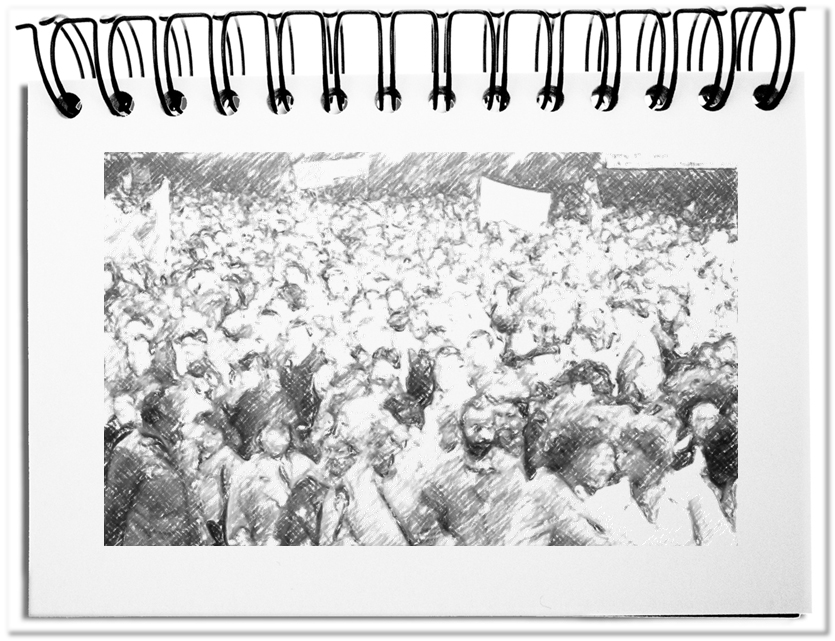
With the political voting results, the parties govern without the support of the majority of the voters. This leads to a rising discontent and more public demonstrations. The new culture of protest is practiced by all segments of the population. The malicious way that the established parties show the various activists understanding is an indication for their lack of ideas of how to grapple with these groups.
The gaps that arise create the room for groups that promise to the public, what they want to hear. Populist forces already exploited in the twentieth century the weakness of many small parties. The consequences were horrifying. Without an extensive consent between the citizens that becomes visible in a convincing public opinion, we spin into an undesirable, well-known direction. Did decision makers learn something from it? Which measures do they take? Do we have to accept that history repeats itself? And afterwards again nobody knew something?
In the meantime the public opinion becomes so little meaningful that on its basis only a few commonalities can be found – except for the xenophobic developments.
P.S.: The same mechanisms can be found in corporations within their framework of the Corporate Identity.