The right word in the right moment has a large influence, whether you arrive in the consciousness of the listeners and readers or not. For this purpose all words are available. The back door to additional expression is provided by intonation and posture as well as pictures and sounds. The third door, or even portal, into the head of the audience, is the choice of the words.
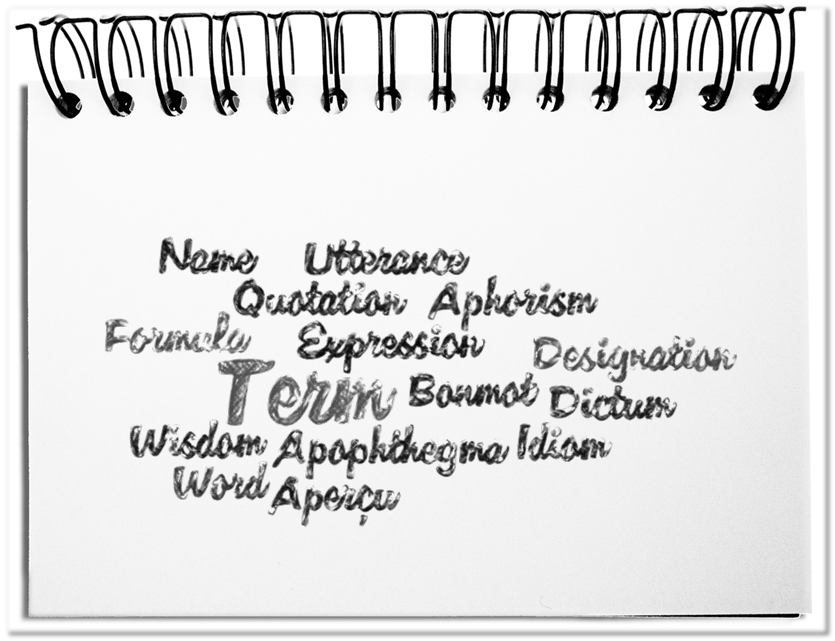
This time we will look at nouns, which describe concrete objects and beings as well as abstract terms, which do not denote concrete ideas. As a way into the mind of the audience you can use keywords, stigma words, invented words, acronyms and synonyms.
- Keywords
are topic-related words that describe the substantial contents of a statement. They provide the information for the understanding and anchor it in the memory of the audience. They convey the actual messages and convictions that are not visible at first sight, like values, habits, presuppositions and the affiliation to a certain culture. The context, in which they are used, determines its meaning.
Let’s look at the word liberalization in the context of negotiations for creating new markets (e.g. TTIP or TISA). Liberalization means here: Deregulation of the public procurement, release of anything that is not explicitly legally forbidden. Nevertheless the word liberalization has also positive connotations – liberal, tolerant, informal. However, the context creates the other meaning.
Therefore you should bother to create an appropriate context when you convey a message, in order to enforce the desired effect of the words. - Stigma words
are words that classify adversely, burden the text with negative feelings and divert attention from the core statements. Examples are words such as black people, in place of Afro-American, gypsy, in place of Sinti and Roma, or Business terms such as crisis, in place of difficulty, or propaganda, instead of advertisement. At the same moment these words can be positive for others and thus be flag words. A good example is the word socialism – for some people it is the perfect bogeyman, for the others a meaningful ideal. There is a danger that stigma words cause negative feelings within the target audience and thus superimpose the actual message.
In business, there are equally loaded words. An example is error. Many people consider this word as negative, since defects or faults are interpreted as the consequence of conscious or sloppy misconduct. That most errors come from misfortunes, blunders or poorly planned concepts is not considered thereby.
Therefore formulations should be checked concerning their effect on the target audience and be replaced with neutral words or even positive ones. - Catchwords/ invented words/ ad-hoc compounds
should support the topic and, whenever possible, adopt the jargon of the target group, in order to increase the acceptance. Catchwords like innovative, flexible, dedicated and optimal can be translated (e.g. innovative=inventive or full of ideas; flexible=adaptable or mobile; dedicated=active or committed; optimal=best possible or perfect.).
Invented words are built from parts of words and provide a comprehensible description of new meaning – Genglish (GErman + eNGLISH) the mixed use of German and English; Bollywood (BOmbay + hoLLYWOOD) the Indian film industry; Brexit (BRitain + EXIT) the withdrawal of Great Britain from the European Union; Bionics (BIology + techNICS) use of natural phenomena in the technology. In German you simply combine words to new ad-hoc connections – change-goal-corridor, strategy-trap, requirement-change-management, and risk-potential-deviation-analysis.
The understanding of a message becomes difficult with these words, which have for the time of being no generally accepted meaning. Therefore it better to avoid these words or at least clarify them with an understandable interpretation. - Abbreviations/ Acronyms
are parts of words and word sequences that are arranged to letter sequences. They are often recognized as letter word due to the lack of vocals and remain incomprehensible without background knowledge or explanation. Depending upon context there are more or less interpretations available (e.g. PLC= public limited corporation or Palestinian Legislative Council or Product Life Cycle; PS= power supply or Photoshop or Polysulfide; SB= see below or silver bullet or Santa Barbara; CP= communist party or contingency plan; MB= megabyte or men in black).
For this reason these artificially created abbreviations do not help in conveying information, if they are not at least explained, when it occurs for the first time, and documented in a glossary. - Synonyms
are words with a same or similar meaning. For example road can be replaced by the following words: Lane, route, park way, boulevard, country road, and alleyway. On closer look the synonyms supply additional meanings. The lane is the place where traffic takes place. A route is a marked-out road. A park way is a road lined with trees. A boulevard is a main street in a big city. A country road is a small, often unpaved road in the country. An alleyway is a road with high walls on both sides. There are also synonyms that describe a similar function from different perspectives. The word transparency has on the one hand the meaning translucency and light permeability. On the other hand it means honesty, openness and frankness.
Due to the broad meaning, synonyms are only useful, if they provide additional information to the topic. For stylistic purpose synonyms avoid the repetitive use of always the same word, but they soften the messages.
The personal vocabulary is defined by the personal experiences, especially through newspapers, magazines, scientific papers and books that you read. In order to improve the vocabulary, it is inevitable to take care of the texts that other people write.
Bottom line: The word choice has a large influence on the effect of your texts and presentations. To use the right keywords, to avoid certain stigma words, invented words and abbreviations as well as the skillful selection of synonyms improve the understandability of your messages.