With the increasing popularity of social networks, new forms of the contacts evolve. The respective network gives different names to these contacts – contact, friend, circles, follower. The users decide individually on the range and/or size of their net. It reaches from the family cocoon, to traditional circle of friends, acquaintances and colleagues, to like-minded people or fans. The number of contacts goes from a handful up to tens of thousands, in special cases to millions (e.g. Lady Gaga has already more than 30 million followers).
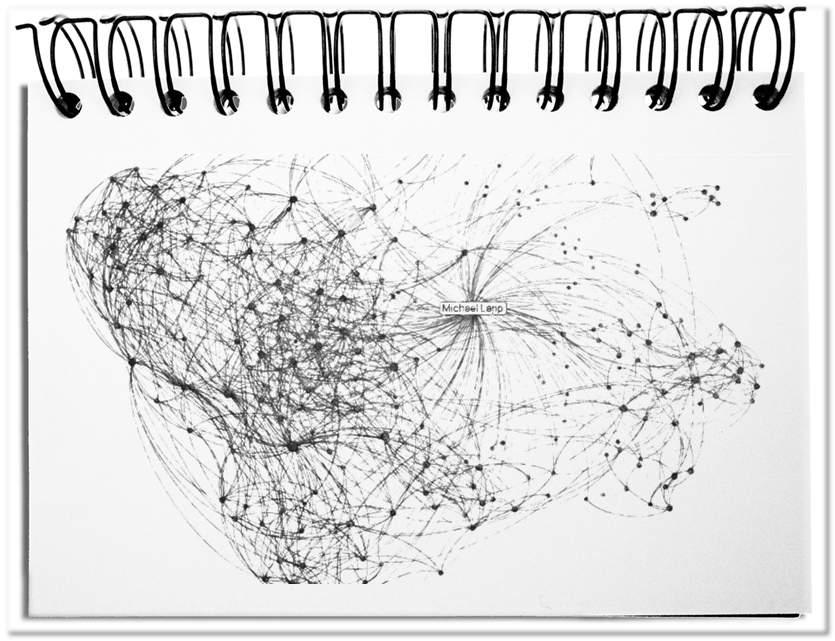
It is clear that the contacts with the best friends have other qualities than the relationship between Lady Gaga and her followers. One contact is not better than the other, but different. Let’s look at the contacts with a difference.
The number of on-line contacts often exceeds the number of traditional relations that exist without Internet (between 100 and 250). On Facebook, a user had in 2013 on average 342 friends. However, mutual communication takes only place regularly with approx. ten people.
This offsets a little the hype about the social networks. Eventually, the number of relationships regulates themselves to a manageable number by the available time. For the personal assessment of the own network, the contacts can be organized according to two aspects: Type of relationship and Contact strength.
Types of relationship
The type of relationship describes the social proximity and, in a certain sense, the purpose of the relationship.
- Family/ close friends
Here you find the direct members of the family (parents, brothers and sisters)and friends, with whom one has certain things in common. Here are the ten contacts that are maintained the most.
- Friends/ closer acquaintance/ kinsfolk
Friendshipsand acquaintances result from collective activities (school, study, work, and hobby). The kinsfolk cover the extended family circle (grandparents, grandchilds, uncles, aunts, nieces, nephews, etc.). The number in this group depends substantially on the user. Taking into account the common activities, it could be easily 40 to 100 contacts.
- Personal acquaintanceships
You are not regularly in contact with people, who you met personally and with whom you exchanged addresses. However, there is a link due to the personal encounter. This group grows with increasing age and will become over time a three-figure number.
- Potential mailing list
Thelargest group is those people, with whom you exchange the contact in the Internet due to common interests or something similar. Also without personal encounter, there is the possibility to contact personally or to send information. The number in this group depends substantially on the individual activities in the social networks. You can quickly develop a four-digit number of contacts. My largest Xing contact has more than 74,000 contacts.
It would be interesting to perform a study concerning the average number of contacts for the different types of relationship.
Contact strength
The second aspect is the contact strength. In this case, you look at the mutuality of the contact.
- None/ one-sided exchange
This is about the contacts that consist of a mere confirmation. The partners do not or very rarely exchange messages.
- More outgoing than incoming
In this relationship sends one partner substantially more direct messages than the other.
- Equivalent outgoing and incoming
This is a balanced mutual relationship.
- More incoming than outgoing
In this case one partner receives substantially more direct messages than he/she is sending.
In the first case, it is the natural noise that exists in social networks. The most contacts are the personal acquaintances and the potential mailing list.
Bottom line
It looks like those social networks behave as communities of the past. The core circles are still the visible 100 to 250 persons, with whom we always had a relationship. Regular, mutual contacts are take place with around ten people.
Further links:
Maintained relationships in Facebook
Dunbar’s number
Persistance of social signatures in human communication