
Archiv der Kategorie: English

Through the veil of symptoms

We still have no explanation of how we are actually able to think consciously. Already the appropriation by means of We that implies that others think is not a matter of fact. And yet we have a silent agreement that we see, hear, feel, taste, smell and think similarly. But we still do not know how the stimuli of the environment are translated into our mental inner self and how our consciousness evolves. All we got is our ‘Cogito ergo sum’. Nevertheless, we ask whether machines have awareness. Only indirect symptoms are measurable – electrical activations and the observable activities. Through this veil of symptoms, we continue to search.
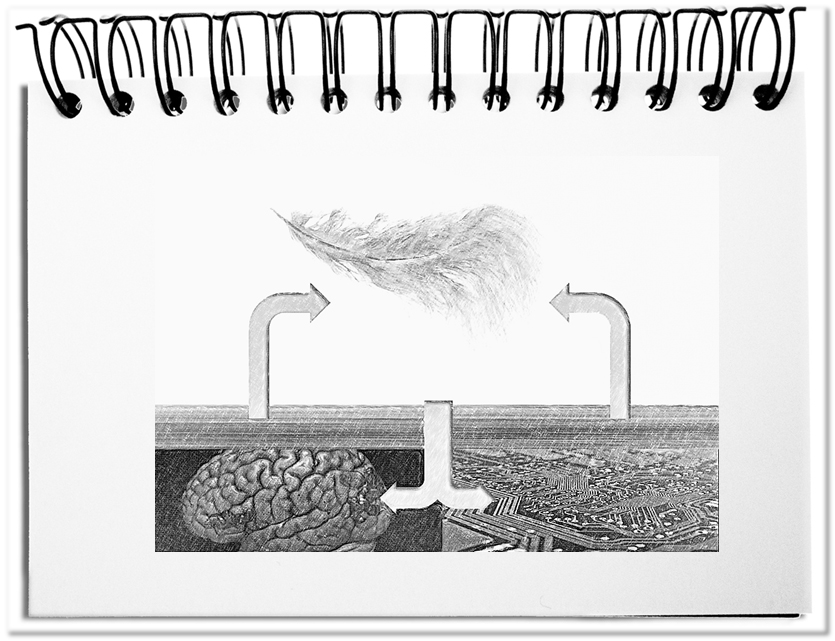
To penetrate the veil, we have at hand the elements of the world, sensory signals, our own consciousness and the resulting activities and artifacts.

  • The world as such
    We take the flora and fauna as well as the natural and man-made things for granted. We are convinced that they are, independent of the observer. The philosophical question is: Do the leaves rustle in the forest, even when we are not there to listen?
    Such questions can come to our minds without being able to find them in others, also not in other living beings. How could you do that on a computer?
  • Perceived signals
    We perceive the world through the five senses. Thus, the receptors in the eyes receive light that is transformed into mental images, the ears perceive sounds that become music, touches on the skin trigger emotions, delicacies stimulate the tongue and create taste experience and scents we sniff and trigger memories. The individual components can be taken more or less good with measuring instruments. However, the triggered experiences cannot be translated from the measurements.
    Of course, we get the signals into a computer. However, we have no idea how to translate the signals into an understanding?
  • Subjective processing
    Nerves transmit the received data from the receptors into the brain. How the signals are translated along the way is unclear. From our own experience, we can certainly confirm that we are aware of our environment. We create images from shapes and colors, which we even recognize in two-dimensional images. High and low, bright and dull, loud and soft sounds become symphonies. The surface of a wooden table feels good. The Madeleine reminds you of the childhood by the sea. The scent of damp grass smells like summer.
    There are still no approaches to let mental processing run in a computer – let alone to be able to observe an emerging consciousness.
  • Visible action
    What we observe in ourselves we cannot see in others – at least not directly. We only have the indirect view of the actions of others. We see their body language, gestures and facial expressions, hear their intonation and observe their activities. From this, we derive their mental and emotional state. The visible acts that (presumably) result from their thoughts, only allow interpretations of what is going on in their mind. We observe the consciousness of other people even more indirect than with ourselves.
    The processing of a computer can be easily tracked – the results that are displayed on the screen or printed out. This goes so far that we can create three-dimensional worlds in the computer and even print out artifacts.

The feather that we can see and touch triggers feelings that make us, for example, smile. In a computer, one could program a feather that is recognized by a camera and sensed by a sensor to make an artificial face smile on the screen. However, this does not mean that the computer develops feelings, as we have. In the medium term, the fast processing speed will lead to more and more visible actions being trained into the computer. The impression will be that the computer behaves like a human being. Whether it develops consciousness or not, will be hardly recognized, just as with other people.

Bottom line: In artificial intelligence, a lot is still argued with faith. The stimuli that the things of the world trigger will be sensitively measured. The processing in humans will not be transferable in a foreseeable future – especially not as long as we do not know what is happening in our consciousness. However, the programs are becoming increasingly powerful so that they can trigger visible actions as if … Believers can look through the veil and presume that there is consciousness behind. Nonbelievers can think the opposite. For the moment, there is no chance than glimpsing through the veil of symptoms.
Em@ilettes become more important

In Germany, we receive on average more than twenty business-related e-mails per day – almost twice as much as three years before. If we assume a serious processing, then reading and answering takes on average five minutes, which leads to more than one and a half hours of email time without working on the actual task. The more emails someone receives, the less time remains for the work resulting in poor quality and email ping pong whereby the burden of emails increases continuously. Although one could reduce the effort for all participants by a conscious email handling and a certain self-discipline – e.g. by a common Em@ilette.

The following approaches could increase the quality of an email and thus reduce the processing time for everyone.

  • Recipient-oriented
    Lengthy self-adulation undermines the recipients‘ attention. More value is created for them by formulating the message from their point of view. This so-called PERYOU takes the interests of the addressees into account and is limited to what is expected of them.
    Thus, listing offers, which do not differ eventually from those of the competitors, does not
    create any curiosity – „We deliver the newest …“
    Writing from the viewpoint of the recipients, than one considers their language, thinking, inner state and situation – „You avoid with this … “
  • Solution-oriented
    The senders often think that they have to explain their problems to the receivers. One reason could be the justification or excuse for a late or incomplete delivery. Or to valorize the own achievement by explaining the difficulty of the task. Or one doesn’t know what to say, because there is currently no solution. Or one cannot anticipate the target group and therefore cannot apply PERYOU.
    The detailed description of the problem and its causes extend the discussion and still does not provide a solution – „Implementation is difficult, because we encounter everywhere resistance, which leads to …“
    Whereas looking at the solution describes the future result – „You get …“
  • KISS
    The English abbreviation KISS (i.e. Keep It Simple, Smart) means in German ‘Brevity is the soul of the spice’. The shorter an email, the easier it can be processed. You’ve found the right length, when you can’t delete anything. Simple and short sentences have a maximum of 12 words. You avoid all kinds of filler words (see below). Clarity is enhanced by one thought per sentence, one topic per paragraph and no more than fiveplusminustwo topics per email.
    In most cases, active instead of passive sentences and verbs instead of substantiations lead to a better understanding – „The administrator activates your account today. Tomorrow you can use the new feature.“
    The icing on the cake in effective emails is positive formulations that clearly name the content – „You get …“ instead of the undefined negative sentence „You cannot get everything.

In addition, formal aspects can be built into an Em@ilette: a meaningful subject line; clear rules for the use of CC; suggestions for personal salutations; examples of appropriate greetings; a basic structure of the content, such as introduction, main body, binding closure, and so on.

Bottom line: The mutual exchange of information plays an important role in our everyday lives. In addition to personal meetings, the written exchange of information has shifted from physical letters to e-mails. The possibilities and the continuous acceleration create „faster disasters“ for those involved. Therefore it makes sense to consider the right use of email. With this article you have an impression of the possibilities in terms of content: Recipient and solution orientation and the shortness of an email. The fact that the number of emails is increasing demonstrates that Em@ilettes are becoming also for you increasingly important.

P.S. Some filler words

a little bit, a long time ago, absolutely, accordingly, actually, adequately, after all, after that, again, all, all around, all in all, almost, already, also, always, any, anyone, anyway, apparently, approximately, as follows, as it were, as well … as, assuredly, at all, at best, at last, at least, at long last, at the most, barely, basically, bluntly, but, by all appearances, by far, by no means, by the way, carefully, certainly, clearly, commonly, comparatively, completely, conceivably, consequently, consistently, constantly, decisively, definitely, downright, each, easy, especially, even, ever, everywhere, evidently, exactly, exceedingly, excellent, here and there, existent, expressly, extremely, fairly, few, finally, for real, for sure, for the second time, for the umpteenth time, for this, formally, fortunately, frequently, from time to time, fully, furthermore, generally known, heartily, here and there, however, I think, I would say, I believe, in a way, in all clearness, in any case, in approximately, in contrast, in general, in itself, in and of itself, in my opinion, in places, in principle, in spite of everything, in this context, in turn, incessantly, incredibly, indeed, indisputably, indubitably, irrelevant, just, just like that, largely, maybe, meanwhile, mind you, more or less, moreover, most of time, mostly, multiple, namely, naturally, nearly, never, nevertheless, nonetheless, now, now and then, obviously, occasionally, oddly enough, of course, often, on the one hand, on the other hand, once, once again, finally, one more time, only, originally, partout, per se, plentiful, possibly, practically, preferably, presumably, presumed, probably, quite, rarely, really, recently, regardless, relatively, repeatedly, senseless, several, simply, smoothly, so, so to say, so to speak, somehow, something, sometime, sometimes, somewhere, straight, straightway, strictly, strikingly, substantially, suddenly, sustained, Thank God, the truth is, theoretically, there, thereby, therefore, ultimately, unconscionable, under no circumstances, undoubtedly, unequivocally, unfortunately, unquestionably, unspeakably, usually, very, visibly, well, without doubt, without exception, without this, yet, you could say