The view on the world is determined by the tools and our position that we use to look at the reality. The telescope allows us the glance into the distance. The small things become visible through the microscope. We learned dealing with different levels of details, by always specifying the range and the resolution of our scope. We call the entire area the whole. The interconnected elements that are part of it are again systems that consist of elements, and so on. Each level has separate characteristics plus the characteristics that result from interaction within the whole. Therefore we speak of: The whole is more than the sum of its parts.
A system is an abstract term for a wholeness that bundles parts and relations within one “object” that functions delimited from the environment. In order to use a system consciously, it is necessary to describe it and recognize its patterns. Some systems evolved from natural conditions. Examples are the solar system, animals and humans, a forest or a lake, the brain, the immune system, etc. Other systems were created by people. Examples are machines, vehicles, thermostats, software, hardware, economic systems, juridical systems, religions, politics, products, services, etc. These lists can be extended at will.
Let’s look at the two following examples: the world and the enterprise.
- World
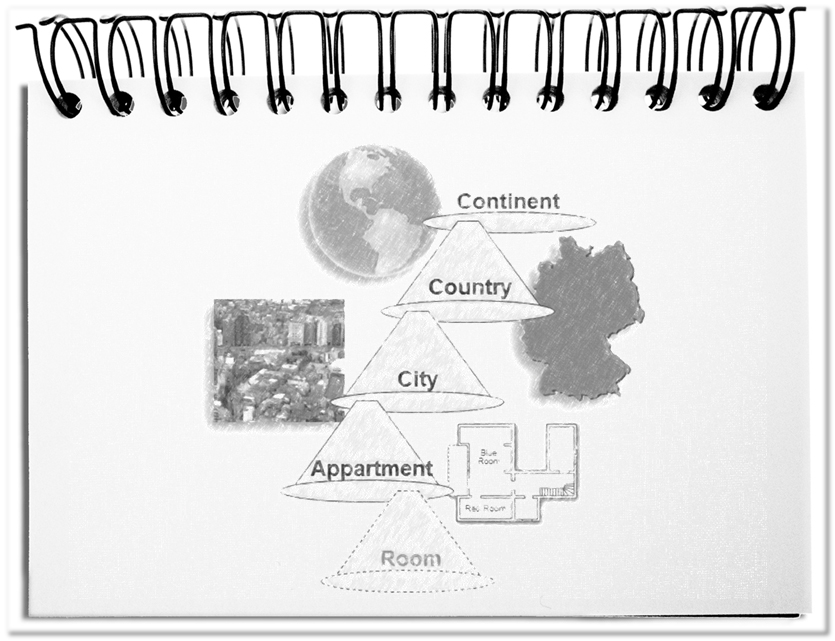
- Our conception of the world became more and more concrete – from the first map, to the globe, to Google Street View.
- You are sitting probably somewhere outside or in a room (e.g. an office, a café, a train compartment). Characteristics are thereby the inventory, the infrastructure, the size etc.
- The room is in a complex (e.g. a house, an office building or a train). Characteristics are the number of floors, the number of buildings and the entrances.
- The apartment is in a city (e.g. a mega city, a town or a village). Characteristics are the number of inhabitants, the traffic connections and the economic power.
- The city is in a country (e.g. Germany, the USA, Brazil or Japan). Characteristics are the Gross Domestic Product, the Gross National Happiness and political stability.
- The country is on a continent (e.g. America, Europe or Asia). Characteristics are the economic zones, the climate zones and the population density.
- Enterprise
- In the enterprise on each level tasks, authority and responsibility (TAR) are assigned that should have as few overlaps as possible.
- The position that an employee occupies, is the finest level from business perspective (e.g. the doorman, the housekeepers, the specialists, the managers, and the executive committee). Characteristics are additionally to the TARs the commitment, the experience and the skills.
- The positions are bundled in teams that follow functions or procedures (e.g. the development of exterior mirrors, the receipt of invoice). Characteristics are additionally to the TAR the group dynamics, the cohesion and the productivity.
- Departments consist of teams (e.g. the computer-aided design, the accounting, and the overseas logistics). Characteristics are additionally to the TARs the power structures, the internal competition and the legacies.
- The departments are assigned to functions (e.g. Research & Development, Finance & Controlling, and Logistics). Characteristics are additionally to the TARs the influence, the innovativeness and the autarky.
- The functional areas belong to enterprises (e.g. aircraft manufacturers, software houses, shipping companies). Characteristics are additionally to the TARs the industry sector, the business form and the revenue.
The individual levels result in a sum of characteristics for the overall system that is larger than the sum of the individual levels.
There is not that perspective in the classical silo thinking. The synergetic characteristics of the superordinate levels are not perceived by the lower levels. At the same time in the silos a lot of energy is wasted for internal competitions that do not create a value-add for the whole.
From the systemic point of view the focus is on the whole – on the advantages that result from the interaction of all elements. The following aspects help opening these sources of earnings.
- Describe your system. Which elements are available and in which relation do they stand to each other? Thus, you create clarity for genuine improvements for the whole.
- Respectively assign the tasks, the authority and the responsibility. Thus, you create autarkic subsystems that act independently and therefore avoid double work and friction losses.
- Observe continuously your system concerning upcoming patterns. It allows adapting promptly to anomalies with relatively small expenditure.
- The holistic view guarantees that you design your procedures in such a way that the individual activities create a value-add for the whole. They regulate in such a way that the individual parts complement each other and do not mutually push efforts and costs around.
- The crucial factor of the system is the meaning that the data and the information convey. Thus you provide the involved ones the chance of doing the right thing right.
Bottom line: The specification of the system improves its control. Each system consists of parts that can be likewise described as system. At the same time each system is a component of a superordinate one. With the view of the respective whole, the elements and relations can be specified. The activities beyond the borders of the whole only become interesting if they touch the own whole. That way the tasks, authority and responsibilities can be delimited and the profit for the whole can be ensured. Activities that lie outside of these borders are represented and performed by other people.